Discovery of the Cell Theory
Interactive passage with audio narration, comprehension questions, and printable PDF.
By completing this purchase you agree to our Terms of Use and Privacy Policy. Your subscription renews automatically until you cancel. You can cancel anytime from your account settings. All sales are final and non-refundable. Digital content is available for download in your account immediately upon purchase.
What's included
Discovery of the Cell Theory preview and details
About this printable Discovery of the Cell Theory science reading passage, NGSS-aligned (Grade 6)
Sample passage and quiz from Discovery of the Cell Theory
Reading passage and comprehension quiz preview
The Discovery of the Cell Theory
Imagine a world where people didn't know what living things were truly made of. For centuries, humans observed animals and plants, but the tiny building blocks of life remained a mystery. It wasn't until a remarkable invention and the curiosity of several brilliant scientists that we began to unravel this secret: the cell theory.
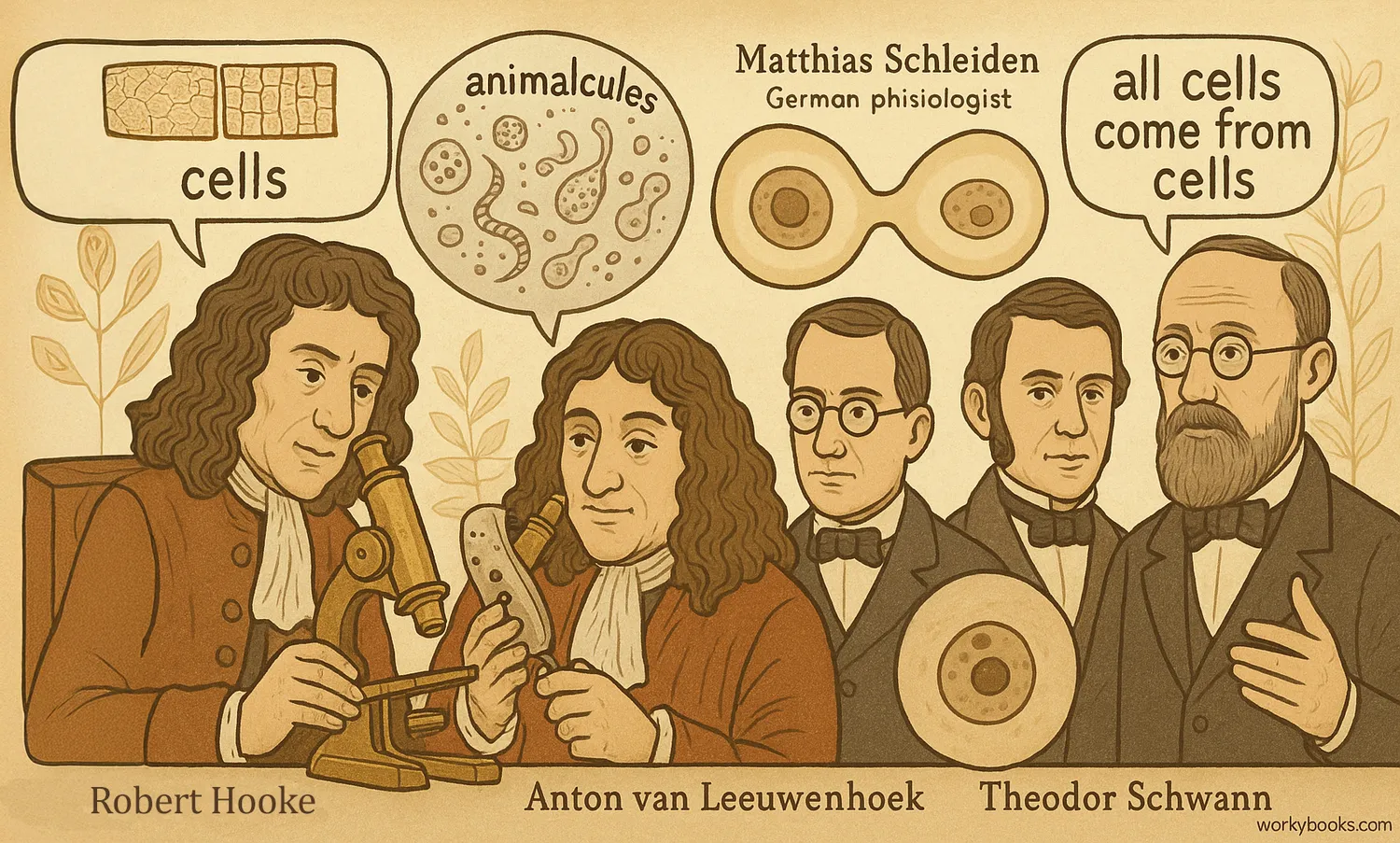
Our journey begins in the 17th century with the invention of the microscope. This powerful tool allowed people to see things too small for the naked eye. In 1665, an English scientist named Robert Hooke used an early microscope to look at a thin slice of cork. What he saw reminded him of the small rooms, or 'cells,' where monks lived. He published his observations, coining the term cells for these tiny, box-like structures. Hooke's discovery was groundbreaking, but he didn't fully understand that these cells were alive or part of living organisms. He thought they were just pores.
Around the same time, in the Netherlands, a draper named Anton van Leeuwenhoek became skilled at making his own microscopes. His microscopes were even more powerful than Hooke's. Leeuwenhoek was fascinated by everything he looked at – pond water, blood, even scrapings from his own teeth! He was the first to observe actual living cells, which he called "animalcules" (tiny animals). These included bacteria and protozoa. His detailed drawings showed a world teeming with microscopic life, confirming that these tiny structures were indeed alive and moving.
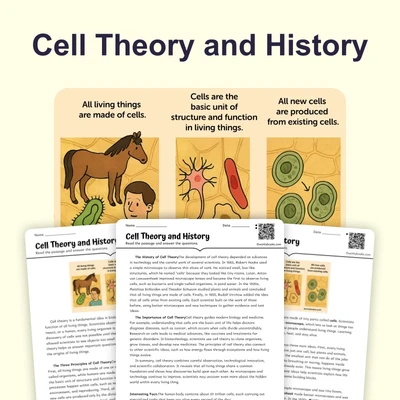
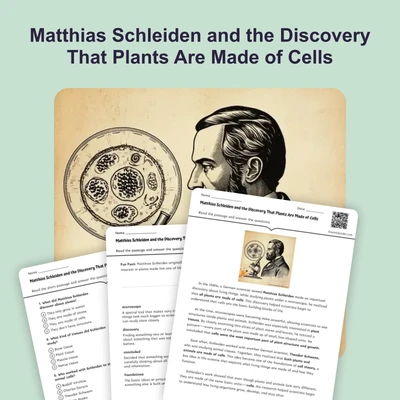
Fast forward to the 19th century, and scientists started putting these pieces together. In 1838, Matthias Schleiden, a German botanist, concluded that all plants are made of cells. A year later, in 1839, Theodor Schwann, a German physiologist, extended this idea to animals, stating that all animals are also made of cells. Together, their work formed the first two parts of the cell theory: 1) All living things are composed of cells, and 2) Cells are the basic unit of life.
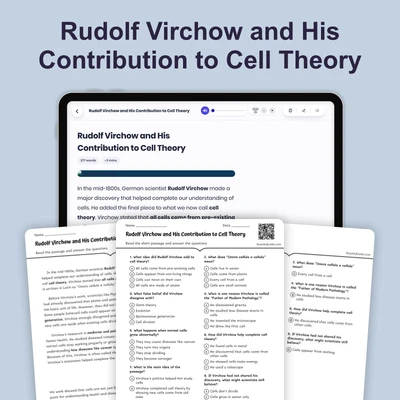
The third and final part of the cell theory was added in 1855 by Rudolf Virchow, a German physician. He proposed that all cells come from pre-existing cells. This idea challenged the old belief of spontaneous generation, which suggested that living things could arise from non-living matter. Virchow's contribution completed the modern cell theory, giving us a complete understanding of how life originates and is structured at its most fundamental level. Thanks to these scientists, we now know that every living thing, from a tiny bacterium to a giant whale, is made of cells.
Interesting Fact: Anton van Leeuwenhoek reportedly made over 500 microscopes in his lifetime, many of which could magnify objects up to 270 times!
Comprehension quiz (10 questions)
1. Who first observed tiny, box-like structures in cork?
2. What invention was crucial to cell discovery?
3. What term did Hooke coin?
4. What did Leeuwenhoek call living cells?
5. Which scientist proposed all plants are made of cells?
6. What did Theodor Schwann conclude about animals?
7. Who proposed that all cells come from pre-existing cells?
8. The cell theory states that cells are the basic unit of life.
9. What does 'spontaneous generation' mean?
10. How did the microscope change scientific understanding?
Perfect for the way you teach
- Build comprehension skills
- Auto-graded quiz
- Differentiated reading
- Read together at home
- Improve fluency
- Quiet reading time
- Reading curriculum support
- Independent practice
- Track Lexile growth