Human Family Tree
Interactive passage with audio narration, comprehension questions, and printable PDF.
By completing this purchase you agree to our Terms of Use and Privacy Policy. Your subscription renews automatically until you cancel. You can cancel anytime from your account settings. All sales are final and non-refundable. Digital content is available for download in your account immediately upon purchase.
What's included
Human Family Tree preview and details
About this printable Human Family Tree science reading passage, NGSS-aligned (Grade 6)
Sample passage and quiz from Human Family Tree
Reading passage and comprehension quiz preview
The Human Family Tree: Our Early Ancestors
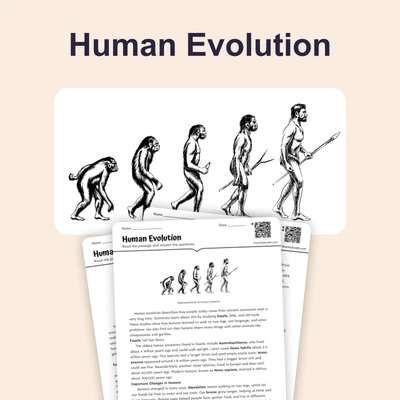
Imagine looking back in time, not just hundreds of years, but millions! We’re going to explore the incredible story of where humans come from – our very own human family tree. This journey takes us deep into Earth's past to meet our early ancestors, a group of creatures called hominids. Hominids are a group that includes modern humans and all our extinct ancestors who are more closely related to us than to chimpanzees.
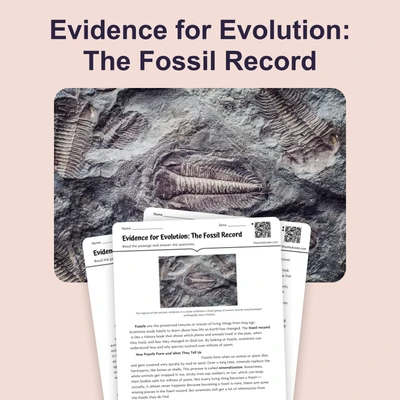
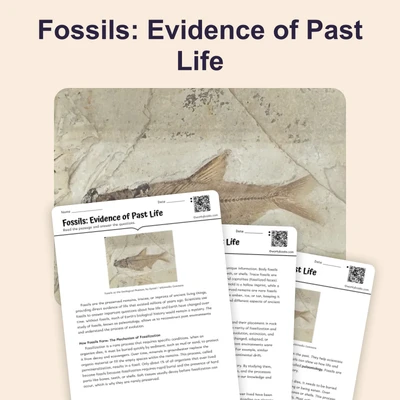
Scientists learn about these ancient relatives by studying fossils. Fossils are the preserved remains or traces of ancient organisms, like bones or footprints, found in rocks. Each fossil is like a tiny piece of a giant puzzle, helping us understand how life, including human life, has changed over millions of years. This field of study is called paleoanthropology.
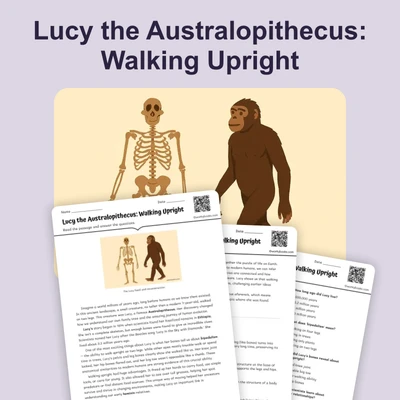
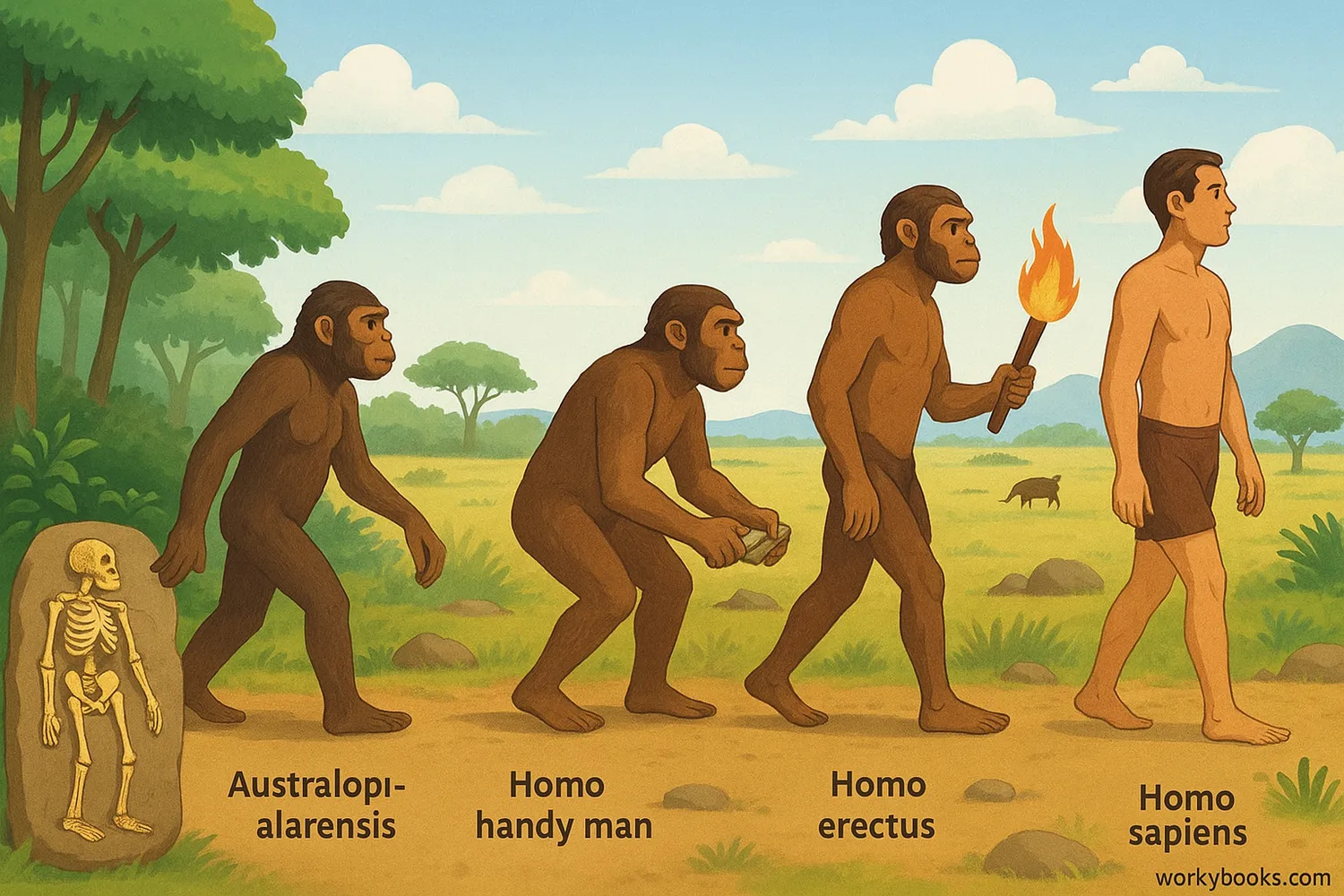
One of the most famous early hominids is named 'Lucy.' Discovered in 1974, Lucy's fossil skeleton is about 3.2 million years old and belongs to a species called Australopithecus afarensis. What made Lucy so special was evidence that she walked upright on two legs, just like us! This bipedalism was a huge step in human evolution, helping our ancestors see further, carry things, and use their hands for other tasks. This adaptation was a key part of our ancestors' survival.
Over vast spans of time, different hominid species emerged and sometimes lived alongside each other. Each species had unique characteristics and adaptations to their environment. For instance, some developed larger brains, like Homo habilis, often called 'handy man' because they were the first to make simple stone tools. Later came Homo erectus, who learned to control fire and migrated out of Africa.
Finally, around 300,000 years ago, our own species, Homo sapiens, appeared. We are the only surviving hominid species today. Studying these early ancestors helps us understand the incredible journey of life on Earth and how our species came to be. It shows us how natural selection and adaptation shaped the human form over millions of years.
Interesting Fact: The oldest known fossil of a human ancestor found so far is Sahelanthropus tchadensis, estimated to be between 6 and 7 million years old.
Comprehension quiz (10 questions)
1. What is the study of ancient human relatives called?
2. What is the name of our own species?
3. The oldest known fossil of a human ancestor is Sahelanthropus tchadensis.
4. Which term describes walking on two legs?
5. Why was bipedalism an important step?
6. How do scientists learn about early hominids?
7. What did Homo erectus learn to control?
8. Which hominid species made stone tools first?
9. What can we infer about early hominid environments?
10. Why is studying fossils like solving a puzzle?
Perfect for the way you teach
- Build comprehension skills
- Auto-graded quiz
- Differentiated reading
- Read together at home
- Improve fluency
- Quiet reading time
- Reading curriculum support
- Independent practice
- Track Lexile growth