The Largest Animal Group on Earth — Reading Comprehension
Rate this
Premium Resource
Present
Present in classroom. No work saved
Assign
Classroom with student accounts, Track progress
Quick Play
No student accounts, assign with a link
Grades
6
PRINT+DIGITAL RESOURCE
This learning resource is available in interactive and printable formats. The interactive worksheet can be played online and assigned to students. The Printable PDF version can be downloaded and printed for completion by hand.
This educational passage, audio-integrated for accessibility, delves into the incredible world of arthropods, Earth's largest animal group. Students will learn about their defining characteristics, such as exoskeletons and segmented bodies, and explore their immense biodiversity. The text explains concepts like metamorphosis and how these creatures have adapted to nearly every habitat on Earth, from the deep oceans to the highest mountains. Aligned with NGSS MS-LS4-1, this passage helps students understand the diversity of life forms and how they have changed over time, providing foundational knowledge about the animal kingdom.
CONTENT PREVIEW
Expand content preview
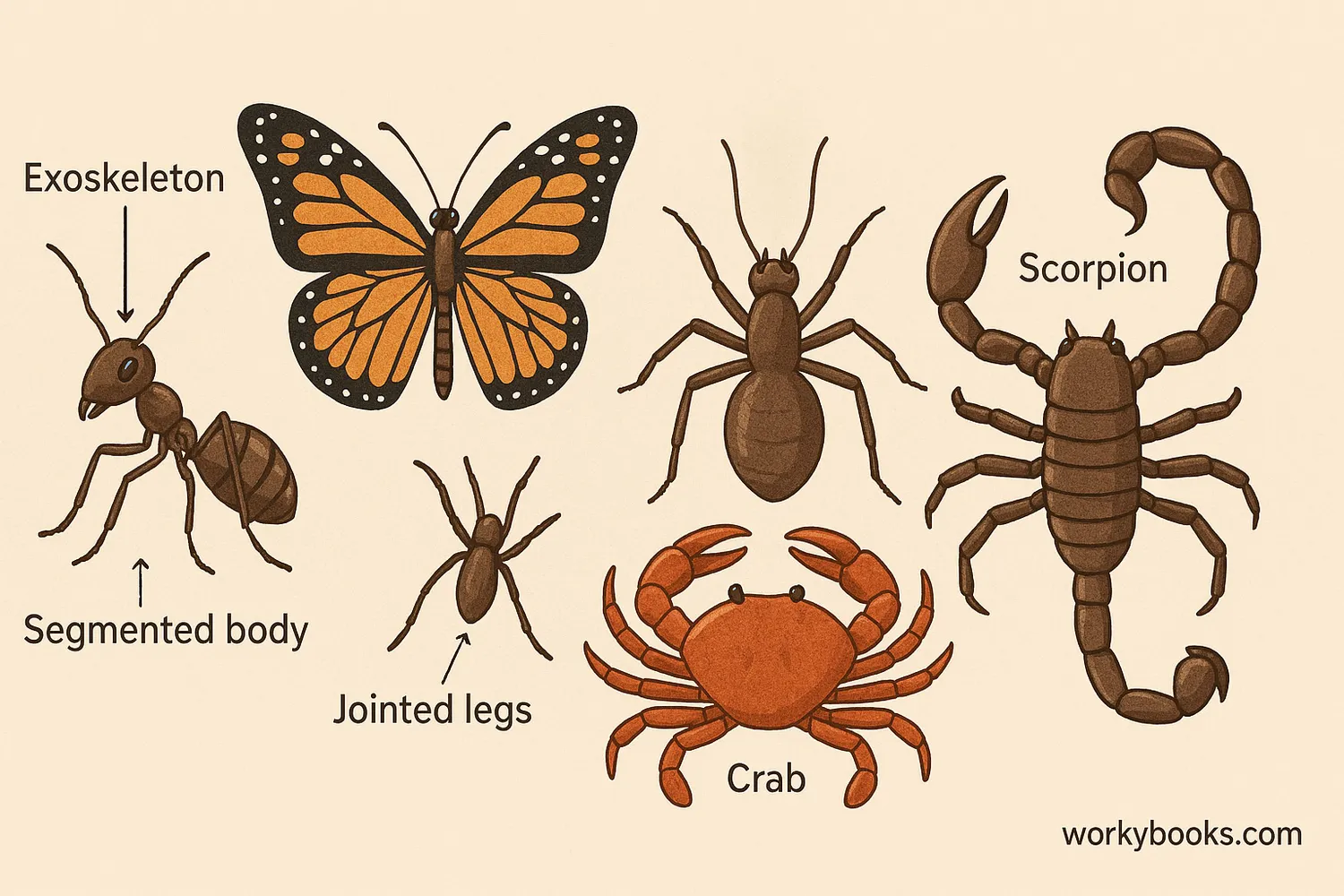
Arthropods: ants, butterflies, spiders, crabs, and more—Earth’s most diverse animal group.
Imagine a group of animals so vast it includes the tiny ant marching on your picnic blanket, the colorful butterfly fluttering in a garden, and even the majestic crab scuttling on a sandy beach. This incredibly diverse group is called the Arthropods, and they are, without a doubt, the largest animal group on Earth. They make up over 80% of all known animal species!
What makes an animal an arthropod? They share several key features. First, they all have an exoskeleton, which is a hard, outer covering that acts like armor and provides support, much like our bones do. This exoskeleton doesn't grow with the animal, so arthropods must molt, or shed their old exoskeleton, to get bigger. Imagine taking off a suit of armor that's become too small!
Another important characteristic is their segmented bodies. This means their bodies are divided into distinct parts, like the head, thorax, and abdomen in an insect. They also have jointed legs, which is where the name “arthropod” comes from – it means “jointed foot.” This design allows for incredible flexibility and movement, helping them thrive in countless environments.
Arthropods are found almost everywhere on Earth. Insects, a subgroup of arthropods, dominate land environments. Spiders and scorpions, known as arachnids, are also arthropods, often found in dry climates. Crabs, lobsters, and shrimp are crustaceans, living in water. Their ability to adapt to so many different habitats, from deserts to deep oceans, is a major reason for their success. Many arthropods also undergo metamorphosis, a process where they change dramatically in form during their life cycle, like a caterpillar turning into a butterfly. This allows them to use different resources at different life stages.
Their immense biodiversity means they play vital roles in nearly every ecosystem. They pollinate plants, decompose dead matter, and serve as food for many other animals. Understanding arthropods helps us appreciate the intricate web of life on our planet and the incredible variety of forms life can take.
Interesting Fact: Some ancient arthropods, like the extinct sea scorpion Jaekelopterus, grew to be over 2.5 meters (8 feet) long, making them some of the largest arthropods ever to live!
Which characteristic defines arthropods?
Soft, internal skeletonExoskeletonOnly aquatic habitatsNo segmented body
What percentage of animal species are arthropods?
Less than 50%Around 60%Over 80%Exactly 75%
Why do arthropods molt?
To change colorTo grow largerTo attract matesTo digest food
Which of these is NOT an arthropod subgroup?
InsectsMammalsArachnidsCrustaceans
What does 'biodiversity' refer to?
Number of habitatsVariety of life formsAmount of waterSize of an animal
How do arthropods benefit ecosystems?
Pollinate plantsBuild large nestsChange weather patternsCreate new habitats
What is an example of metamorphosis?
A fish swimmingA bird flyingCaterpillar to butterflyA spider building web
If an animal has jointed legs and a hard outer shell, it is likely an arthropod.
TrueFalse
Which term describes a dramatic change in an animal's life form?
AdaptationMigrationMetamorphosisHibernation
Consider an animal that lives in the desert, has eight legs, and sheds its skin to grow. Based on the passage, what type of animal is it most likely to be?
A fishAn insectAn arachnidA mammal
Perfect For:
👩🏫 Teachers
• Reading comprehension practice
• Auto-graded assessments
• Literacy skill development
👨👩👧👦 Parents
• Reading practice at home
• Comprehension improvement
• Educational reading time
🏠 Homeschoolers
• Reading curriculum support
• Independent reading practice
• Progress monitoring
Reading Features:
📖
Reading Passage
Engaging fiction or nonfiction text
❓
Comprehension Quiz
Auto-graded questions
📊
Instant Feedback
Immediate results and scoring
📄
Printable Version
Download for offline reading
🔊
Read Aloud
Voice-over with word highlighting
Reviews & Ratings
No reviews yet. Be the first to share your experience!
Related Content
Understanding Biological Evolution and Diversity
This passage addresses the NGSS standard 3-LS4-2 focusing on biological evolution and the unity and diversity of life. T...
RI.3.3RI.4.3RI.5.33-LS4-2
Theory of Evolution
This middle school science passage explains the theory of evolution and the concept of common ancestry, aligning with NG...
MS-LS4-1MS-LS4-2
Evidence for Evolution: Comparative Anatomy
This middle school science reading passage explores the evidence for evolution through comparative anatomy, aligning wit...
MS-LS4-2MS-LS4-3
The Nature of Life Science
This passage, aligned with NGSS MS-LS1-1, introduces students in grades 6-8 to the foundational concepts of life science...
MS-LS1-1
Human Evolution
This middle school science passage explains the scientific evidence for human evolution, aligning with NGSS standards MS...
MS-LS4-1MS-LS4-2
Science Vocabulary
This worksheet on domain-specific words will help students learn some science vocabulary. Students will be asked to matc...
L.3.6L.3.4.A
The Giant Isopod: Biological Evolution
This NGSS passage examines how giant isopods evolved for deep-sea survival, including slow metabolism for food scarcity,...
MS-LS4-4RI.6.3RI.7.3RI.8.8
Evidence for Evolution: The Fossil Record
This middle school science passage explains the importance of fossils as preserved evidence of ancient life and their ro...
MS-LS4-1
Simple Machines Science Report
This science writing task requires students to clearly explain how three simple machines work using precise domain-speci...
W.5.4
Fossil Evidence of Human Evolution
This engaging, audio-integrated reading passage, 'Fossil Evidence of Human Evolution,' introduces Grade 6 students to th...
The Science of Hibernation
This educational module, featuring an audio-integrated reading passage titled 'The Science of Hibernation,' is designed ...
What is an amphibian
This audio-integrated reading passage, "The Life of Amphibians," is designed for 4th-grade students to explore the fasci...
The Levels of Australopithecus
This educational content offers an engaging, audio-integrated reading passage titled 'The Levels of Biological Classific...
The Nature of Science
This passage explores the nature of science for middle school students, aligning with NGSS standards MS-ETS1-4, MS-PS1-1...
MS-ETS1-4MS-PS1-1MS-LS1-1
The Pumpkin Life Cycle
This informational worksheet explores the pumpkin lifecycle, guiding students through procedural steps in a scientific t...
RI.2.3RI.2.10
What Is Earth Science?
This engaging middle school science passage introduces students to the field of Earth science, aligning with NGSS standa...
MS-ESS1MS-ESS2MS-ESS3SEP
Citizen Science and Ecological Monitoring
This engaging passage for grades 6-8 introduces the concept of citizen science and its critical role in ecological monit...
MS-LS2-1
Tools and Technology in Earth Science
This middle school science reading passage explores the wide range of tools and technologies used in Earth science, from...
MS-ESS2-2MS-ESS3-2MS-ETS1-1MS-PS4-3
The Life Cycle of an Angiosperm
This educational content package delves into the intriguing world of angiosperms and their complex life cycles, perfectl...
History of Life on Earth
This comprehensive middle school science reading passage provides an engaging overview of the history of life on Earth, ...