Trade Routes 300 CE
Interactive passage with audio narration, comprehension questions, and printable PDF.
By completing this purchase you agree to our Terms of Use and Privacy Policy. Your subscription renews automatically until you cancel. You can cancel anytime from your account settings. All sales are final and non-refundable. Digital content is available for download in your account immediately upon purchase.
What's included
Trade Routes 300 CE preview and details
About this printable Trade Routes 300 CE reading passage (Grades 5-8)
Sample passage and quiz from Trade Routes 300 CE
Reading passage and comprehension quiz preview
Trade Routes 300 CE
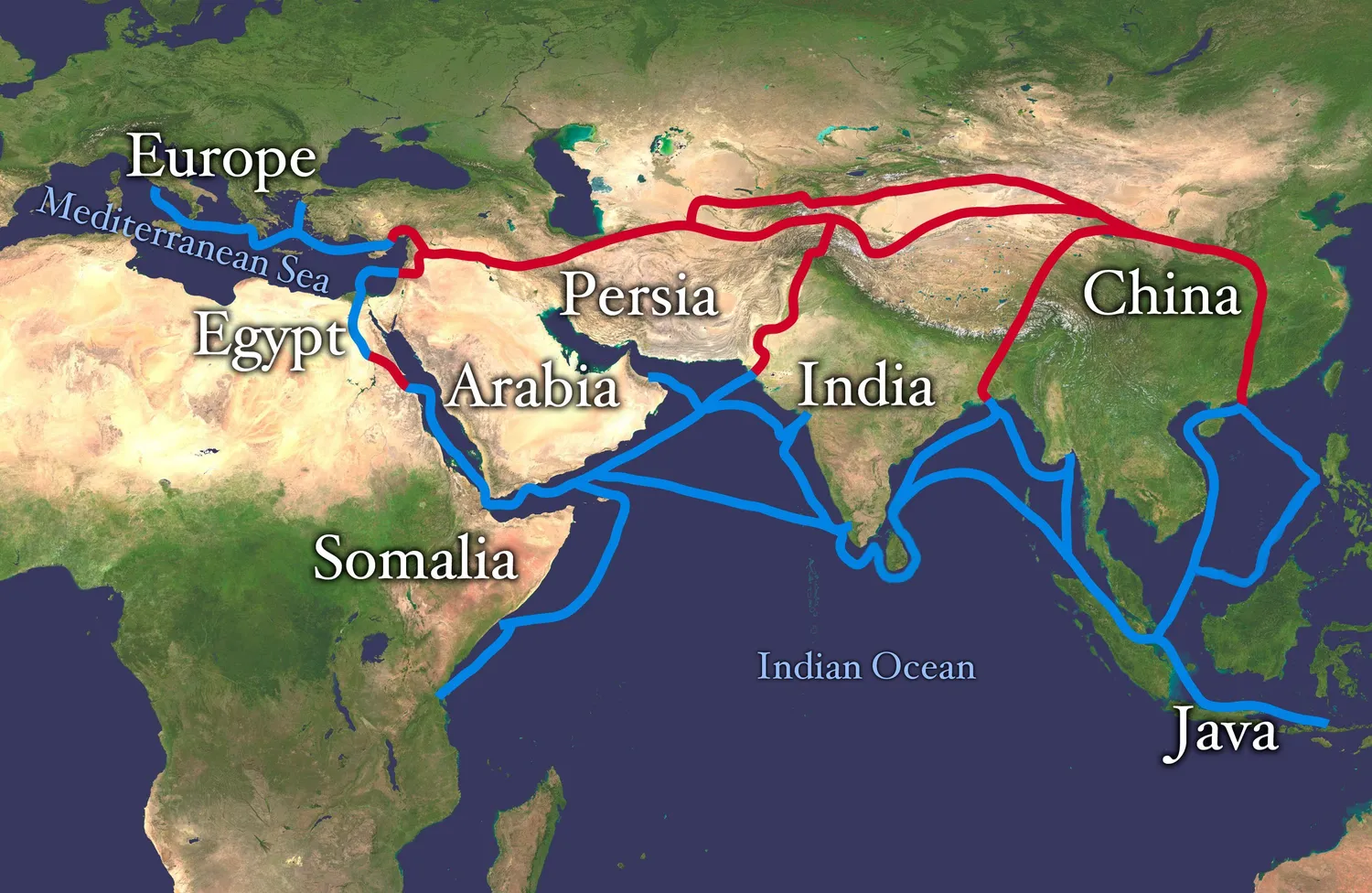
"Silk route"/ Wikimedia Commons (Public domain).
The ancient world in 300 CE was shaped by trade routes that linked Africa, Europe, and Asia. Merchants, travelers, and rulers depended on these routes to move goods, people, and ideas over thousands of miles. Trade networks like the Silk Road and Indian Ocean sea lanes connected distant civilizations, fostering economic growth and cultural diffusion.
One of the most famous ancient trade routes was the Silk Road, a network of overland paths and caravan trails stretching from China through Central Asia to the Mediterranean. By 300 CE, silk, spices, and precious stones traveled west from China, while wool, glassware, and silver moved east from the Roman Empire. Archaeological discoveries, such as silk fragments found in Roman tombs and Roman coins in India, show evidence of this long-distance trade. The Silk Road also transported ideas, technologies, and religions, including Buddhism, which spread from India to China along these routes.
Maritime trade also flourished. The Indian Ocean connected East Africa, Arabia, India, and Southeast Asia. African merchants exported gold, ivory, and slaves from ports like Aksum. Indian traders exchanged spices, textiles, and gems. Seasonal monsoon winds made sailing possible across the Indian Ocean. Ancient Greek and Roman texts, such as the "Periplus of the Erythraean Sea" (1st century CE), describe bustling ports, diverse peoples, and exotic goods. Ships from Egypt and Rome reached as far as India and East Africa. In return, African and Asian goods arrived in Mediterranean markets, enriching city-states and empires.
These vast trade networks influenced daily life and social hierarchy. Wealthy merchants gained power and prestige, sometimes even more than local nobles. Cities along trade routes, such as Alexandria, Rome, Chang'an, and Aksum, became cosmopolitan centers, blending languages, beliefs, and customs. However, the movement of people and animals also spread diseases, showing the risks of global connections. Despite these challenges, trade routes brought new crops, artistic styles, and inventions to different regions, changing societies over time.
The interconnectedness of Africa, Europe, and Asia in 300 CE shaped world history. Trade routes were more than highways for goods; they were bridges between cultures, enabling exchange and innovation. The legacy of these ancient networks can still be seen in the global trade and cultural connections of today.
This study of ancient trade routes helps us understand how geography, technology, and human ambition have always shaped the world.
Interesting Fact: Silk was so valuable in ancient Rome that it was sometimes worth its weight in gold!
Comprehension quiz (8 questions)
1. What was the Silk Road?
2. Which goods went from China westward?
3. What did African merchants export?
4. How did monsoon winds help?
5. Why were cities like Alexandria important?
6. How did trade affect social hierarchy?
7. Silk was cheap in ancient Rome.
8. What is cultural diffusion?
Perfect for the way you teach
- Build comprehension skills
- Auto-graded quiz
- Differentiated reading
- Read together at home
- Improve fluency
- Quiet reading time
- Reading curriculum support
- Independent practice
- Track Lexile growth