This learning resource is available in interactive and printable formats. The interactive worksheet can be played online and assigned to students. The Printable PDF version can be downloaded and printed for completion by hand.
This educational passage, designed for Grade 3, introduces students to the fascinating world of amphibians. It covers the three main types: frogs, salamanders, and caecilians, explaining their unique characteristics and diverse habitats. Key terms like 'amphibian,' 'metamorphosis,' and 'habitat' are defined in simple language. The passage highlights how these creatures, from rainforest frogs to underground caecilians, contribute to global biodiversity. It aligns with NGSS LS4.D: Biodiversity and Humans. The content is audio integrated, making it accessible and engaging for young learners. Activities include reading comprehension questions, a glossary, and short answer questions to reinforce understanding of amphibian biology and their role in different ecosystems.
CONTENT PREVIEW
Expand content preview
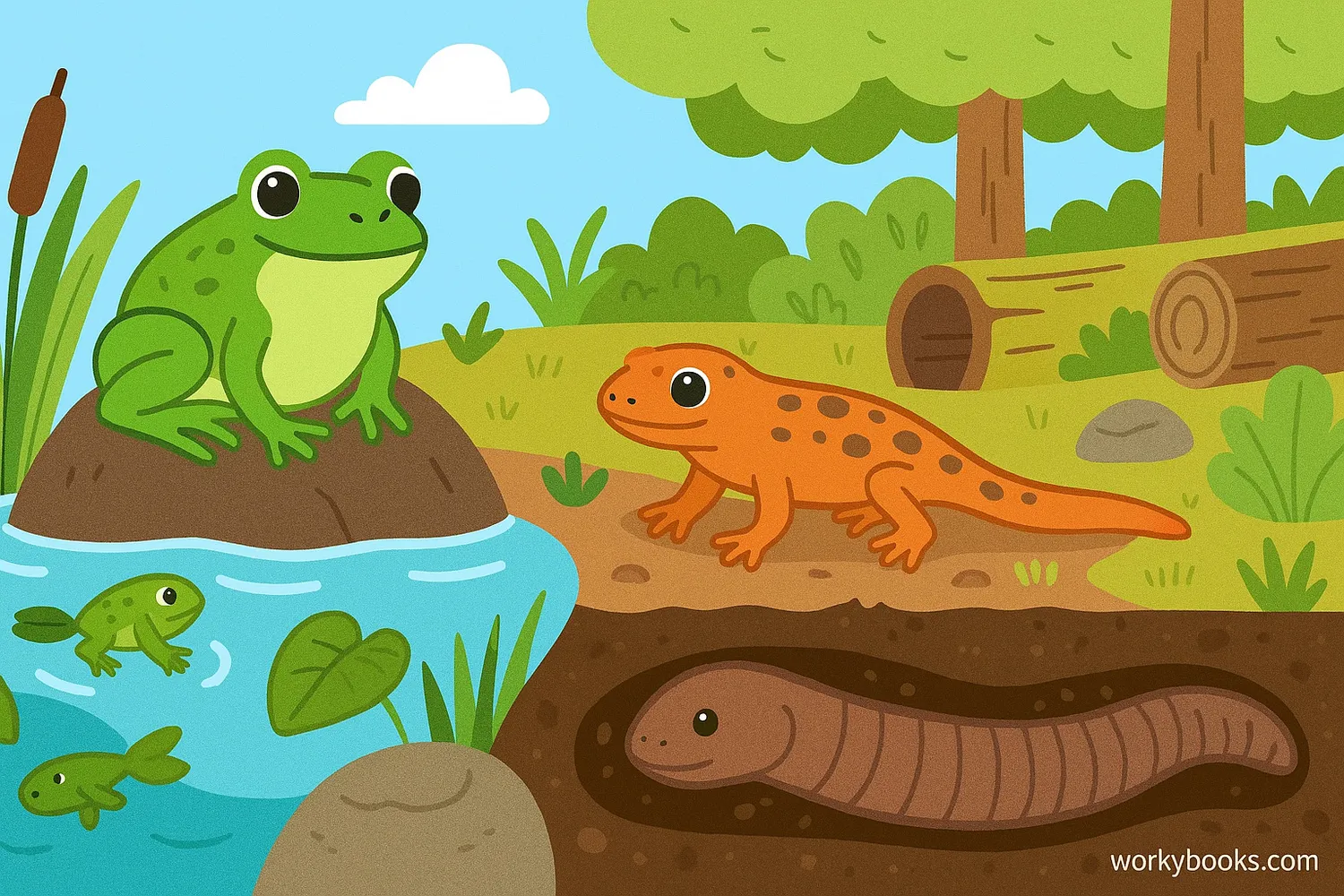
Three amphibians in water, land, and soil environments showing biodiversity and metamorphosis.
Types Of Amphibians
Scientists use classification to organize all living things into groups. Amphibians are a special group of animals called vertebrates, which means they have backbones. All amphibians have some things in common, but they can look very different from each other.
There are three main types of amphibians, like three branches of a family tree. The first type is the Order Anura, which includes frogs and toads. Adult Anura do not have tails. They have long back legs for jumping and hopping. There are more than 7,000 species of Anura. Most people are familiar with frogs and toads because they are found almost everywhere in the world.
The second type is Order Caudata, which includes salamanders and newts. These amphibians keep their tails their whole lives. They have four legs that are about the same length, and they walk or swim instead of hopping. There are about 700 species of Caudata. Some salamanders can even grow lost body parts back!
The third type is Order Gymnophiona, also called caecilians. They are the least known type of amphibian, with about 200 species. Caecilians have no legs at all and look a lot like worms or snakes. They live underground or in water, where it is dark and moist.
Even though these three types look different, all amphibians share some important features. They have moist skin that helps them breathe, and they are cold-blooded, which means their body temperature changes with the air or water around them. Amphibians start their lives in water, breathing with gills. Most go through metamorphosis, changing from a larva (like a tadpole) to an adult.
Amphibians come in many sizes. Some frogs are so small they could sit on your thumbnail, while giant salamanders can grow longer than a fourth grader is tall!
Interesting Fact: The largest amphibian in the world is the Chinese giant salamander, which can grow up to 6 feet (1.8 meters) long!
What does 'amphibian' mean?
Cold-blooded animal with backboneAnimal with furPlant that grows in waterBird that lays eggs
Which group includes frogs?
Order AnuraOrder CaudataOrder GymnophionaOrder Mammalia
What special feature do salamanders keep?
TailsWingsShellsFur
Which amphibian has no legs?
CaecilianToadFrogNewt
Why do amphibians need moist skin?
Helps them breatheKeeps them warmHelps them flyGives them color
What is metamorphosis?
Body changes from young to adultHiding in waterSleeping in winterLosing skin color
Frogs are cold-blooded. True or false?
TrueFalse
Which word means 'grouping by traits'?
ClassificationMetamorphosisVertebrateMoisture
Perfect For:
👩🏫 Teachers
• Reading comprehension practice
• Auto-graded assessments
• Literacy skill development
👨👩👧👦 Parents
• Reading practice at home
• Comprehension improvement
• Educational reading time
🏠 Homeschoolers
• Reading curriculum support
• Independent reading practice
• Progress monitoring
Reading Features:
📖
Reading Passage
Engaging fiction or nonfiction text
❓
Comprehension Quiz
Auto-graded questions
📊
Instant Feedback
Immediate results and scoring
📄
Printable Version
Download for offline reading
🔊
Read Aloud
Voice-over with word highlighting
Reviews & Ratings
No reviews yet. Be the first to share your experience!
Related Content
Understanding Biological Evolution and Diversity
This passage addresses the NGSS standard 3-LS4-2 focusing on biological evolution and the unity and diversity of life. T...
RI.3.3RI.4.3RI.5.33-LS4-2
Theory of Evolution
This middle school science passage explains the theory of evolution and the concept of common ancestry, aligning with NG...
MS-LS4-1MS-LS4-2
Evidence for Evolution: Comparative Anatomy
This middle school science reading passage explores the evidence for evolution through comparative anatomy, aligning wit...
MS-LS4-2MS-LS4-3
The Nature of Life Science
This passage, aligned with NGSS MS-LS1-1, introduces students in grades 6-8 to the foundational concepts of life science...
MS-LS1-1
Human Evolution
This middle school science passage explains the scientific evidence for human evolution, aligning with NGSS standards MS...
MS-LS4-1MS-LS4-2
The Giant Isopod: Biological Evolution
This NGSS passage examines how giant isopods evolved for deep-sea survival, including slow metabolism for food scarcity,...
MS-LS4-4RI.6.3RI.7.3RI.8.8
Evidence for Evolution: The Fossil Record
This middle school science passage explains the importance of fossils as preserved evidence of ancient life and their ro...
MS-LS4-1
Science Vocabulary
This worksheet on domain-specific words will help students learn some science vocabulary. Students will be asked to matc...
L.3.6L.3.4.A
Simple Machines Science Report
This science writing task requires students to clearly explain how three simple machines work using precise domain-speci...
W.5.4
The Science of Hibernation
This educational module, featuring an audio-integrated reading passage titled 'The Science of Hibernation,' is designed ...
What is an amphibian
This audio-integrated reading passage, "The Life of Amphibians," is designed for 4th-grade students to explore the fasci...
The Levels of Australopithecus
This educational content offers an engaging, audio-integrated reading passage titled 'The Levels of Biological Classific...
The Pumpkin Life Cycle
This informational worksheet explores the pumpkin lifecycle, guiding students through procedural steps in a scientific t...
RI.2.3RI.2.10
The Nature of Science
This passage explores the nature of science for middle school students, aligning with NGSS standards MS-ETS1-4, MS-PS1-1...
MS-ETS1-4MS-PS1-1MS-LS1-1
What Is Earth Science?
This engaging middle school science passage introduces students to the field of Earth science, aligning with NGSS standa...
MS-ESS1MS-ESS2MS-ESS3SEP
The Life Cycle of an Angiosperm
This educational content package delves into the intriguing world of angiosperms and their complex life cycles, perfectl...
Citizen Science and Ecological Monitoring
This engaging passage for grades 6-8 introduces the concept of citizen science and its critical role in ecological monit...
MS-LS2-1
Tools and Technology in Earth Science
This middle school science reading passage explores the wide range of tools and technologies used in Earth science, from...
MS-ESS2-2MS-ESS3-2MS-ETS1-1MS-PS4-3
Barnacle Life Cycle
This audio-integrated reading passage, "Barnacle Life Cycle," delves into the intriguing growth and development of barna...
History of Life on Earth
This comprehensive middle school science reading passage provides an engaging overview of the history of life on Earth, ...