This learning resource is available in interactive and printable formats. The interactive worksheet can be played online and assigned to students. The Printable PDF version can be downloaded and printed for completion by hand.
This engaging, audio-integrated reading passage, "Types of Glaciers," is designed for a 6th-grade reading level and explores the fascinating world of glaciers. Students will learn about the formation and characteristics of different glacier types, such as continental and alpine glaciers, and understand their role in shaping Earth's landscapes through processes like weathering and erosion. The passage defines key terms, making complex scientific concepts accessible. Aligned with NGSS 4-ESS2-1, this resource helps students make observations and measurements to provide evidence of the effects of weathering or the rate of erosion by water, ice, wind, or vegetation, with a specific focus on ice. Activities include comprehension questions, a glossary, and short answer prompts to reinforce learning about these massive ice formations and their geological impact. This passage is audio integrated, making it accessible to a wide range of learners.
CONTENT PREVIEW
Expand content preview
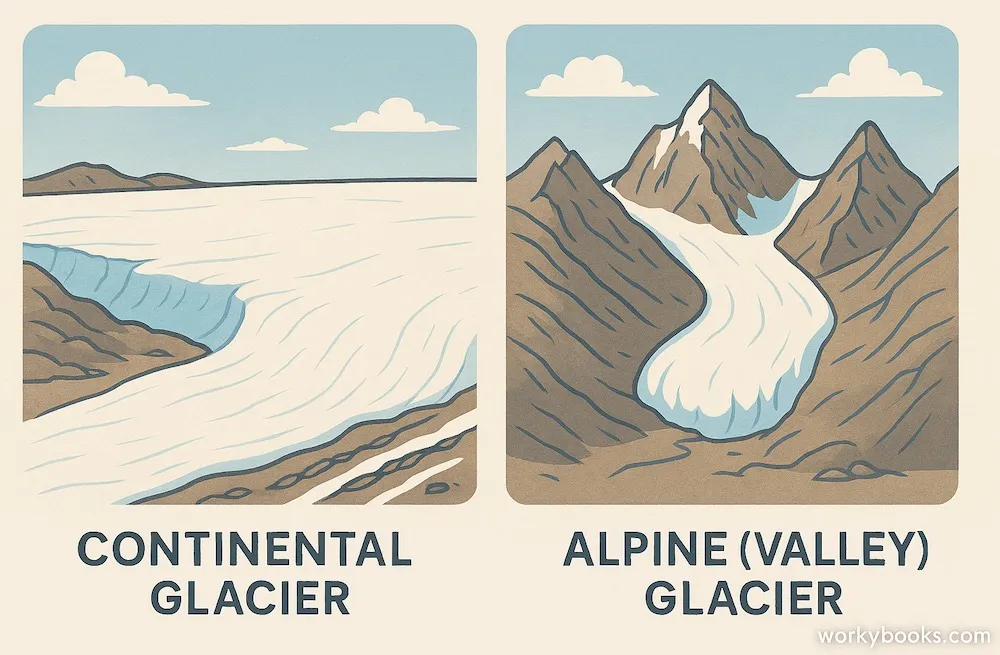
Two glacier types: vast continental ice sheet and narrow alpine glacier in mountain valley.
What Are Glaciers?
Glaciers are enormous, slow-moving rivers of ice. They form when more and more snow falls each year and piles up. Over hundreds of years, the weight of the snow squeezes the snow at the bottom into solid ice. Gravity then pulls this ice downhill, making the glacier move very slowly.
The Two Main Types of Glaciers
There are two main types of glaciers. The first is the valley glacier, also called an alpine glacier. These glaciers form in mountain valleys and flow between tall peaks, like frozen rivers. You can find valley glaciers in places such as Alaska, the Alps, and the Himalayas.
The second type is the ice sheet, also known as a continental glacier. Ice sheets are huge blankets of ice that cover entire continents! They are so large they can even bury mountains underneath. Today, ice sheets are only found in Antarctica and Greenland.
How Do Glaciers Shape the Land?
Glaciers are powerful forces of nature. As they move, they carve out valleys, create lakes, and carry giant boulders for miles. Glaciers leave behind moraines, which are piles of rocks and dirt pushed along by the ice. They also create deep cracks called crevasses. When pieces of glacier break off into the ocean, they form icebergs.
Glaciers and Climate
Glaciers are found in cold places, including the polar regions and during the ice ages long ago. Today, many glaciers are melting faster than ever because Earth's climate is getting warmer.
Glaciers are like frozen rivers moving in super-slow motion—taking years to travel what water travels in minutes!
Interesting Fact: Some glacier ice is thousands of years old, and some glaciers move only a few inches each day!
What is a glacier?
A huge, slow-moving river of iceA kind of fast riverA type of mountainA rainstorm in winter
Where are ice sheets found today?
Antarctica and GreenlandAlaska and the AlpsEvery continentOnly in Asia
What is a moraine?
A pile of rocks left by glaciersA type of glacierA mountain peakA frozen lake
How do glaciers form?
Snow piles up and turns to iceRain freezes in placeWind blows rocks togetherMountains collapse
What happens when glacier pieces break into ocean?
They form icebergsThey become morainesThey make volcanoesThey melt instantly
Why are glaciers melting faster now?
Earth is getting warmerGlaciers are getting heavierThere is less snowMountains are taller
Glaciers move as fast as rivers. True or false?
TrueFalse
What is a crevasse?
A deep crack in a glacierA small lakeA type of snowA mountain pass
Perfect For:
👩🏫 Teachers
• Reading comprehension practice
• Auto-graded assessments
• Literacy skill development
👨👩👧👦 Parents
• Reading practice at home
• Comprehension improvement
• Educational reading time
🏠 Homeschoolers
• Reading curriculum support
• Independent reading practice
• Progress monitoring
Reading Features:
📖
Reading Passage
Engaging fiction or nonfiction text
❓
Comprehension Quiz
Auto-graded questions
📊
Instant Feedback
Immediate results and scoring
📄
Printable Version
Download for offline reading
🔊
Read Aloud
Voice-over with word highlighting
Reviews & Ratings
No reviews yet. Be the first to share your experience!
Related Content
Tools and Technology in Earth Science
This middle school science reading passage explores the wide range of tools and technologies used in Earth science, from...
MS-ESS2-2MS-ESS3-2MS-ETS1-1MS-PS4-3
Scientific Inquiry in Earth Science
This passage explores scientific inquiry in Earth science for grades 6-8, aligned with NGSS standards MS-ESS1-4, MS-ESS2...
MS-ESS1-4MS-ESS2-1MS-ESS3-5SEP
What Is Earth Science?
This engaging middle school science passage introduces students to the field of Earth science, aligning with NGSS standa...
MS-ESS1MS-ESS2MS-ESS3SEP
Earth: Our Home in Space
This engaging Grade 4-5 science passage, aligned to NGSS, introduces students to Earth's special place in the solar syst...
Earth's Spheres
This middle school science passage introduces students to Earth's four major spheres: the geosphere, hydrosphere, atmosp...
MS-ESS2-4MS-ESS2-6
What Is Space Weather and How Does It Affect the Earth?
This NGSS-aligned science passage for middle school explains what space weather is and how it affects Earth. Students le...
MS-ESS2-2
Earth's Energy Balance
This engaging, NGSS-aligned science passage for grades 6–8 explores Earth's energy balance, a key process that keeps our...
MS-ESS2-6
Earth's Rotation
This middle school science passage, aligned with NGSS standard MS-ESS1-1, focuses on Earth's rotation—how Earth spins on...
MS-ESS1-1
Earth's Land and Water
This 250-word reading passage introduces fourth-grade students to the fundamental concept of how land and water are dist...
NGSS 4-ESS2-2ESS2.B
Earth's Interior
This comprehensive passage for grades 6-8 explores Earth's layered interior, including the crust, mantle, outer core, an...
MS-ESS2-1MS-ESS2-2
Facts About Earth
This engaging science reading passage introduces Grade 4 and 5 students to Earth, our home planet. Aligned with NGSS sta...
Meteorite Impacts on Earth
This engaging science reading passage for Grades 4-5 explores meteorite impacts on Earth, aligning with NGSS standards. ...
Venus: Earth's Twin?
This comprehensive science passage for grades 6-8 examines Venus—often called Earth's twin—by exploring its similarities...
MS-ESS1-2MS-ESS1-3
Earth Changes Over Millions of Years
This engaging, audio-integrated science passage for Grade 4-5 students explores how Earth has changed over millions of y...
Volcano Patterns on Earth
This Grade 4 science reading passage introduces students to volcano patterns on Earth, aligned with NGSS standard 4-ESS2...
NGSS 4-ESS2-2
Earth's Moon Facts
This engaging science passage, 'The Moon: Earth's Companion,' is designed for Grade 4-5 students and aligns with NGSS ge...
Earth's Quick and Slow Changes
In 'Earth's Quick and Slow Changes,' students categorize 12 Earth events by their speed of occurrence, enhancing underst...
Earth: Our Home Planet
This comprehensive science passage for grades 6-8 explores Earth’s unique characteristics and the interconnected systems...
MS-ESS1-2
Earth's Revolution
This middle school science passage explores the science behind Earth's revolution around the Sun, closely aligned with N...
MS-ESS1-1
Earthquake Patterns on Earth
This engaging 250-word reading passage introduces fourth-grade students to earthquake patterns on Earth, aligned with NG...