United Kingdom of Israel
Interactive passage with audio narration, comprehension questions, and printable PDF.
By completing this purchase you agree to our Terms of Use and Privacy Policy. Your subscription renews automatically until you cancel. You can cancel anytime from your account settings. All sales are final and non-refundable. Digital content is available for download in your account immediately upon purchase.
What's included
Part of this bundle

United Kingdom of Israel preview and details
About this printable United Kingdom of Israel reading passage (Grades 5-8)
Sample passage and quiz from United Kingdom of Israel
Reading passage and comprehension quiz preview
United Kingdom of Israel
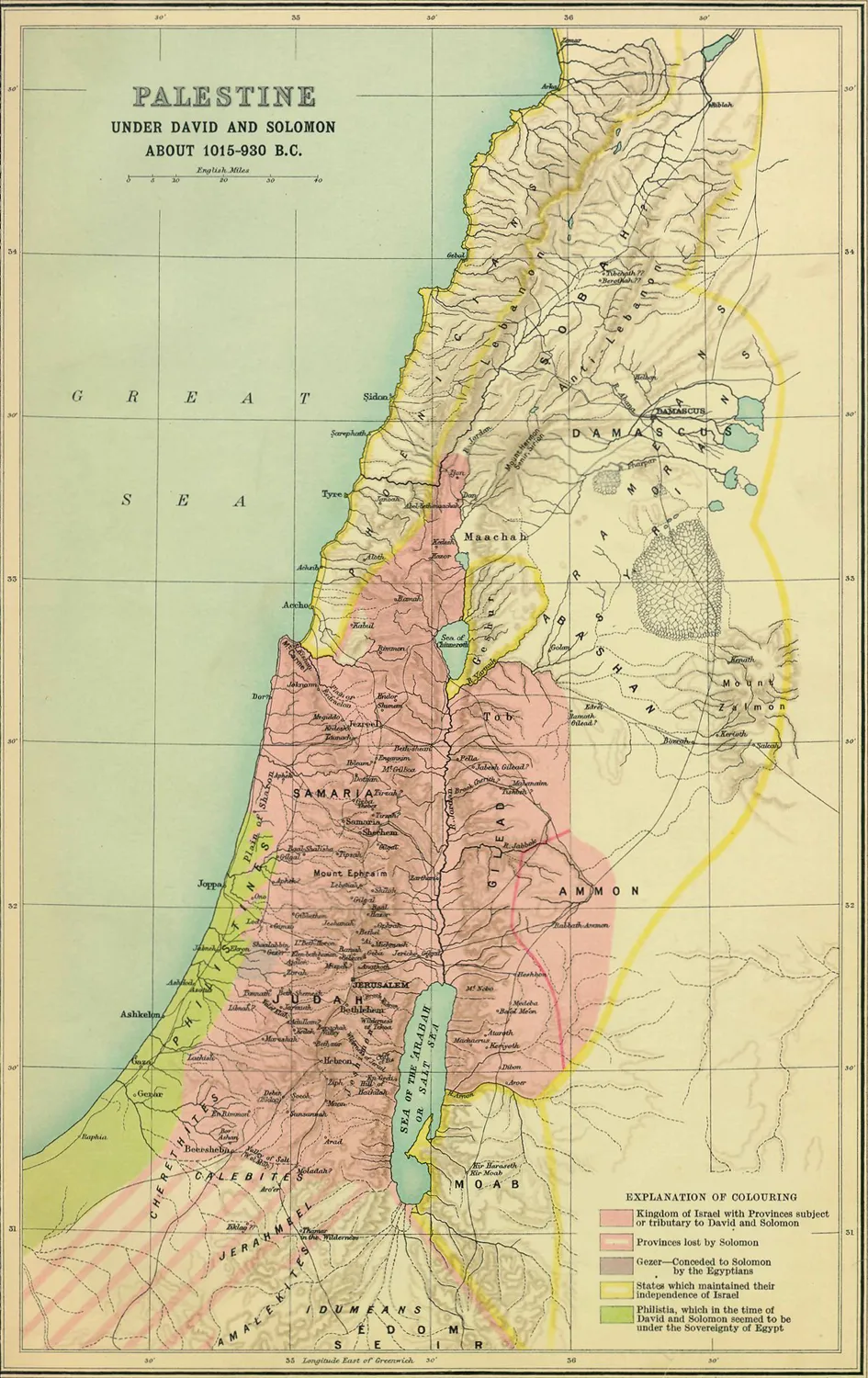
Palestine under David and Solomon (Smith, 1915) by George Adam Smith / Wikimedia Commons
The ancient Kingdom of Israel emerged in the eastern Mediterranean region around the late 11th century BCE. This kingdom is notable for its transformation from a group of independent tribes into a unified monarchy under its first three kings: Saul, David, and Solomon. These rulers helped shape Israel’s political, cultural, and religious traditions, influencing both their own society and future civilizations.
King Saul, chosen as the first king by the prophet Samuel, began his rule around 1020 BCE. Saul’s main achievement was uniting the twelve tribes of Israel to resist threats from the Philistines, a powerful neighboring people. Archaeological evidence, such as pottery and weapons found at ancient sites like Gibeah, supports accounts that Saul organized a military defense. However, Saul struggled to maintain control as conflicts and internal divisions increased. According to the Hebrew Bible, Saul lost favor after disobeying religious commands, leading to the rise of a new leader.
David, a former shepherd from Bethlehem, became king after Saul’s death. David is known for making Jerusalem the capital of Israel, a strategic decision because of its central location and strong defenses. Archaeologists have found ancient fortifications and inscriptions in Jerusalem that date to this period, supporting historical accounts. David expanded the kingdom’s territory and established a dynasty, or royal family, that would rule Israel for generations. He is also credited with composing many of the Psalms, religious songs still used today.
After David, his son Solomon became king. Solomon is remembered for building the First Temple in Jerusalem, which became the center of Jewish worship. Descriptions of the temple’s construction appear in ancient texts, and archaeologists have discovered remains of large structures from the era. Solomon’s reign is often seen as a time of peace, prosperity, and trade with neighboring kingdoms. However, heavy taxes and forced labor created tensions among the people. After Solomon’s death, the kingdom split into two parts: Israel in the north and Judah in the south.
The reigns of Saul, David, and Solomon illustrate how leadership, religion, and geography shaped ancient Israel. Their actions established traditions and institutions that influenced later Jewish, Christian, and Islamic societies. Studying the Kingdom of Israel allows us to understand the rise and fall of ancient civilizations and the ways human choices impact history.
These events connect to broader themes in world history, such as the development of governments, the role of religion in society, and the importance of geographic location in shaping civilizations.
Interesting Fact: According to many historians, the famous story of David and Goliath may reflect real conflicts between early Israelites and the Philistines, who were advanced in iron weapon technology.
Comprehension quiz (8 questions)
1. Who was Israel's first king?
2. What city did David make the capital?
3. What did Solomon build?
4. Why did Saul lose favor?
5. What caused the kingdom to split?
6. How did geography affect Israel's capital?
7. Solomon's reign brought peace and trade.
8. What is a 'dynasty'?
Perfect for the way you teach
- Build comprehension skills
- Auto-graded quiz
- Differentiated reading
- Read together at home
- Improve fluency
- Quiet reading time
- Reading curriculum support
- Independent practice
- Track Lexile growth