What Are Index Fossils
Interactive passage with audio narration, comprehension questions, and printable PDF.
By completing this purchase you agree to our Terms of Use and Privacy Policy. Your subscription renews automatically until you cancel. You can cancel anytime from your account settings. All sales are final and non-refundable. Digital content is available for download in your account immediately upon purchase.
What's included
What Are Index Fossils preview and details
About this printable What Are Index Fossils science reading passage, NGSS-aligned (Grades 6-8)
Sample passage and quiz from What Are Index Fossils
Reading passage and comprehension quiz preview
What Are Index Fossils
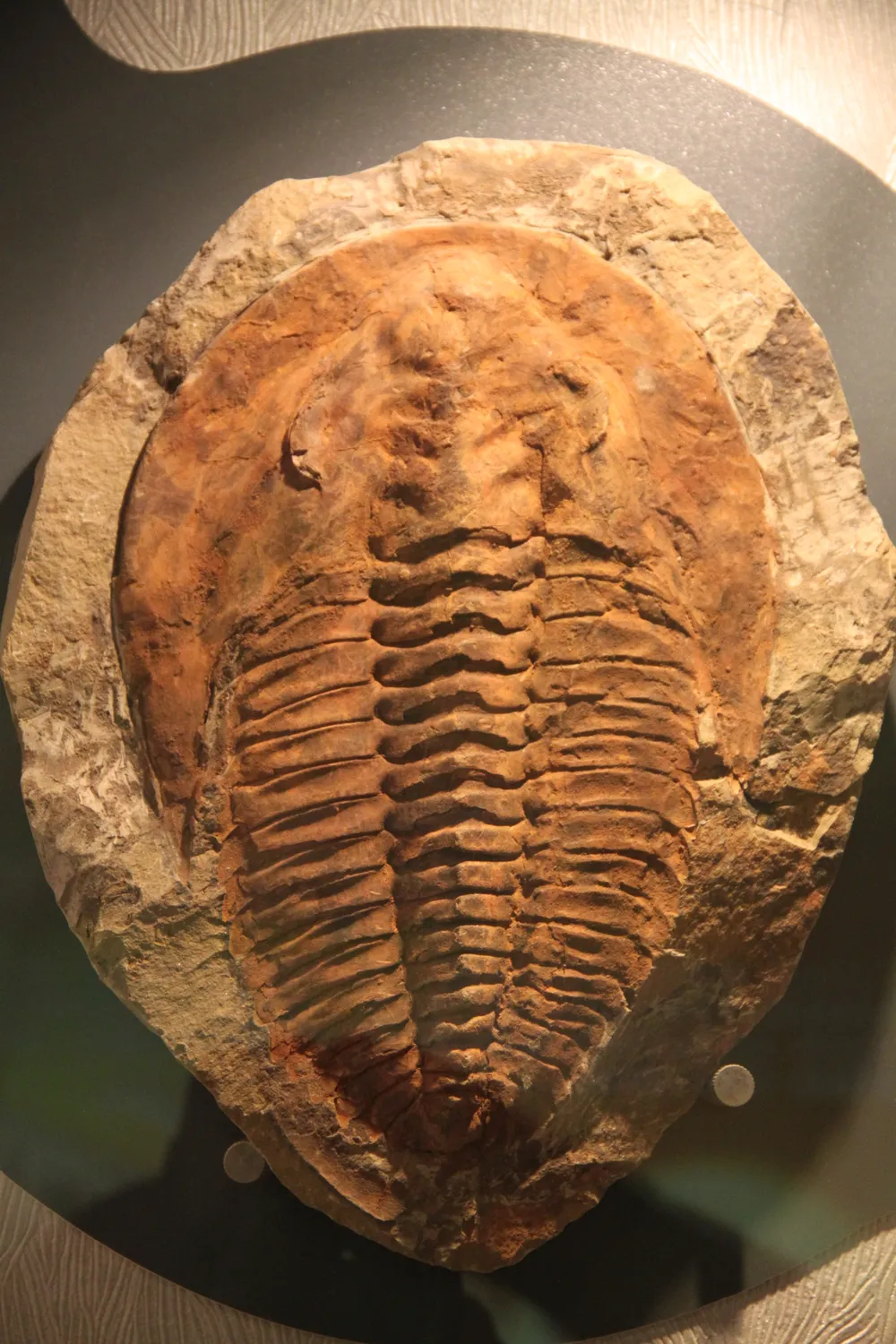
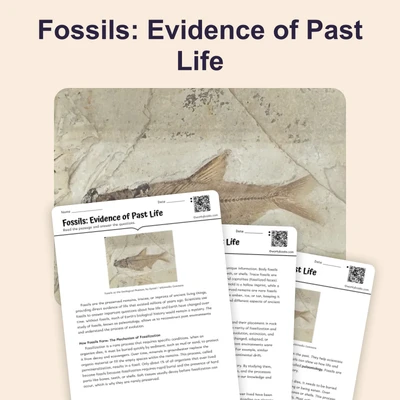
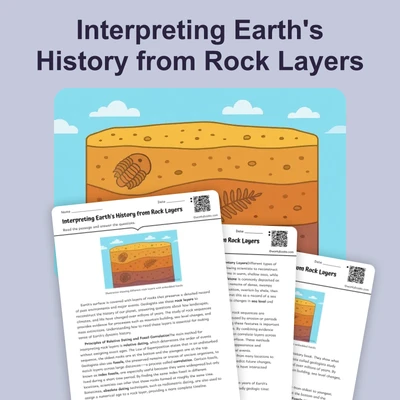
"Fossil Trilobite" by Gary Todd / Wikimedia Commons
Index fossils are remains or traces of organisms that lived during specific, relatively short periods of Earth's history. These fossils have three important characteristics that make them valuable to scientists. First, the organisms lived for a short, well-defined time period in geologic history. Second, they were geographically widespread, meaning they lived in many different locations around the world. Third, they are easily recognized because of their distinctive features. Together, these qualities make index fossils reliable markers for dating and identifying rock layers.
Geologists use index fossils to determine the relative age of rocks. Relative age tells us whether one rock layer is older or younger than another, even if we don't know the exact age in years. When geologists find the same index fossil in rock layers at different locations, they know those layers formed during the same time period. This process is called correlation. For example, if a geologist finds a particular trilobite fossil in rocks in both Arizona and Pennsylvania, those rock layers likely formed at the same time, even though they are thousands of miles apart.
Trilobites are excellent examples of index fossils. These extinct marine animals had hard, segmented bodies that fossilized well. Different species of trilobites lived during specific time periods in the Paleozoic Era, which lasted from about 541 to 252 million years ago. When geologists find a particular trilobite species in a rock layer, they can identify when that layer formed. Because trilobites lived in oceans worldwide and evolved rapidly into many different species, they help scientists match rocks across continents.
Ammonites are another important group of index fossils. These extinct relatives of squid and octopuses had distinctive spiral shells. Different ammonite species lived during the Mesozoic Era, from about 252 to 66 million years ago. Like trilobites, ammonites were widespread and evolved quickly, producing many species that each lived for relatively short time periods. Their shells had unique patterns and shapes that make them easy to identify, even in broken fragments.
The practice of using index fossils connects to broader methods geologists use to understand Earth's history. Relative age dating relies on several principles, including the idea that in undisturbed rock layers, older layers are at the bottom and younger layers are at the top. Index fossils provide additional evidence that helps geologists piece together the sequence of events in Earth's past. By comparing index fossils found in different locations, scientists can create a timeline of geologic events and understand how life changed over millions of years.
Not every fossil can be an index fossil. The organism must have lived for a geologically short time period, usually a few million years or less. This requirement ensures that when we find the fossil, it points to a specific time in Earth's history. The organism also must have been abundant and widespread so that its fossils appear in many different rock layers around the world. Finally, the organism must have distinctive features that make it easy to identify. Sedimentary rocks, which form from layers of sediment, are the type of rocks that typically contain index fossils.
Index fossils are essential tools for understanding Earth's geologic history. They allow geologists to match rock layers across vast distances, determine the relative ages of rocks, and reconstruct the sequence of events that shaped our planet. By studying index fossils like trilobites and ammonites, scientists can create a detailed picture of how life evolved and how Earth's surface changed over hundreds of millions of years. This information helps us understand not only the past but also how geological processes continue to shape our world today.
Interesting Fact: Some index fossils are so useful that geologic time periods are named after them, and a single well-preserved index fossil can help date an entire rock formation spanning hundreds of square miles.
Comprehension quiz (10 questions)
1. What are the three main characteristics that make a fossil an index fossil?
2. What does the term 'correlation' mean when geologists study rock layers?
3. During which era did trilobites live?
4. Why were ammonites good index fossils?
5. If a geologist finds the same index fossil in rock layers in two different states, what can they conclude?
6. What does 'relative age' tell us about rocks?
7. What type of rock typically contains index fossils?
8. Why must an index fossil organism have lived for a geologically short time period?
9. Index fossils can only be found in one specific location on Earth.
10. Trilobites and ammonites are both extinct organisms that serve as index fossils.
Perfect for the way you teach
- Build comprehension skills
- Auto-graded quiz
- Differentiated reading
- Read together at home
- Improve fluency
- Quiet reading time
- Reading curriculum support
- Independent practice
- Track Lexile growth