What Happened During the Cenozoic Era
Interactive passage with audio narration, comprehension questions, and printable PDF.
By completing this purchase you agree to our Terms of Use and Privacy Policy. Your subscription renews automatically until you cancel. You can cancel anytime from your account settings. All sales are final and non-refundable. Digital content is available for download in your account immediately upon purchase.
What's included
What Happened During the Cenozoic Era preview and details
About this printable What Happened During the Cenozoic Era science reading passage, NGSS-aligned (Grades 6-8)
Sample passage and quiz from What Happened During the Cenozoic Era
Reading passage and comprehension quiz preview
What Happened During the Cenozoic Era
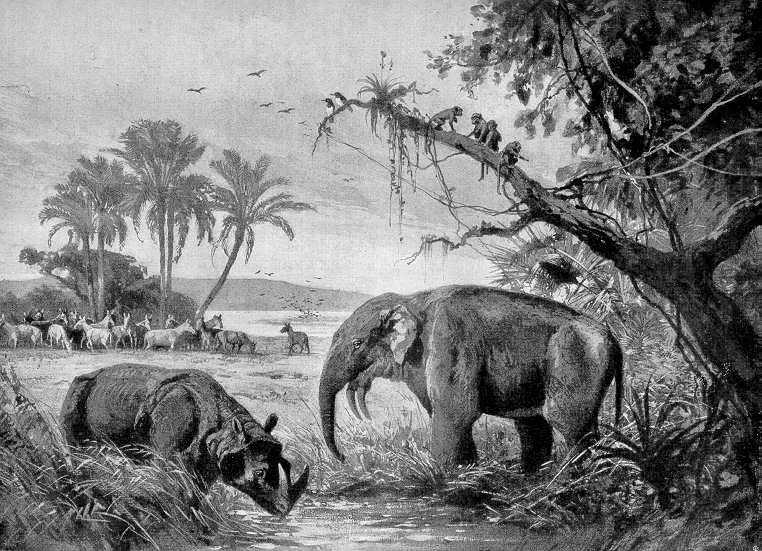
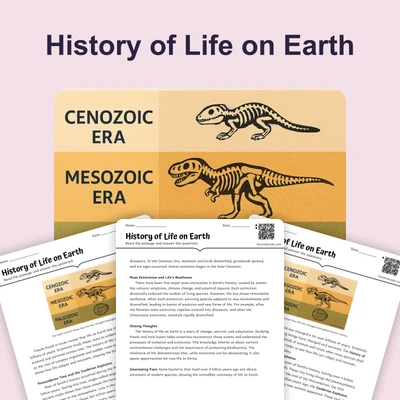
The Cenozoic Era is known as the "Age of Mammals" because mammals rapidly evolved and filled the ecological roles that dinosaurs once occupied. "Cenozoic" by Heinrich Harder (1858-1935) / Wikimedia Commons
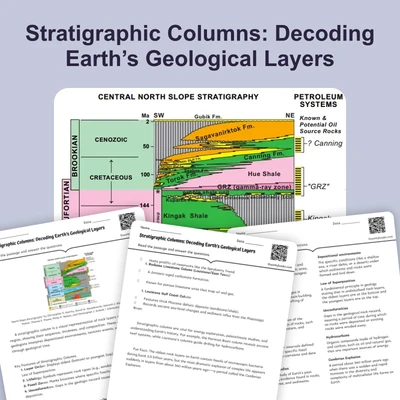
The Cenozoic Era began 66 million years ago and continues to the present day. This era started after a massive asteroid impact caused the extinction of dinosaurs and many other species. The Cenozoic Era is known as the "Age of Mammals" because mammals rapidly evolved and filled the ecological roles that dinosaurs once occupied. During this time, Earth's continents moved to their current positions, the climate cooled significantly, and new ecosystems developed that shape the world we see today.
After the dinosaurs disappeared, mammals diversified quickly into many different forms and sizes. Small, shrew-like mammals that had lived in the shadows of dinosaurs now had opportunities to evolve into new species. Some mammals became large herbivores that grazed on plants, while others became predators that hunted for food. Adaptive radiation occurred as mammals evolved to fill different ecological niches in forests, oceans, grasslands, and even the air. Whales evolved from land mammals and returned to the oceans, while bats developed the ability to fly. This rapid diversification happened because many habitats were now available without dinosaur competition.
One of the most important developments during the Cenozoic Era was the evolution and spread of grasses. About 40 million years ago, grasses began to dominate many landscapes, creating vast grassland ecosystems called prairies, savannas, and steppes. These grasslands supported large herds of grazing mammals such as horses, elephants, and bison. Grasses are different from other plants because they grow from their base rather than their tips, which allows them to survive being eaten by animals. The development of grasslands changed food webs and led to the evolution of specialized grazing animals with teeth adapted for chewing tough plant material.
Throughout the Cenozoic Era, Earth's climate gradually cooled. At the beginning of this era, the planet was much warmer than today, with tropical forests extending to polar regions. However, continental drift caused changes in ocean currents and atmospheric circulation patterns. As continents moved to their current positions, Antarctica drifted to the South Pole and became isolated by ocean currents. This isolation prevented warm water from reaching Antarctica, leading to the formation of massive ice sheets. Similarly, polar ice caps formed in the Arctic region. These ice caps reflected sunlight back into space, which further cooled the planet in a process called the ice-albedo feedback.
The cooling climate and continental movements created the modern world's geography and ecosystems. Mountain ranges like the Himalayas formed when continents collided, affecting weather patterns and creating rain shadows. Different climate zones developed from the equator to the poles, supporting diverse ecosystems from tropical rainforests to tundra. These environmental changes influenced mammal evolution, favoring species that could adapt to cooler temperatures and seasonal changes. Many mammals developed thick fur, larger body sizes, or migration behaviors to survive in these new conditions.
Humans appeared relatively recently in the Cenozoic Era. The first members of the human family, called hominins, evolved in Africa about 6 to 7 million years ago. Modern humans, Homo sapiens, appeared only about 300,000 years ago. Humans evolved larger brains, walked upright on two legs, and developed complex tools and language. The cooler, variable climate of the Cenozoic Era may have encouraged human ancestors to develop problem-solving skills and adaptability. Today, humans have spread across all continents and have become the dominant species affecting Earth's ecosystems.
Interesting Fact: During the Cenozoic Era, some mammals grew to enormous sizes, including Paraceratherium, a hornless rhinoceros relative that stood 18 feet tall at the shoulder and weighed about 20 tons, making it the largest land mammal that ever lived.
Comprehension quiz (10 questions)
1. When did the Cenozoic Era begin?
2. Why is the Cenozoic Era called the "Age of Mammals"?
3. What does the term "adaptive radiation" mean in the context of the passage?
4. What makes grasses different from other plants?
5. How did continental drift affect Earth's climate during the Cenozoic Era?
6. What is the ice-albedo feedback process?
7. When did modern humans (Homo sapiens) first appear?
8. Which of the following is an example of how mammals adapted to cooler Cenozoic climates?
9. True or False: Grasslands developed before the Cenozoic Era began.
10. True or False: The formation of polar ice caps helped cool Earth's climate even more.
Perfect for the way you teach
- Build comprehension skills
- Auto-graded quiz
- Differentiated reading
- Read together at home
- Improve fluency
- Quiet reading time
- Reading curriculum support
- Independent practice
- Track Lexile growth