What Does the Grand Canyon Record Tell Us
Interactive passage with audio narration, comprehension questions, and printable PDF.
By completing this purchase you agree to our Terms of Use and Privacy Policy. Your subscription renews automatically until you cancel. You can cancel anytime from your account settings. All sales are final and non-refundable. Digital content is available for download in your account immediately upon purchase.
What's included
What Does the Grand Canyon Record Tell Us preview and details
About this printable What Does the Grand Canyon Record Tell Us science reading passage, NGSS-aligned (Grades 6-8)
Sample passage and quiz from What Does the Grand Canyon Record Tell Us
Reading passage and comprehension quiz preview
What Does the Grand Canyon Record Tell Us
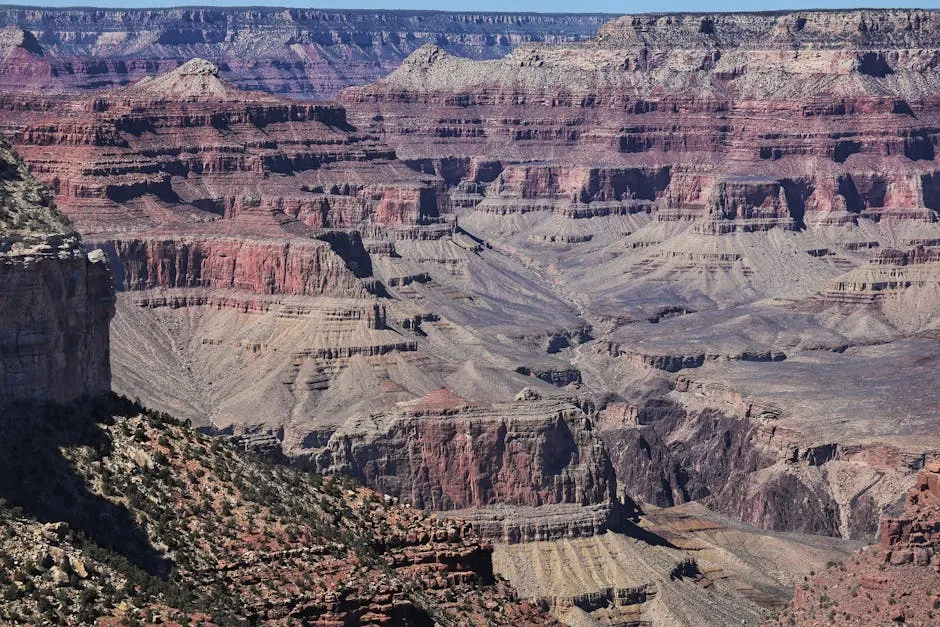
The Grand Canyon is one of Earth's most complete and accessible geological records. Stunning geological formations and vibrant layers of the Grand Canyon under a clear sky. Image by Wes Guild / Pexels.
The Grand Canyon is one of Earth's most complete and accessible geological records. This massive canyon in Arizona exposes nearly 2 billion years of rock layers, creating a natural timeline of Earth's history. The canyon walls reveal rocks from the Precambrian period at the bottom to Paleozoic sedimentary sequences at the top. Geologists study these layers to understand how Earth's surface has changed over time.
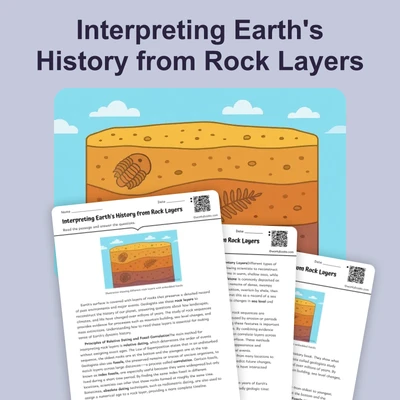
The principle of superposition is fundamental to reading the Grand Canyon's record. This principle states that in undisturbed rock layers, the oldest rocks are at the bottom and the youngest are at the top. Each layer represents a different time period in Earth's history. The canyon's walls act like pages in a history book, with each rock layer telling a story about ancient environments. The Vishnu Schist at the canyon's base is nearly 2 billion years old, while the Kaibab Limestone at the rim formed about 270 million years ago.
Geologists also study unconformities in the Grand Canyon. An unconformity is a gap in the rock record where layers are missing due to erosion or lack of deposition. The Great Unconformity in the Grand Canyon represents a missing period of about 1.2 billion years. This gap tells geologists that either rocks were eroded away or no new layers formed during this time. Unconformities help scientists understand periods when the area was above sea level and experiencing erosion.
The principle of fossil succession helps geologists determine the age and environment of each rock layer. Different fossils appear in specific layers, showing how life changed over time. Marine fossils like trilobites and brachiopods in certain layers indicate that ancient seas once covered the region. Other layers contain fossils of land organisms, suggesting the area was once a coastal environment or desert. The Coconino Sandstone layer shows cross-bedding patterns typical of ancient sand dunes, revealing that a vast desert existed in this location about 275 million years ago.
The Grand Canyon's sedimentary rocks preserve evidence of different ancient environments. The Redwall Limestone formed in a warm, shallow sea teeming with marine life. The Bright Angel Shale contains mudcracks and ripple marks, indicating it formed in a coastal tidal flat environment. The Hermit Shale shows red coloring from iron oxide, suggesting it formed in a river floodplain with periodic flooding and drying. Each layer's characteristics—including color, grain size, and structures—provide clues about temperature, water depth, and climate conditions when the rocks formed.
Geologists use these principles together to reconstruct Earth's history. By combining evidence from superposition, unconformities, and fossil succession, scientists have determined that the Grand Canyon region experienced multiple cycles of sea level rise and fall. The area was alternately covered by oceans, coastal swamps, river systems, and deserts over hundreds of millions of years. This detailed record helps geologists understand not just local history but also global patterns of climate change and tectonic activity.
The Grand Canyon demonstrates how geological principles apply to reading Earth's history anywhere. The same methods used to interpret the canyon's layers work for rock formations worldwide. Understanding superposition helps geologists determine the relative age of rocks. Identifying unconformities reveals periods of erosion or non-deposition. Analyzing fossils provides information about past life and environments. These tools allow scientists to piece together Earth's 4.6-billion-year history from the rocks beneath our feet.
Interesting Fact: The Colorado River, which carved the Grand Canyon, is relatively young—only about 5-6 million years old. The rocks it cut through are up to 2 billion years old, meaning the river exposed ancient rocks that formed long before the canyon itself existed.
Comprehension quiz (10 questions)
1. According to the passage, how many years of Earth's history does the Grand Canyon expose?
2. What does the principle of superposition state?
3. What is an unconformity in the geological record?
4. The presence of marine fossils like trilobites in certain rock layers indicates that:
5. What does the red coloring in the Hermit Shale suggest about its formation environment?
6. How do geologists use the principle of fossil succession?
7. The Coconino Sandstone layer with cross-bedding patterns suggests that the area was once:
8. According to the passage, what caused the Grand Canyon region to experience multiple cycles of environmental change?
9. True or False: The Colorado River that carved the Grand Canyon is older than the rocks it cut through.
10. True or False: The Great Unconformity in the Grand Canyon represents a missing period of about 1.2 billion years.
Perfect for the way you teach
- Build comprehension skills
- Auto-graded quiz
- Differentiated reading
- Read together at home
- Improve fluency
- Quiet reading time
- Reading curriculum support
- Independent practice
- Track Lexile growth