This learning resource is available in interactive and printable formats. The interactive worksheet can be played online and assigned to students. The Printable PDF version can be downloaded and printed for completion by hand.
This comprehensive middle school science passage explores what minerals are, how they form, and why they matter in understanding the Earth’s structure and systems. Designed for grades 6-8 and aligned to NGSS MS-ESS2-1, students discover the defining characteristics of minerals—such as being naturally occurring, inorganic, solid, having a crystal structure, and a definite chemical composition. The passage explains mineral formation through processes like cooling of magma, precipitation, and pressure changes, and distinguishes minerals from rocks. Common minerals such as quartz, feldspar, mica, and calcite are discussed, with connections to real-world uses and environmental impact. The resource includes a glossary, a Spanish translation, simplified Lexile version, comprehension quiz, writing prompts, and graphic organizers, all audio-integrated to support diverse learners. This resource helps build foundational geology knowledge and scientific thinking.
CONTENT PREVIEW
Expand content preview
What Are Minerals?
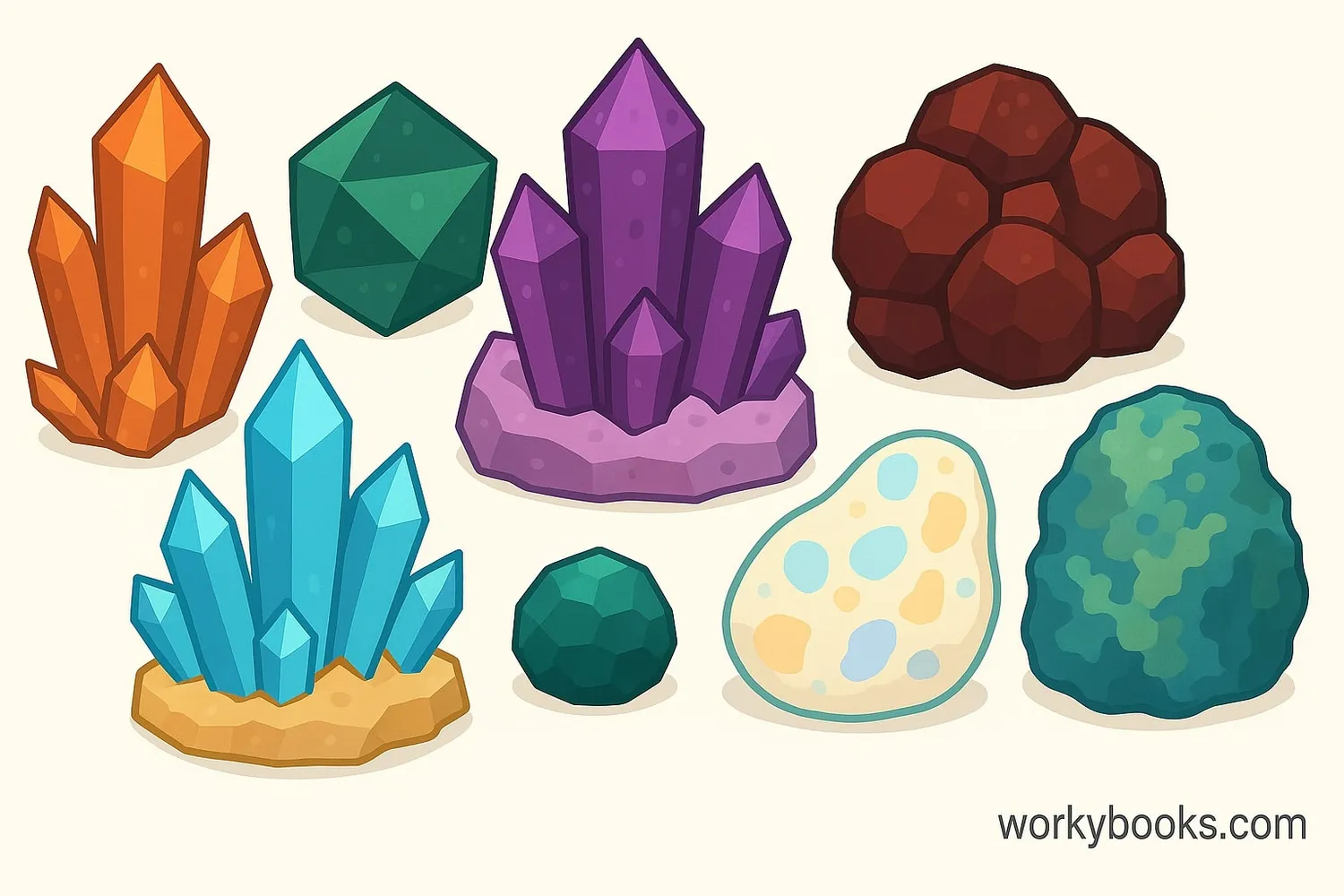
Minerals are essential components of the Earth's crust and are the basic building blocks of rocks. Scientists define a mineral as a substance that is naturally occurring, inorganic, a solid, has an ordered crystal structure, and a definite chemical composition. There are over 4,000 known minerals, but only about 20 of them are common enough to form most of the rocks on Earth. Understanding minerals helps scientists learn about the processes that shape our planet and the resources we use every day.
How Do Minerals Form?
Minerals form through a variety of processes that involve changes in temperature, pressure, and chemical environments. One major way minerals form is by the cooling of magma or lava. As the molten rock cools, atoms arrange themselves into repeating patterns, creating crystals. The rate of cooling affects crystal size—slow cooling deep underground forms large crystals, while rapid cooling at the surface produces small ones. Minerals can also form when substances precipitate out of water solutions, such as when saltwater evaporates and leaves behind halite (rock salt). Changes in pressure and temperature can cause existing minerals to transform into new ones, a process common in the formation of metamorphic rocks.
Mineral Properties and Examples
Each mineral has unique properties based on its composition and crystal structure. Scientists classify minerals by their crystal system—such as cubic, hexagonal, or monoclinic—based on the geometric arrangement of atoms. For example, quartz forms six-sided crystals, while halite forms cubes. Feldspar and mica are other common rock-forming minerals. Calcite, found in limestone, reacts with acid and is important for understanding fossils and sedimentary rocks. These minerals are found in rocks, veins, and mineral deposits all over the world, from mountain ranges to ocean floors.
Minerals vs. Rocks and Their Importance
It is important to distinguish minerals from rocks. While minerals are pure substances with consistent properties, rocks are made up of one or more minerals combined together. For instance, granite is a rock made from quartz, feldspar, and mica. Minerals are not only crucial for identifying rocks, but they also have many uses in technology, construction, and industry. The study of minerals, called mineralogy, informs the search for valuable resources and helps scientists understand Earth's history and the cycling of materials through the planet's systems.
Minerals are fundamental to geology and play a key role in Earth's systems. They affect soil formation, water chemistry, and even living organisms that depend on mineral nutrients. As research advances, scientists continue to discover new minerals and learn more about their properties and roles on Earth and beyond.
Interesting Fact: Diamond and graphite are both made of pure carbon, but their atoms are arranged differently. As a result, diamond is the hardest natural substance, while graphite is soft enough to write with!
What are the five main characteristics that define a mineral?
Naturally occurring, inorganic, solid, crystal structure, definite chemical compositionMade by living things, liquid, organic, variable shape, no structureAlways metallic, soft, transparent, man-made, changes form easilyOnly found in water, always colorful, melts at room temperature, contains fossils, flexible
How do minerals most commonly form from magma?
By cooling and arranging atoms into repeating patternsBy melting rocks at the surfaceBy plants absorbing minerals from soilBy mixing with organic materials
Which of the following is NOT a common rock-forming mineral?
QuartzFeldsparMicaPlastic
What happens to the size of mineral crystals if magma cools slowly underground?
Crystals become largeCrystals remain tinyNo crystals formCrystals melt
In the passage, what does the word 'precipitate' mean?
To form a solid from a solutionTo rain heavilyTo heat up quicklyTo dissolve in water
What does 'inorganic' mean in the context of minerals?
Not formed by living thingsMade by animalsContains carbon from plantsAlways found in water
Why are minerals important for science and society?
They are used in technology, help understand Earth's processes, and are building blocks of rocksThey are only important for making jewelryThey are only found in the oceanThey are not important for humans
If a rock is made from quartz, feldspar, and mica, what is it called?
GraniteHaliteCalciteDiamond
True or False: Rocks are made of one or more minerals.
TrueFalse
True or False: Diamond and graphite have the same chemical composition but different crystal structures.
TrueFalse
Perfect For:
👩🏫 Teachers
• Reading comprehension practice
• Auto-graded assessments
• Literacy skill development
👨👩👧👦 Parents
• Reading practice at home
• Comprehension improvement
• Educational reading time
🏠 Homeschoolers
• Reading curriculum support
• Independent reading practice
• Progress monitoring
Reading Features:
📖
Reading Passage
Engaging fiction or nonfiction text
❓
Comprehension Quiz
Auto-graded questions
📊
Instant Feedback
Immediate results and scoring
📄
Printable Version
Download for offline reading
🔊
Read Aloud
Voice-over with word highlighting
Reviews & Ratings
No reviews yet. Be the first to share your experience!
Related Content
Talus Slopes: Formation and Features
This earth science passage explains talus slope formation through mechanical weathering processes, aligning with NGSS MS...
MS-ESS2-1MS-ESS2-2RST.6-8.4
Biological Weathering: Types and Examples
This passage details biological weathering processes, connecting to NGSS MS-ESS2-1 (Earth's systems) and LS2.B (ecosyste...
MS-ESS2-1MS-PS1-2RST.6-8.3
Frost Wedging: How Ice Splits Rock
This passage explains frost wedging as a mechanical weathering process. Aligned with NGSS MS-ESS2-1 (Earth’s systems) a...
MS-ESS2-1MS-ESS2-2RST.6-8.3
Chemical Weathering: The Breakdown of Rocks Through Chemical Reactions
This passage explains chemical weathering processes, aligned with NGSS MS-ESS2-1 (Earth’s systems) and ESS2-2 (surface ...
MS-ESS2-1MS-ESS2-2RST.6-8.4
Limestone Caves: Nature’s Underground Wonders
This passage explains limestone cave formation through carbonation, aligned with NGSS MS-ESS2-1 (Earth’s systems) and L...
MS-ESS2-1LS2.CRST.6-8.7
The Coldest City in the World: Yakutsk
This NGSS-aligned science passage introduces middle school readers to Yakutsk, the coldest city on Earth. Students will ...
MS-ESS2-1
Igneous Rocks
This comprehensive passage introduces middle school students to igneous rocks, focusing on how these rocks form from mol...
MS-ESS2-1MS-ESS3-1
Sedimentary Rocks
This comprehensive middle school science passage introduces students to sedimentary rocks, detailing their step-by-step ...
MS-ESS2-1MS-ESS2-3MS-ESS3-1
Metamorphic Rocks
This engaging middle school science passage introduces students to the fascinating world of metamorphic rocks. Aligned w...
MS-ESS2-1MS-ESS3-1
Scientific Inquiry in Earth Science
This passage explores scientific inquiry in Earth science for grades 6-8, aligned with NGSS standards MS-ESS1-4, MS-ESS2...
MS-ESS1-4MS-ESS2-1MS-ESS3-5SEP
Contour Lines and Elevation
This passage, designed for grades 6-8 and aligned with NGSS standards MS-ESS2-2 and MS-ESS2-1, introduces students to th...
MS-ESS2-2MS-ESS2-1SEP.4SEP.8
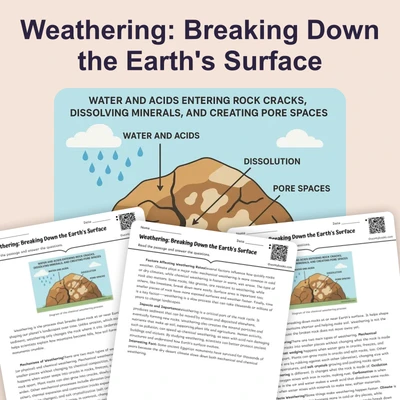
Weathering
This comprehensive science reading passage for grades 6-8 focuses on the concept of weathering, aligning with NGSS stand...
MS-ESS2-1
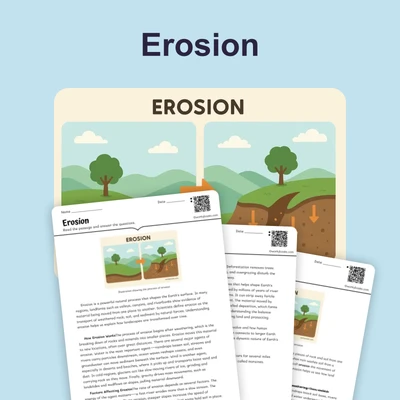
Erosion
This comprehensive middle school science passage explains erosion—the process that transports weathered rock and soil fr...
MS-ESS2-1
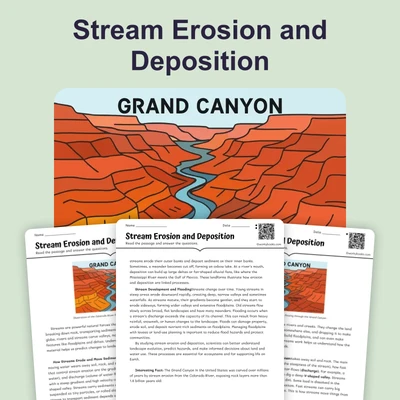
Stream Erosion and Deposition
This middle school science passage, aligned to NGSS MS-ESS2-1, introduces students to the dynamic processes of stream er...
MS-ESS2-1
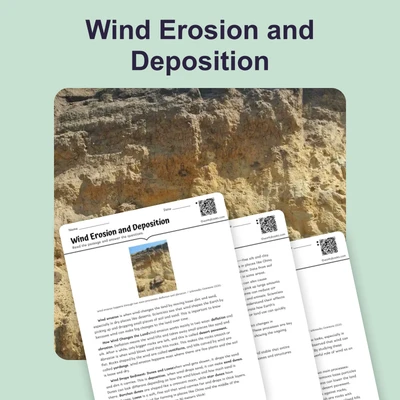
Wind Erosion and Deposition
This comprehensive science reading passage for grades 6-8 explores the processes of wind erosion and deposition, alignin...
MS-ESS2-1
Glacial Erosion and Deposition
This middle school science passage explores glacial erosion and deposition, focusing on the mechanisms by which glaciers...
MS-ESS2-1
Mass Movements
This NGSS-aligned passage introduces middle school students to the science of mass movements—gravity-driven motions of r...
MS-ESS2-1MS-ESS3-2
Soil Formation and Composition
This comprehensive middle school science passage explores soil formation and composition, perfectly aligned to NGSS stan...
MS-ESS2-1
Constructive and Destructive Forces
This middle school science passage explores how Earth's surface is constantly shaped by the interplay of constructive an...
MS-ESS2-1
Mountains and Mountain Building
This NGSS-aligned passage for grades 6-8 covers the fascinating processes that create Earth's highest landforms—mountain...