What are the products of Photosynthesis? — Reading Comprehension
Rate this
Premium Resource
Present
Present in classroom. No work saved
Assign
Classroom with student accounts, Track progress
Quick Play
No student accounts, assign with a link
Grades
3
4
5
6
7
8
PRINT+DIGITAL RESOURCE
This learning resource is available in interactive and printable formats. The interactive worksheet can be played online and assigned to students. The Printable PDF version can be downloaded and printed for completion by hand.
"This NGSS-aligned reading passage for middle school students (grades 6-8) explores the vital process of photosynthesis and its products. The text explains how plants use sunlight, carbon dioxide, and water to create two essential products: glucose and oxygen. It details the role of chlorophyll and chloroplasts in this process and connects photosynthesis to the broader ecosystem, highlighting its significance for both plants and other living organisms. The passage is designed to be a direct, informative resource for self-study, reinforcing key scientific concepts related to matter and energy flow in ecosystems. It uses clear, concise language to make complex ideas accessible to a middle school audience."
CONTENT PREVIEW
Expand content preview
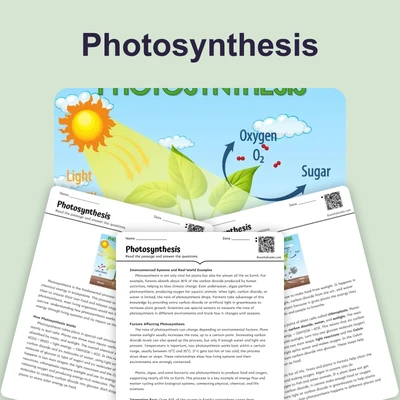
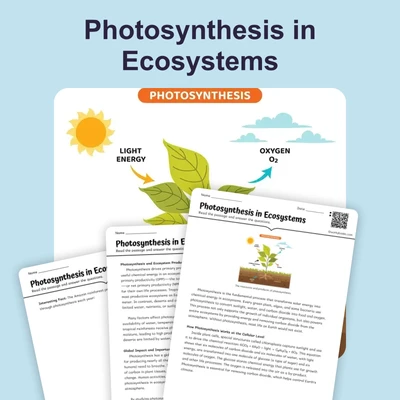
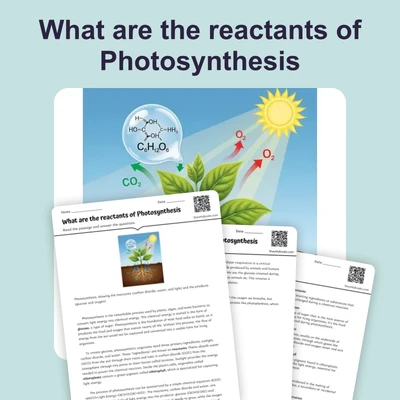
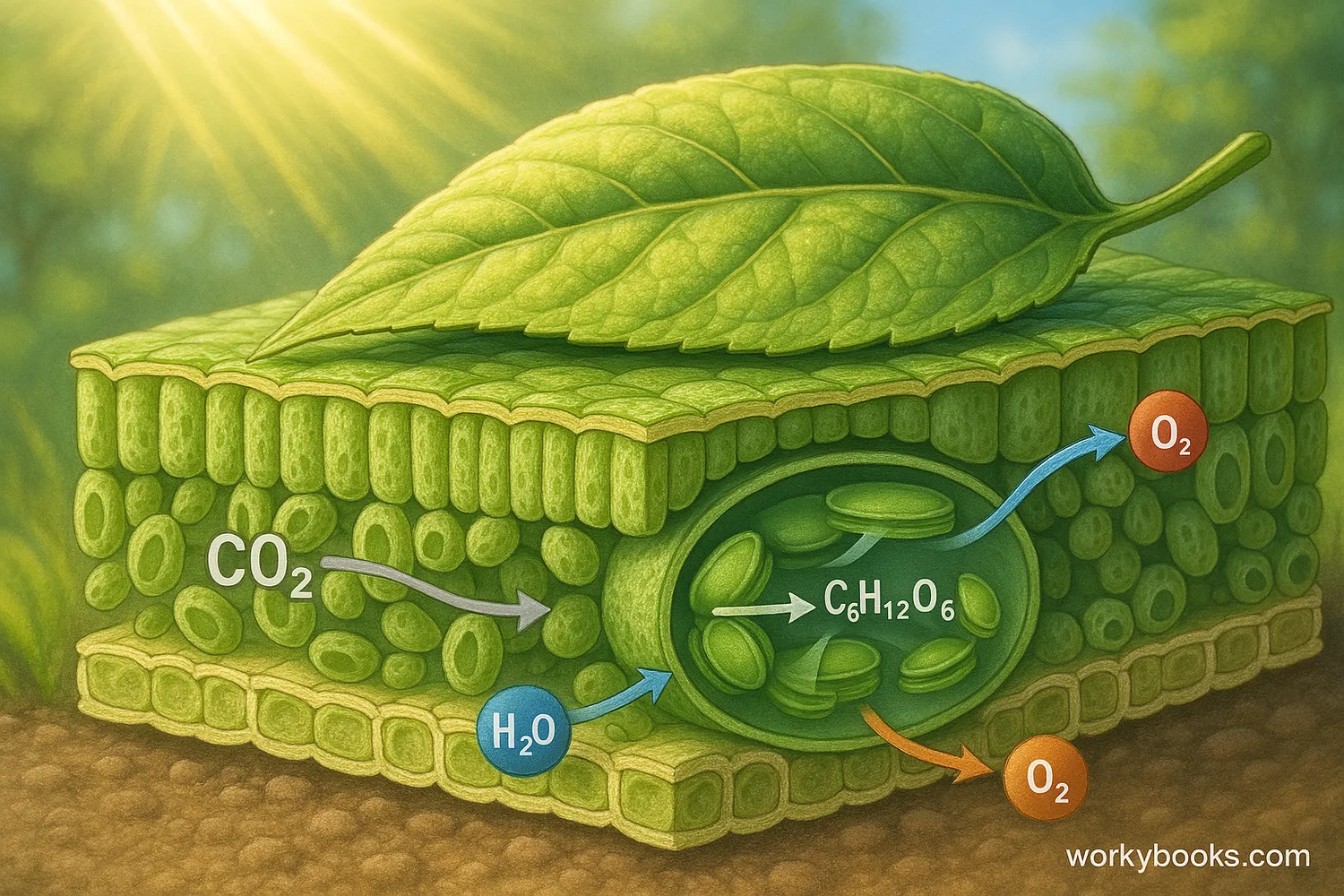
Process of photosynthesis, where a plant uses sunlight, water, and carbon dioxide to produce glucose and oxygen.
Photosynthesis is the fundamental process by which green plants, algae, and some bacteria convert light energy into chemical energy. This process is crucial for life on Earth, as it is the primary way that energy from the sun is captured and stored in organic molecules. The key players in this chemical reaction are carbon dioxide (CO2) and water (H2O), which act as the reactants. These ingredients are used to create the essential products that sustain the plant and, directly or indirectly, most other living organisms.
Inside a plant's cells, organelles called chloroplasts contain a green pigment called chlorophyll. Chlorophyll is responsible for absorbing light energy, which then powers the conversion of the reactants. The overall chemical reaction can be summarized as:
6CO2+6H2O+Light Energy→C6H12O6+6O2
This formula shows that in the presence of light, six molecules of carbon dioxide and six molecules of water are transformed into one molecule of glucose and six molecules of oxygen. These resulting substances—glucose and oxygen—are the two main products of photosynthesis.
Glucose (C6H12O6) is a simple sugar that serves as the plant’s food source. It is a form of chemical energy that the plant uses for growth, reproduction, and other metabolic activities. Excess glucose can be stored as starch, which can be broken down later for energy. The second product is oxygen (O2), which is released into the atmosphere as a byproduct. This oxygen is vital for the survival of most organisms on Earth, including humans, which depend on it for cellular respiration. Therefore, photosynthesis not only feeds plants but also replenishes the air we breathe.
Fun Fact: The oxygen that we breathe comes from the water molecules that plants take in, not from the carbon dioxide.
What is the main purpose of photosynthesis for plants?
To release carbon dioxideTo absorb sunlightTo create their own foodTo produce water
Which two substances are the main products of photosynthesis?
Carbon dioxide and waterWater and glucoseGlucose and oxygenOxygen and carbon dioxide
What is the role of chlorophyll in photosynthesis?
To release oxygenTo absorb light energyTo store glucoseTo produce water
The chemical formula C6H12O6 represents which product of photosynthesis?
WaterCarbon dioxideOxygenGlucose
Based on the passage, where does the oxygen released during photosynthesis originate from?
The carbon dioxide moleculesThe soilThe water moleculesThe chlorophyll
Which of the following best describes the overall process of photosynthesis?
Converting chemical energy to light energyBreaking down glucose for energyCapturing light to create foodReleasing water and carbon dioxide
If a plant is grown in a sealed container with a limited amount of carbon dioxide, what would be the likely effect on its ability to perform photosynthesis?
The plant would produce more oxygen.Photosynthesis would slow down.The plant would produce more glucose.The process would be unaffected.
Which organelle in a plant cell is the site of photosynthesis?
NucleusMitochondriaChloroplastVacuole
Perfect For:
👩🏫 Teachers
• Reading comprehension practice
• Auto-graded assessments
• Literacy skill development
👨👩👧👦 Parents
• Reading practice at home
• Comprehension improvement
• Educational reading time
🏠 Homeschoolers
• Reading curriculum support
• Independent reading practice
• Progress monitoring
Reading Features:
📖
Reading Passage
Engaging fiction or nonfiction text
❓
Comprehension Quiz
Auto-graded questions
📊
Instant Feedback
Immediate results and scoring
📄
Printable Version
Download for offline reading
🔊
Read Aloud
Voice-over with word highlighting
Reviews & Ratings
No reviews yet. Be the first to share your experience!
Related Content
Cell Structure and Function
This middle school science passage introduces the fundamental concept that cells are the basic unit of life, aligned wit...
MS-LS1-1MS-LS1-2
Claws vs. Nails: Structure and Function
This engaging, audio-integrated reading passage, "Claws vs. Nails: Structure and Function," introduces sixth-grade stude...
Plant Parts Function Sort
This classification activity helps students understand how different plant structures contribute to survival. Students c...
4-LS1-1
Animal Structures Word Sort
This engaging classification activity helps students understand the different structures that make up animal bodies. Stu...
4-LS1-1
The Nature of Life Science
This passage, aligned with NGSS MS-LS1-1, introduces students in grades 6-8 to the foundational concepts of life science...
MS-LS1-1
Science Vocabulary
This worksheet on domain-specific words will help students learn some science vocabulary. Students will be asked to matc...
L.3.6L.3.4.A
Simple Machines Science Report
This science writing task requires students to clearly explain how three simple machines work using precise domain-speci...
W.5.4
Animal Body Parts and Their Functions
In this 'Animal Body Parts and Their Functions' word sort activity aligned with LS1.A, students learn about how differen...
Golgi Apparatus and Its Function
This NGSS-aligned reading passage introduces middle school students to the structure and function of the Golgi apparatus...
MS-LS1-1
Bacteria: Prokaryotic Cell Structure
This engaging and audio-integrated reading passage, 'Bacteria: Prokaryotic Cell Structure,' introduces 6th-grade student...
Whale Blubber: Function and Adaptation
This engaging, audio-integrated reading passage, 'Whale Blubber Function and Adaptation,' introduces young learners to t...
Citizen Science and Ecological Monitoring
This engaging passage for grades 6-8 introduces the concept of citizen science and its critical role in ecological monit...
MS-LS2-1
Tools and Technology in Earth Science
This middle school science reading passage explores the wide range of tools and technologies used in Earth science, from...
MS-ESS2-2MS-ESS3-2MS-ETS1-1MS-PS4-3
The Nucleolus and Its Function
This NGSS-aligned reading passage focuses on the nucleolus, a key structure inside the cell’s nucleus responsible for ma...
MS-LS1-1MS-LS1-2
Blobfish Adaptations to Extreme Pressure
This engaging passage explores the fascinating world of the blobfish and its unique adaptations to the extreme pressure ...
What Is Earth Science?
This engaging middle school science passage introduces students to the field of Earth science, aligning with NGSS standa...
MS-ESS1MS-ESS2MS-ESS3SEP
The Nature of Science
This passage explores the nature of science for middle school students, aligning with NGSS standards MS-ETS1-4, MS-PS1-1...
MS-ETS1-4MS-PS1-1MS-LS1-1
The Aorta: Molecules to Organisms of the Body's Largest Artery
This educational content features a fascinating reading passage, audio integrated for an enhanced learning experience, a...
The Pumpkin Life Cycle
This informational worksheet explores the pumpkin lifecycle, guiding students through procedural steps in a scientific t...
RI.2.3RI.2.10
Cell Membrane Structure
This comprehensive passage explores the structure and function of the cell membrane, aligning with NGSS standard MS-LS1-...