What causes the Coriolis Effect
Interactive passage with audio narration, comprehension questions, and printable PDF.
By completing this purchase you agree to our Terms of Use and Privacy Policy. Your subscription renews automatically until you cancel. You can cancel anytime from your account settings. All sales are final and non-refundable. Digital content is available for download in your account immediately upon purchase.
What's included
What causes the Coriolis Effect preview and details
About this printable What causes the Coriolis Effect science reading passage, NGSS-aligned (Grades 3-8)
Sample passage and quiz from What causes the Coriolis Effect
Reading passage and comprehension quiz preview
What causes the Coriolis Effect
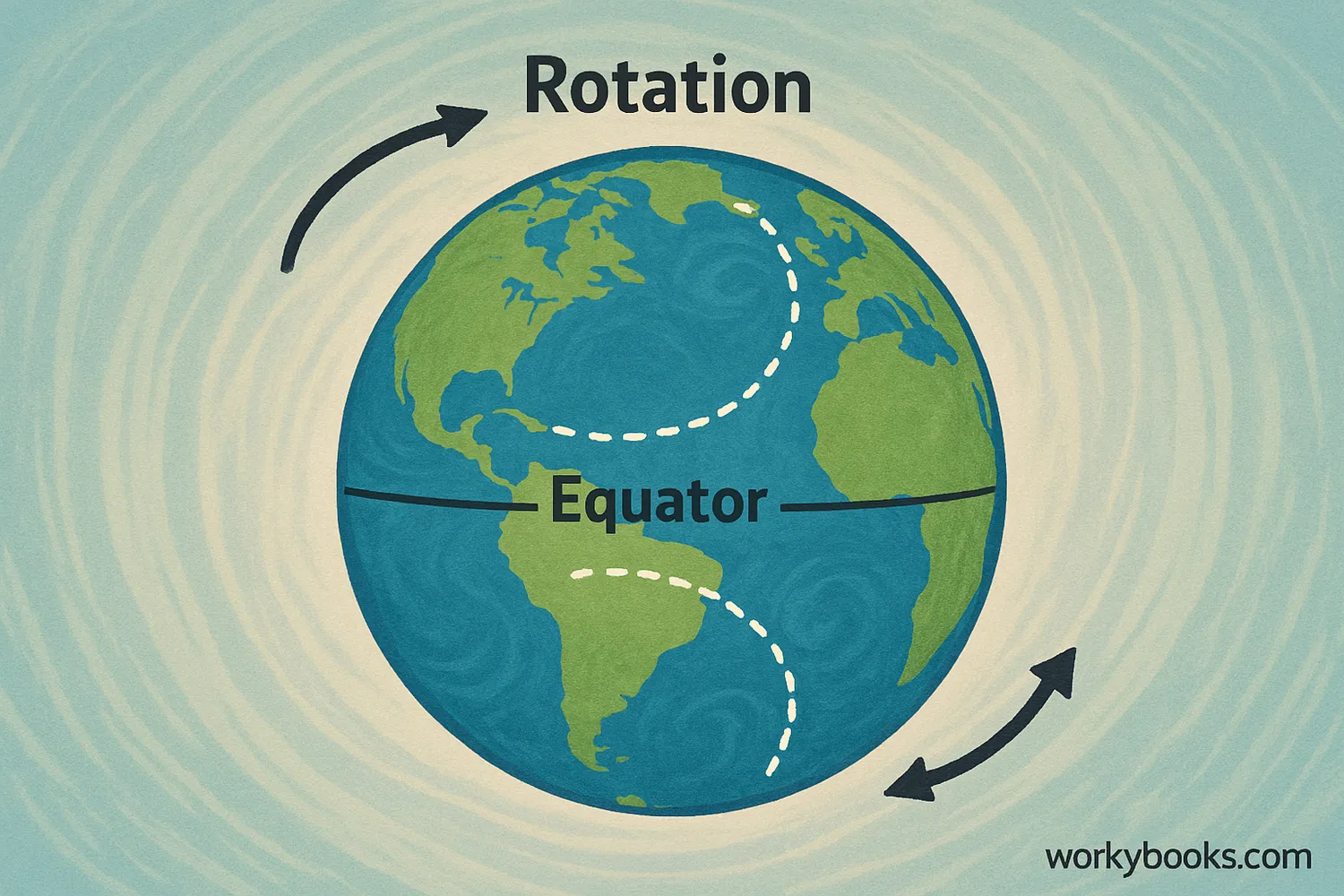
The Coriolis effect is a phenomenon that describes the apparent deflection of moving objects, like air and water, when they travel over long distances on Earth. This effect isn't a true force but rather a result of our planet's rotation. Because the Earth is a sphere that rotates, different latitudes travel at different speeds. The equator moves fastest, covering a greater distance in a 24-hour day, while locations closer to the poles move much more slowly. This difference in rotational speed causes objects moving freely across the surface to appear to curve from our perspective on the ground.
In the Northern Hemisphere, the Coriolis effect causes objects moving long distances to deflect to the right. This deflection is a key factor in the formation of large-scale weather systems. For example, air moving toward a low-pressure area is not able to travel in a straight line. Instead, it is bent to the right, causing it to circulate counterclockwise around the low-pressure center. This is why hurricanes and other cyclones spin counterclockwise north of the equator.
Conversely, in the Southern Hemisphere, the deflection is to the left. Air flowing into a low-pressure system in the Southern Hemisphere is deflected to the left, which causes the storm to spin clockwise. This same principle applies to ocean currents, which form massive, rotating systems called gyres. The Coriolis effect is what makes these gyres circulate clockwise in the Northern Hemisphere and counterclockwise in the Southern Hemisphere, playing a vital role in global heat distribution.
Understanding the Coriolis effect is crucial for fields like meteorology and navigation. Without accounting for it, a long-distance missile or an airplane's flight path would miss its target. The effect is most pronounced near the poles and becomes weaker as you approach the equator, where it is virtually nonexistent.
Fun Fact: The Coriolis effect is too weak to influence small-scale events like the direction water drains in a sink or toilet. This common myth is often disproven by the simple forces of the plumbing itself.
Comprehension quiz (8 questions)
1. What is the main cause of the Coriolis effect?
2. In the Northern Hemisphere, which direction does the Coriolis effect deflect moving objects?
3. How does the rotational speed of Earth's surface differ at various latitudes?
4. How does the Coriolis effect influence hurricanes in the Northern Hemisphere?
5. Where on Earth is the Coriolis effect most pronounced?
6. Based on the passage, what would likely happen to an ocean current flowing from the equator toward the South Pole?
7. The primary purpose of the reading passage is to:
8. Why is it important for pilots and missile engineers to account for the Coriolis effect?
Perfect for the way you teach
- Build comprehension skills
- Auto-graded quiz
- Differentiated reading
- Read together at home
- Improve fluency
- Quiet reading time
- Reading curriculum support
- Independent practice
- Track Lexile growth