What is an Atmospheric River — Reading Comprehension
Rate this
Premium Resource
Present
Present in classroom. No work saved
Assign
Classroom with student accounts, Track progress
Quick Play
No student accounts, assign with a link
Grades
3
4
5
6
7
8
PRINT+DIGITAL RESOURCE
This learning resource is available in interactive and printable formats. The interactive worksheet can be played online and assigned to students. The Printable PDF version can be downloaded and printed for completion by hand.
"This passage provides a comprehensive overview of atmospheric rivers, a key concept in Earth and space science. Designed for middle school students, the text explains the formation and function of these powerful moisture-transport systems. It aligns with NGSS standards related to Earth's systems and weather patterns, offering clear explanations of scientific terms like 'jet streams' and 'orographic lift.' Students will learn how atmospheric rivers, while crucial for water supply and drought relief, can also lead to destructive floods and landslides. The content is structured to support self-study, with real-world examples to enhance understanding of weather phenomena."
CONTENT PREVIEW
Expand content preview
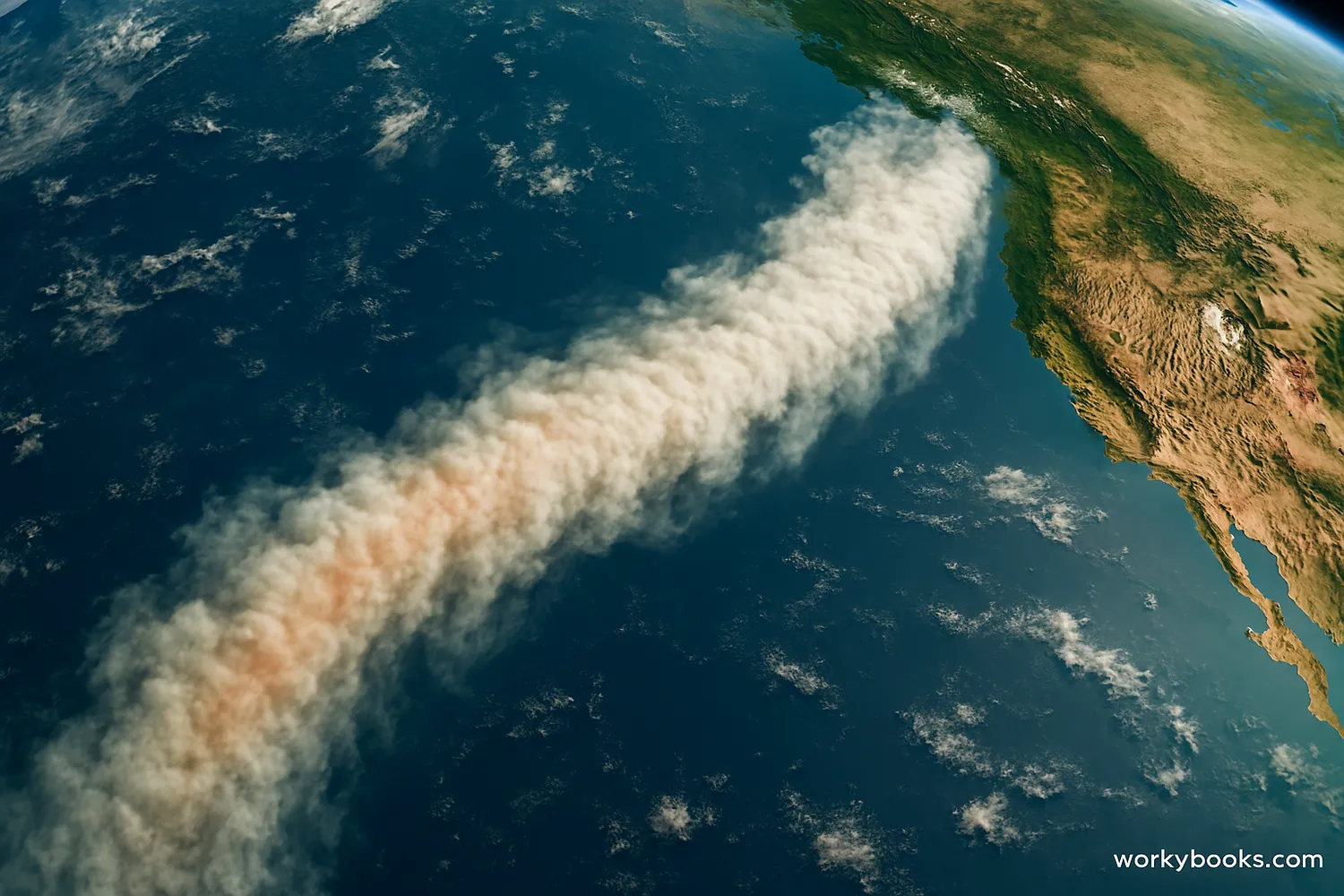
A satellite image shows an atmospheric river, a long band of water vapor, moving across the ocean toward a coastal mountain range.
An atmospheric river is a long, narrow band of concentrated moisture that moves through the atmosphere. These "rivers in the sky" are essentially powerful conveyor belts of water vapor, transporting it from tropical and subtropical oceans to higher latitudes. While not visible to the naked eye, they play a critical role in Earth's water cycle, delivering large amounts of precipitation in the form of rain or snow to the regions they impact. Understanding atmospheric rivers is important for managing water resources, as they can be both a source of much-needed water and a cause of extreme weather events.
Atmospheric rivers form when warm ocean water in the tropics evaporates, releasing immense amounts of moisture into the air. Jet streams, which are fast-flowing air currents, then act as guides, steering these moist air masses over thousands of miles. The most well-known example is the "Pineapple Express," which transports moisture from near Hawaii to the West Coast of the United States. As the atmospheric river approaches land, the moist air is forced upward by mountains. This process, known as orographic lift, causes the air to cool, and the water vapor condenses into clouds, releasing its moisture as heavy precipitation.
The effects of atmospheric rivers can be significant and varied. On one hand, they are a vital source of freshwater, often accounting for half of the annual precipitation in coastal regions. This moisture replenishes reservoirs, increases snowpack in mountains, and helps to end droughts. On the other hand, a strong or persistent atmospheric river can be hazardous. The enormous volume of water released in a short period can lead to widespread flooding, landslides, and mudslides. The intensity of these events depends on the river's strength, how long it lingers over a region, and the local geography.
Fun Fact: A single atmospheric river can transport a greater volume of water vapor than the average flow of the Amazon River, the largest river on Earth.
What is an atmospheric river primarily composed of?
Liquid waterWater vaporIce crystalsNitrogen and oxygen
What is the role of a jet stream in the formation of an atmospheric river?
It causes the water to evaporate.It cools the water vapor to form clouds.It steers the moist air masses.It creates a low-pressure system.
What process causes an atmospheric river to release its moisture as precipitation?
CondensationEvaporationOrographic liftSublimation
The "Pineapple Express" is mentioned as an example of what?
A dangerous flood eventA jet streamA tropical stormAn atmospheric river
How do atmospheric rivers benefit regions they impact?
They increase wind speeds.They replenish water sources.They cause warmer temperatures.They prevent droughts completely.
What is a potential negative consequence of a strong atmospheric river?
Decreased reservoir levelsWidespread wildfiresIncreased air pressureFlooding and landslides
Which statement best summarizes the main idea of the passage?
Atmospheric rivers are the primary cause of all major floods.Atmospheric rivers are a natural part of the water cycle that can be both beneficial and destructive.Scientists are still unsure how atmospheric rivers form.The "Pineapple Express" is the only atmospheric river in the world.
If an atmospheric river were to hit a region with no mountains, what would likely happen?
The precipitation would be much heavier.The air would not be forced to cool as much.The river would stop flowing entirely.The temperature of the air would increase.
Perfect For:
👩🏫 Teachers
• Reading comprehension practice
• Auto-graded assessments
• Literacy skill development
👨👩👧👦 Parents
• Reading practice at home
• Comprehension improvement
• Educational reading time
🏠 Homeschoolers
• Reading curriculum support
• Independent reading practice
• Progress monitoring
Reading Features:
📖
Reading Passage
Engaging fiction or nonfiction text
❓
Comprehension Quiz
Auto-graded questions
📊
Instant Feedback
Immediate results and scoring
📄
Printable Version
Download for offline reading
🔊
Read Aloud
Voice-over with word highlighting
Reviews & Ratings
No reviews yet. Be the first to share your experience!
Related Content
Climate and weather activity
This worksheet is perfect for understanding the differences between climate and weather. Students will read the phrases ...
Climate and Weather — Distinguishing Characterstics
This worksheet highlights the differences between climate and weather. The chart format makes comparing and contrasting ...
Comparing Weather and Climate Texts
This reading comprehension worksheet has 5th graders read two informational texts about Weather and Climate. Students th...
RI.5.9
Tools and Technology in Earth Science
This middle school science reading passage explores the wide range of tools and technologies used in Earth science, from...
MS-ESS2-2MS-ESS3-2MS-ETS1-1MS-PS4-3
What Is Earth Science?
This engaging middle school science passage introduces students to the field of Earth science, aligning with NGSS standa...
MS-ESS1MS-ESS2MS-ESS3SEP
What Is Space Weather and How Does It Affect the Earth?
This NGSS-aligned science passage for middle school explains what space weather is and how it affects Earth. Students le...
MS-ESS2-2
Extreme Weather and Climate Change
This Grade 6-8 science passage, aligned to NGSS standards, explores the impact of climate change on extreme weather even...
What Is The Difference Between Climate Model And Weather Model?
This reading passage delves into the fundamental differences between weather models and climate models, explaining their...
Scientific Inquiry in Earth Science
This passage explores scientific inquiry in Earth science for grades 6-8, aligned with NGSS standards MS-ESS1-4, MS-ESS2...
MS-ESS1-4MS-ESS2-1MS-ESS3-5SEP
Earth's Major Climate Zones Explained
This engaging science passage for grades 6-8 explains Earth's major climate zones, including tropical, temperate, and po...
Climate Through Earth's History
This engaging passage for grades 6-8 explores how Earth's climate has naturally changed over millions of years, highligh...
MS-ESS1-4MS-ESS2-6
Earth: Our Home in Space
This engaging Grade 4-5 science passage, aligned to NGSS, introduces students to Earth's special place in the solar syst...
Weather vs. Climate
This comprehensive passage for grades 6-8 explores the difference between weather and climate, aligning with NGSS standa...
MS-ESS2-6
How is Climate Different from Weather?
This passage distinguishes climate from weather for young readers. It defines climate as the usual weather patterns over...
RI.3.1RI.4.14.ESS2.D
Air Masses and Weather
This audio-integrated passage, "Air Masses and Weather," is designed for 6th-grade students to understand how the moveme...
Antarctica Climate
This engaging science passage for grades 6-8 explores Antarctica, the coldest climate zone on Earth. Students will learn...
How Climate Change Affects Weather
This middle school science passage explores how and why weather patterns are changing globally. Students will learn abou...
MS-ESS3-5
Climate Zones Word Sort
This word sort activity helps students understand different climate zones through real-world locations. Students classif...
Escape Velocity and Space Travel
This middle school science passage introduces students to the concept of escape velocity—the minimum speed required to b...
MS-ESS1-2MS-PS2-4
Weather Tools & Measurements Word Sort
This word sort activity connects weather measurement tools with their corresponding measurements. Students match 12 weat...