What Is Atmospheric Pressure? — Reading Comprehension
Rate this
Premium Resource
Present
Present in classroom. No work saved
Assign
Classroom with student accounts, Track progress
Quick Play
No student accounts, assign with a link
Grades
6
PRINT+DIGITAL RESOURCE
This learning resource is available in interactive and printable formats. The interactive worksheet can be played online and assigned to students. The Printable PDF version can be downloaded and printed for completion by hand.
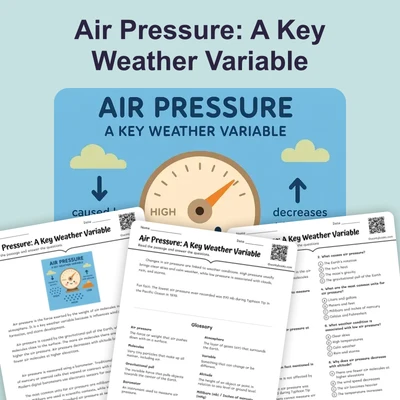
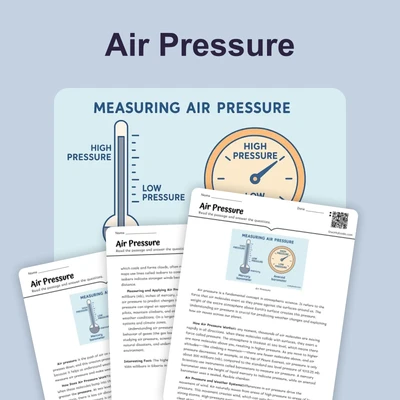
Dive into the fascinating world of atmospheric pressure with this educational content, designed for 6th-grade students. This passage, titled "What Is Atmospheric Pressure?", defines key terms like 'atmosphere' and 'density,' explaining how air pressure is created and measured. Students will learn about the role of Earth's gravity in keeping our atmosphere close and how changes in atmospheric pressure influence weather conditions. Aligned with NGSS MS-ESS2-5, this resource includes an audio-integrated reading passage, multiple-choice questions, a glossary, and short answer questions to enhance comprehension and application of scientific concepts related to air masses and weather. It's an excellent tool for understanding the complex interactions that shape our daily weather.
CONTENT PREVIEW
Expand content preview
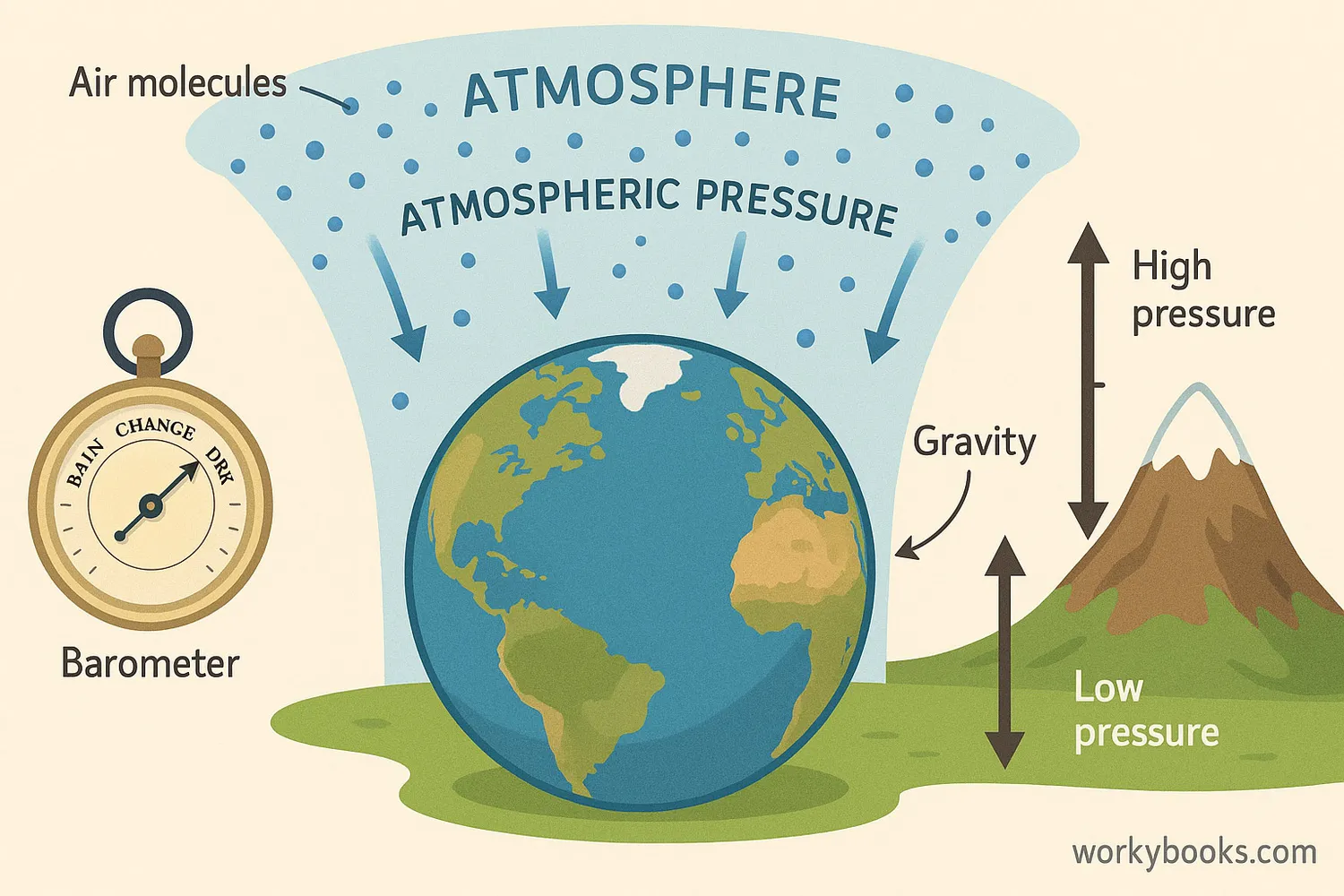
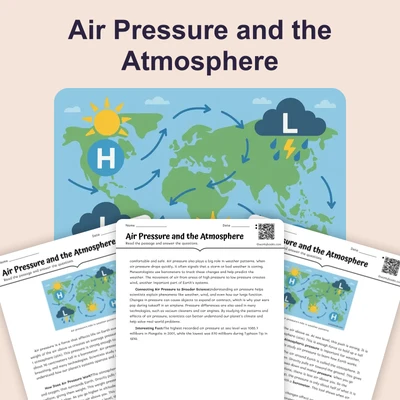
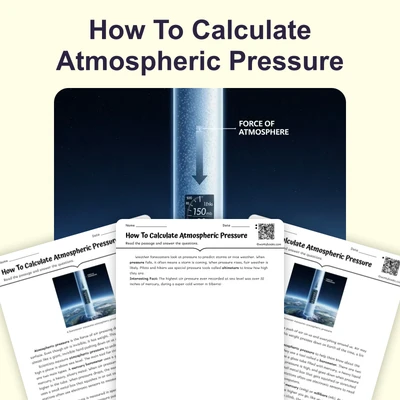
Invisible air blanket pressing down, showing pressure differences and weather effects.
Imagine a giant, invisible blanket made of air wrapped around our planet. This blanket is called the atmosphere, and it's much heavier than you might think! Every living thing on Earth, and every object, has this blanket of air pressing down on it. That invisible force is what we call atmospheric pressure, also known as air pressure.
So, what exactly causes this pressure? It all comes down to two main things: air molecules and Earth's gravity. Air is made up of countless tiny molecules that are constantly moving. Because Earth's gravity pulls everything towards its center, these air molecules are pulled downwards. The more air molecules there are above a certain point, the more they weigh and the greater the pressure they exert. Think of it like a stack of books: the books at the bottom have more weight pressing down on them than the books at the top.
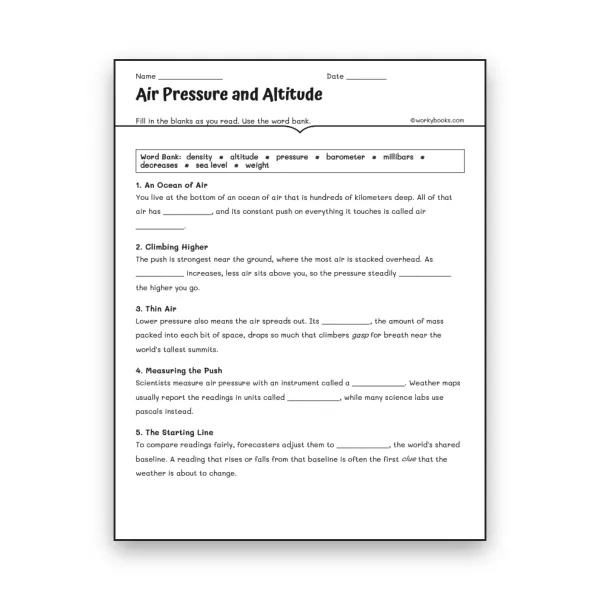
This means that atmospheric pressure is not the same everywhere. At sea level, there's a taller column of air above you, so the pressure is higher. As you go higher up a mountain, there are fewer air molecules above you, so the atmospheric pressure decreases. This is why your ears might pop when you travel up a mountain or in an airplane – it's your body adjusting to the change in air pressure.
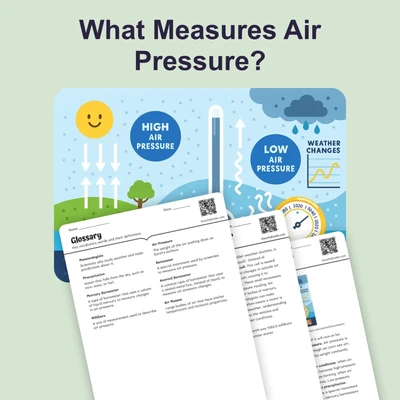
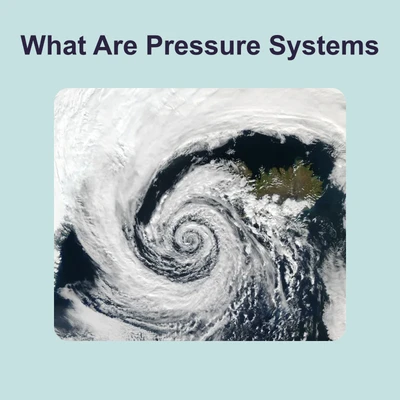
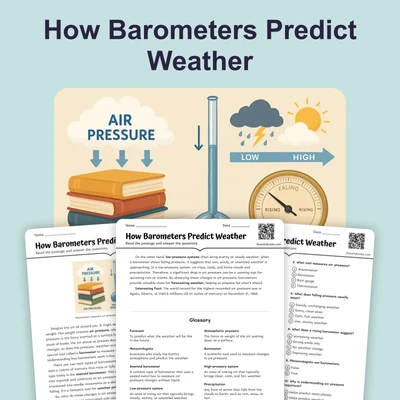
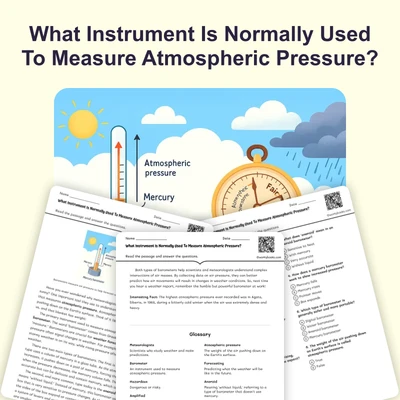
Scientists measure atmospheric pressure using an instrument called a barometer. Barometers help us understand changes in weather. When a region has high pressure, it usually means clear skies and stable weather. This is because the air is sinking, which prevents clouds from forming. On the other hand, low pressure often brings cloudy, rainy, or stormy weather. In a low-pressure system, air is rising, allowing moisture to condense and form clouds.
Understanding atmospheric pressure is key to understanding weather patterns. It's a fundamental part of Earth's atmosphere and plays a crucial role in how air masses interact, leading to the various weather conditions we experience every day. Without this invisible force, our planet's weather would be very different indeed.
Interesting Fact: The total weight of the atmosphere pressing down on the Earth's surface is about 5.5 quadrillion tons, which is equivalent to the weight of approximately 100 million pyramids of Giza!
What is the invisible blanket of air around Earth called?
AtmosphereStratosphereBiosphereHydrosphere
What instrument measures atmospheric pressure?
ThermometerAnemometerBarometerRain gauge
Which force pulls air molecules downwards?
Magnetic forceEarth's gravityWind currentSolar radiation
What typically causes clearer skies?
Low pressureHigh pressureRising airMany clouds
Why does pressure decrease on a mountain?
Less gravityFewer air moleculesMore oxygenWarmer temperatures
What does a low-pressure system often bring?
Clear weatherSunny skiesRainy weatherNo wind
How do air masses interact to change weather?
By reflecting lightBy changing temperatureThrough pressure differencesBy absorbing sound
Atmospheric pressure is the same everywhere.
TrueFalse
What causes your ears to pop in an airplane?
Engine noiseAir temperature changeBody adjusting to pressureFood you ate
What is the meaning of 'gravity' as used?
Force of repulsionForce of attractionForce of windForce of heat
Perfect For:
👩🏫 Teachers
• Reading comprehension practice
• Auto-graded assessments
• Literacy skill development
👨👩👧👦 Parents
• Reading practice at home
• Comprehension improvement
• Educational reading time
🏠 Homeschoolers
• Reading curriculum support
• Independent reading practice
• Progress monitoring
Reading Features:
📖
Reading Passage
Engaging fiction or nonfiction text
❓
Comprehension Quiz
Auto-graded questions
📊
Instant Feedback
Immediate results and scoring
📄
Printable Version
Download for offline reading
🔊
Read Aloud
Voice-over with word highlighting
Reviews & Ratings
No reviews yet. Be the first to share your experience!
Related Content
Climate and weather activity
This worksheet is perfect for understanding the differences between climate and weather. Students will read the phrases ...
Climate and Weather — Distinguishing Characterstics
This worksheet highlights the differences between climate and weather. The chart format makes comparing and contrasting ...
Comparing Weather and Climate Texts
This reading comprehension worksheet has 5th graders read two informational texts about Weather and Climate. Students th...
RI.5.9
Tools and Technology in Earth Science
This middle school science reading passage explores the wide range of tools and technologies used in Earth science, from...
MS-ESS2-2MS-ESS3-2MS-ETS1-1MS-PS4-3
What Is Earth Science?
This engaging middle school science passage introduces students to the field of Earth science, aligning with NGSS standa...
MS-ESS1MS-ESS2MS-ESS3SEP
What Is Space Weather and How Does It Affect the Earth?
This NGSS-aligned science passage for middle school explains what space weather is and how it affects Earth. Students le...
MS-ESS2-2
Extreme Weather and Climate Change
This Grade 6-8 science passage, aligned to NGSS standards, explores the impact of climate change on extreme weather even...
What Is The Difference Between Climate Model And Weather Model?
This reading passage delves into the fundamental differences between weather models and climate models, explaining their...
Scientific Inquiry in Earth Science
This passage explores scientific inquiry in Earth science for grades 6-8, aligned with NGSS standards MS-ESS1-4, MS-ESS2...
MS-ESS1-4MS-ESS2-1MS-ESS3-5SEP
Earth's Major Climate Zones Explained
This engaging science passage for grades 6-8 explains Earth's major climate zones, including tropical, temperate, and po...
Climate Through Earth's History
This engaging passage for grades 6-8 explores how Earth's climate has naturally changed over millions of years, highligh...
MS-ESS1-4MS-ESS2-6
Earth: Our Home in Space
This engaging Grade 4-5 science passage, aligned to NGSS, introduces students to Earth's special place in the solar syst...
Weather vs. Climate
This comprehensive passage for grades 6-8 explores the difference between weather and climate, aligning with NGSS standa...
MS-ESS2-6
How is Climate Different from Weather?
This passage distinguishes climate from weather for young readers. It defines climate as the usual weather patterns over...
RI.3.1RI.4.14.ESS2.D
Air Masses and Weather
This audio-integrated passage, "Air Masses and Weather," is designed for 6th-grade students to understand how the moveme...
Antarctica Climate
This engaging science passage for grades 6-8 explores Antarctica, the coldest climate zone on Earth. Students will learn...
How Climate Change Affects Weather
This middle school science passage explores how and why weather patterns are changing globally. Students will learn abou...
MS-ESS3-5
Climate Zones Word Sort
This word sort activity helps students understand different climate zones through real-world locations. Students classif...
Escape Velocity and Space Travel
This middle school science passage introduces students to the concept of escape velocity—the minimum speed required to b...
MS-ESS1-2MS-PS2-4
Weather Tools & Measurements Word Sort
This word sort activity connects weather measurement tools with their corresponding measurements. Students match 12 weat...