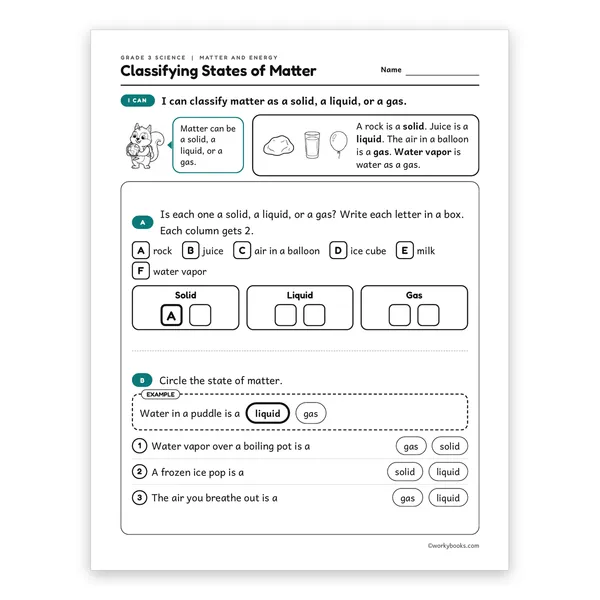
This learning resource is available in interactive and printable formats. The interactive worksheet can be played online and assigned to students. The Printable PDF version can be downloaded and printed for completion by hand.
This engaging Grade 4-5 science passage explores the process of melting, where solids turn into liquids. Students learn key concepts and vocabulary such as melting point, phase change, and energy, with bolded glossary terms for easy reference. Real-world examples like ice melting into water and chocolate softening in your hand help students connect science to everyday life. The passage is aligned to NGSS standards and includes an "Interesting Fact" to spark curiosity. The resource offers a multiple-choice quiz, Spanish translation, and writing prompts that encourage deeper understanding and critical thinking. Glossary definitions and integrated audio support vocabulary development. This resource is ideal for classroom or home learning, and helps students strengthen reading, science, and language skills.
CONTENT PREVIEW
Expand content preview
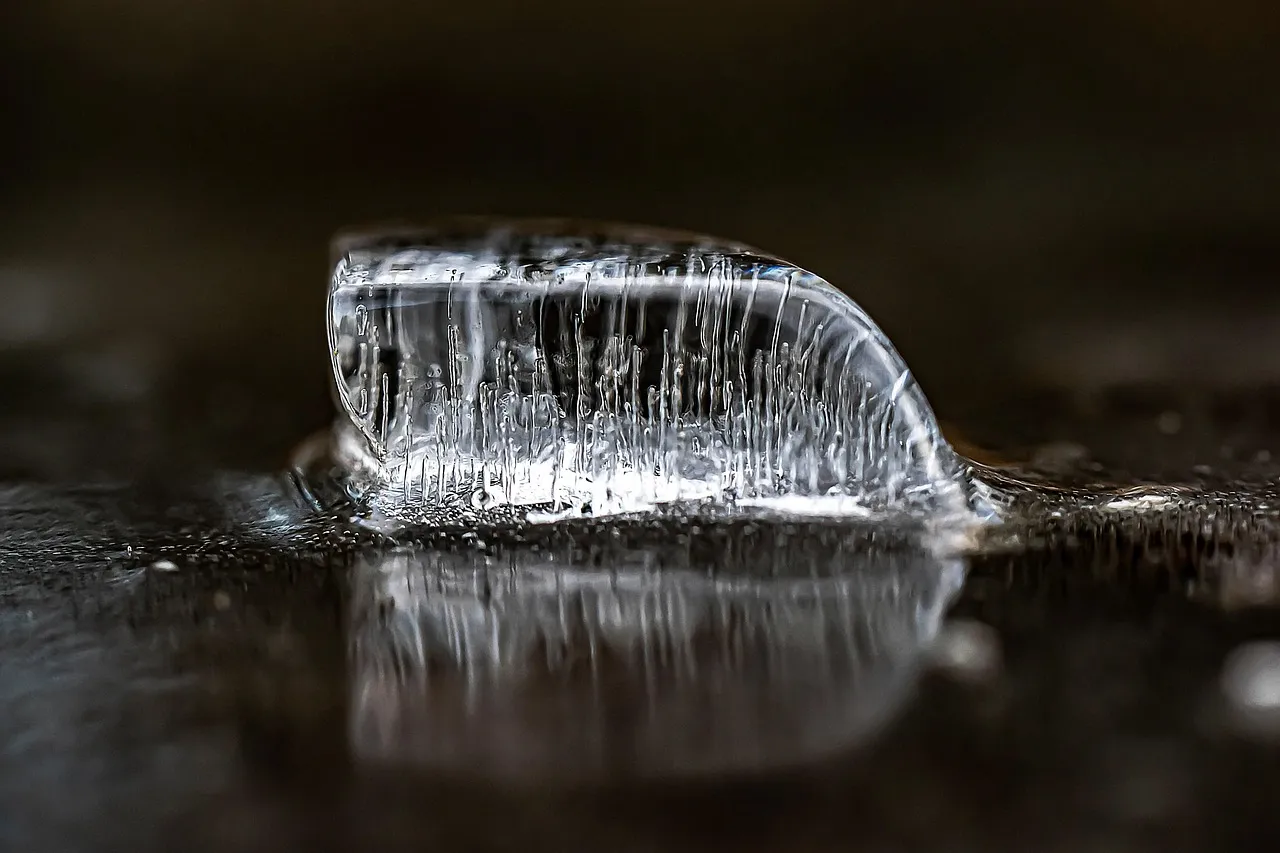
"Solid to Liquid: Melting / Source: Pixabay.
Melting is a physical change that happens when a solid turns into a liquid. This change occurs when heat energy is added to the solid. Understanding melting helps us explain many everyday events, from ice cubes disappearing in a glass of water to snow turning into puddles on a warm spring day.
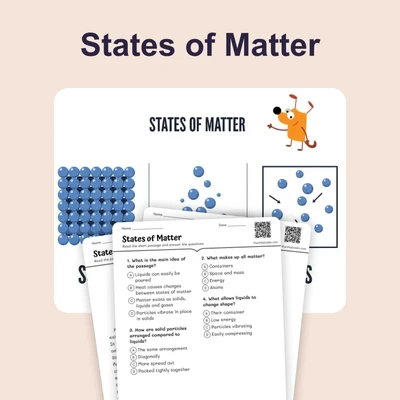
All matter is made up of tiny particles that are always moving. In a solid, these particles are packed closely together and vibrate in place. They hold their shape because the particles don't have enough energy to move freely. When you add heat to a solid, the particles gain energy—the ability to do work or cause change. As the particles gain more energy, they start to vibrate faster and faster.
When enough heat is added, the particles gain so much energy that they can break free from their fixed positions. They begin to slide past each other instead of just vibrating in place. This is when the solid becomes a liquid. The melting point is the specific temperature at which this change happens. Different substances have different melting points. Ice melts at 32°F (0°C), while chocolate melts at about 86°F (30°C).
Ice turning into water is the perfect example of melting. When you take an ice cube out of the freezer, it is cold and solid. The water particles in the ice are locked in place, vibrating but not moving around. As the ice sits at room temperature, heat from the warmer air moves into the ice. This heat gives the water particles more energy. Soon, the particles are moving fast enough to slide past each other, and the ice becomes liquid water.
An important fact about melting is that the substance—the type of matter—stays the same. Ice and liquid water are both made of water particles. Only the state of matter changes. The solid becomes a liquid, but it's still the same substance. If you froze the water again, it would turn back into ice. This is different from other changes, like burning wood, where the substance itself changes into something completely different.
Think of melting like children on a playground. When they stand in tight rows for a class photo, they're like particles in a solid—close together and in fixed positions. When the teacher says they can play, they spread out and move around freely, like particles in a liquid. The children are still the same people, just in a different arrangement.
Interesting Fact: The metal gallium has a melting point of only 85.6°F (29.8°C), which means it can melt in your hand! Scientists use this unusual metal in thermometers and electronics.
What is melting?
A solid turning into a liquidA liquid turning into a gasA gas turning into a solidA liquid turning into a solid
What is the melting point of ice?
86°F100°F32°F50°F
What happens to particles when heat is added?
They stop moving completelyThey gain energy and move fasterThey get colderThey disappear
Why can ice become water then ice again?
The substance changes each timeNew particles are createdOnly the state changes, not substanceThe particles become different
How do particles move in a solid?
They slide freely past each otherThey float in the airThey vibrate in fixed positionsThey do not move at all
What allows particles to slide in a liquid?
They lose all their energyThey gain enough energy from heatThey become smallerThey stick together more
The substance changes when ice melts into water.
TrueFalse
What does 'energy' mean in this passage?
The color of matterThe ability to cause changeThe size of particlesThe weight of an object
Perfect For:
👩🏫 Teachers
• Reading comprehension practice
• Auto-graded assessments
• Literacy skill development
👨👩👧👦 Parents
• Reading practice at home
• Comprehension improvement
• Educational reading time
🏠 Homeschoolers
• Reading curriculum support
• Independent reading practice
• Progress monitoring
Reading Features:
📖
Reading Passage
Engaging fiction or nonfiction text
❓
Comprehension Quiz
Auto-graded questions
📊
Instant Feedback
Immediate results and scoring
📄
Printable Version
Download for offline reading
🔊
Read Aloud
Voice-over with word highlighting
Reviews & Ratings
No reviews yet. Be the first to share your experience!
Related Content
Physical Properties of Matter
This comprehensive reading passage introduces grades 6-8 students to the concept of physical properties of matter, perfe...
MS-PS1-1
Changes in Matter
This engaging science passage introduces Grade 4-5 students to the concept of how matter can change, meeting NGSS standa...
What Are Physical Changes?
This engaging Grade 4-5 science passage introduces students to the concept of physical changes in matter, aligning with ...
Kinetic Theory of Matter
This middle school science reading passage introduces students to the kinetic theory of matter, aligning with NGSS MS-PS...
MS-PS1-4
The Nature of Science
This passage explores the nature of science for middle school students, aligning with NGSS standards MS-ETS1-4, MS-PS1-1...
MS-ETS1-4MS-PS1-1MS-LS1-1
Particle Model of Matter
This comprehensive science reading passage for grades 6-8 explores the particle model of matter, aligning with NGSS stan...
MS-PS1-1MS-PS1-4
Evaporation as Physical Change
This middle school science passage examines the process of evaporation, a fundamental physical change where a liquid tur...
MS-PS1-4
Physical Changes: Deposition
This middle school science passage explores the concept of deposition, a type of physical change where matter transition...
MS-PS1-4
Sublimation as Physical Change
This educational passage for grades 6-8 explores the science of sublimation—a physical change where a solid transforms d...
MS-PS1-4
Physical Changes: Condensation
This middle school science passage explores the process of condensation, the physical change where a gas becomes a liqui...
MS-PS1-4
Is Evaporation a Physical Change
"This reading passage is designed for middle school students to explore the concept of evaporation and its classificatio...
Chemical Properties of Matter
This engaging middle school science passage explores the chemical properties of matter, focusing on how these properties...
MS-PS1-2
Science Vocabulary
This worksheet on domain-specific words will help students learn some science vocabulary. Students will be asked to matc...
L.3.6L.3.4.A
Simple Machines Science Report
This science writing task requires students to clearly explain how three simple machines work using precise domain-speci...
W.5.4
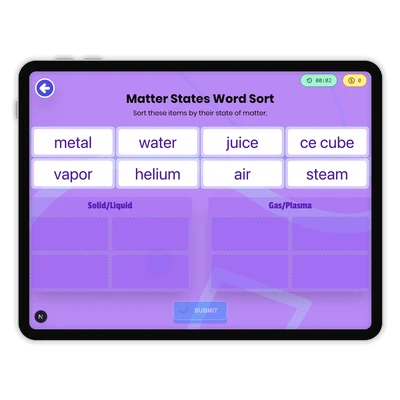
Matter States Word Sort
This interactive word sort focuses on helping students understand the different states of matter through real-world exam...
PS1.A
The Idea of the Atom
This informational science passage introduces middle school students (grades 6-8) to the concept that all matter is made...
MS-PS1-1
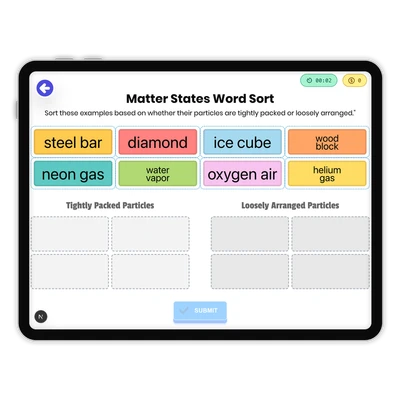
Matter States Word Sort
This classification activity helps students understand how particles are arranged in different states of matter. Student...
5-PS1-1
What Is Density?
This comprehensive science passage introduces middle school students (grades 6-8) to the concept of density, aligned wit...
MS-PS1-1
What Is Earth Science?
This engaging middle school science passage introduces students to the field of Earth science, aligning with NGSS standa...
MS-ESS1MS-ESS2MS-ESS3SEP
Citizen Science and Ecological Monitoring
This engaging passage for grades 6-8 introduces the concept of citizen science and its critical role in ecological monit...