What Is The Asthenosphere Made Of?
Interactive passage with audio narration, comprehension questions, and printable PDF.
By completing this purchase you agree to our Terms of Use and Privacy Policy. Your subscription renews automatically until you cancel. You can cancel anytime from your account settings. All sales are final and non-refundable. Digital content is available for download in your account immediately upon purchase.
What's included
What Is The Asthenosphere Made Of? preview and details
About this printable What Is The Asthenosphere Made Of? science reading passage, NGSS-aligned (Grade 6)
Sample passage and quiz from What Is The Asthenosphere Made Of?
Reading passage and comprehension quiz preview
What Is The Asthenosphere Made Of?
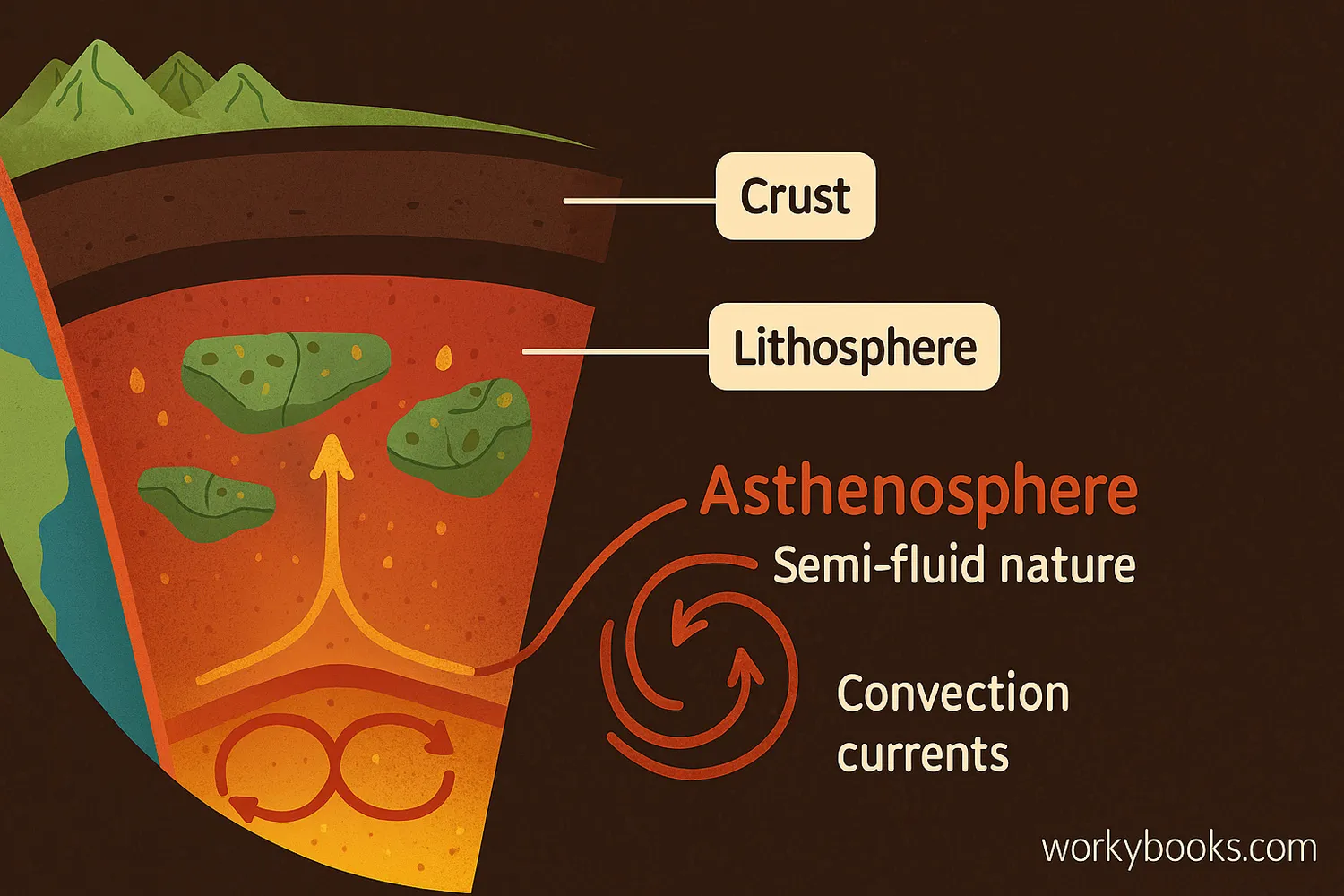
Have you ever wondered what's beneath your feet, deep inside our planet? Earth is made of several layers, much like an onion. The outermost layer we live on is called the crust. Below the crust is the mantle, which is the thickest layer. And within the mantle, there's a very special layer called the asthenosphere. Understanding the asthenosphere is key to understanding many Earth processes, like plate tectonics.
So, what exactly is the asthenosphere made of? It's primarily composed of solid rock, but here's the interesting part: this rock is extremely hot and under immense pressure. Because of these extreme conditions, the rock in the asthenosphere behaves differently than the rock in the crust. It's not completely liquid like magma, but it's not totally rigid and solid either. Scientists describe it as being plastic or 'semi-fluid.' Think of it like very thick, slowly flowing tar or playdough – it can move and deform over long periods.
The main material in the asthenosphere is a type of rock called peridotite, which is rich in minerals like olivine. While it's mostly solid, tiny pockets of molten rock, or magma, can exist within it, especially where temperatures are highest. This semi-fluid nature is incredibly important because it allows the rigid plates of the lithosphere (which includes the crust and the uppermost part of the mantle) to 'float' and move on top of it. This movement is what drives plate tectonics, leading to earthquakes, volcanic eruptions, and the formation of mountains.
The immense heat within the Earth causes slow-moving currents within the asthenosphere, similar to how water boils in a pot. These are called convection currents. Hotter, less dense material rises, while cooler, denser material sinks. These currents are the primary engine for the movement of Earth's tectonic plates. Therefore, the asthenosphere's unique composition and properties are fundamental to the continuous cycling of Earth's materials.
Interesting Fact: The word "asthenosphere" comes from the Greek words "asthenēs" meaning "weak" and "sphaira" meaning "sphere," perfectly describing its less rigid nature compared to the lithosphere.
Comprehension quiz (10 questions)
1. What is the outermost layer of Earth called?
2. Which layer is the thickest?
3. The asthenosphere is completely liquid like magma.
4. Which word describes the asthenosphere's rock behavior?
5. What drives the movement of tectonic plates?
6. What is the primary material of the asthenosphere?
7. If the asthenosphere suddenly became completely solid, what might happen?
8. What does the 'plastic' nature of the asthenosphere allow?
9. Why is the asthenosphere important for Earth's materials cycling?
10. Which term means the movement of Earth's plates?
Perfect for the way you teach
- Build comprehension skills
- Auto-graded quiz
- Differentiated reading
- Read together at home
- Improve fluency
- Quiet reading time
- Reading curriculum support
- Independent practice
- Track Lexile growth