What is the Coriolis Effect — Reading Comprehension
Rate this
Premium Resource
Present
Present in classroom. No work saved
Assign
Classroom with student accounts, Track progress
Quick Play
No student accounts, assign with a link
Grades
3
4
5
6
7
8
PRINT+DIGITAL RESOURCE
This learning resource is available in interactive and printable formats. The interactive worksheet can be played online and assigned to students. The Printable PDF version can be downloaded and printed for completion by hand.
This science reading passage for middle school students explains the concept of the Coriolis effect, a key phenomenon resulting from Earth's rotation. The content is structured to align with NGSS standards related to Earth and Space Science (ESS). It provides clear explanations of how the planet's rotation causes objects like air and water to deflect, creating large-scale patterns in weather systems and ocean currents. The passage details the difference in deflection between the Northern and Southern Hemispheres, making the concept easy to understand. It connects the scientific principle to real-world examples, such as the rotation of hurricanes and the formation of ocean gyres, reinforcing the relevance of the topic. The passage is designed for self-study, using a direct and informative tone while incorporating key vocabulary. It aims to build a foundational understanding of this important meteorological and oceanic principle.
CONTENT PREVIEW
Expand content preview
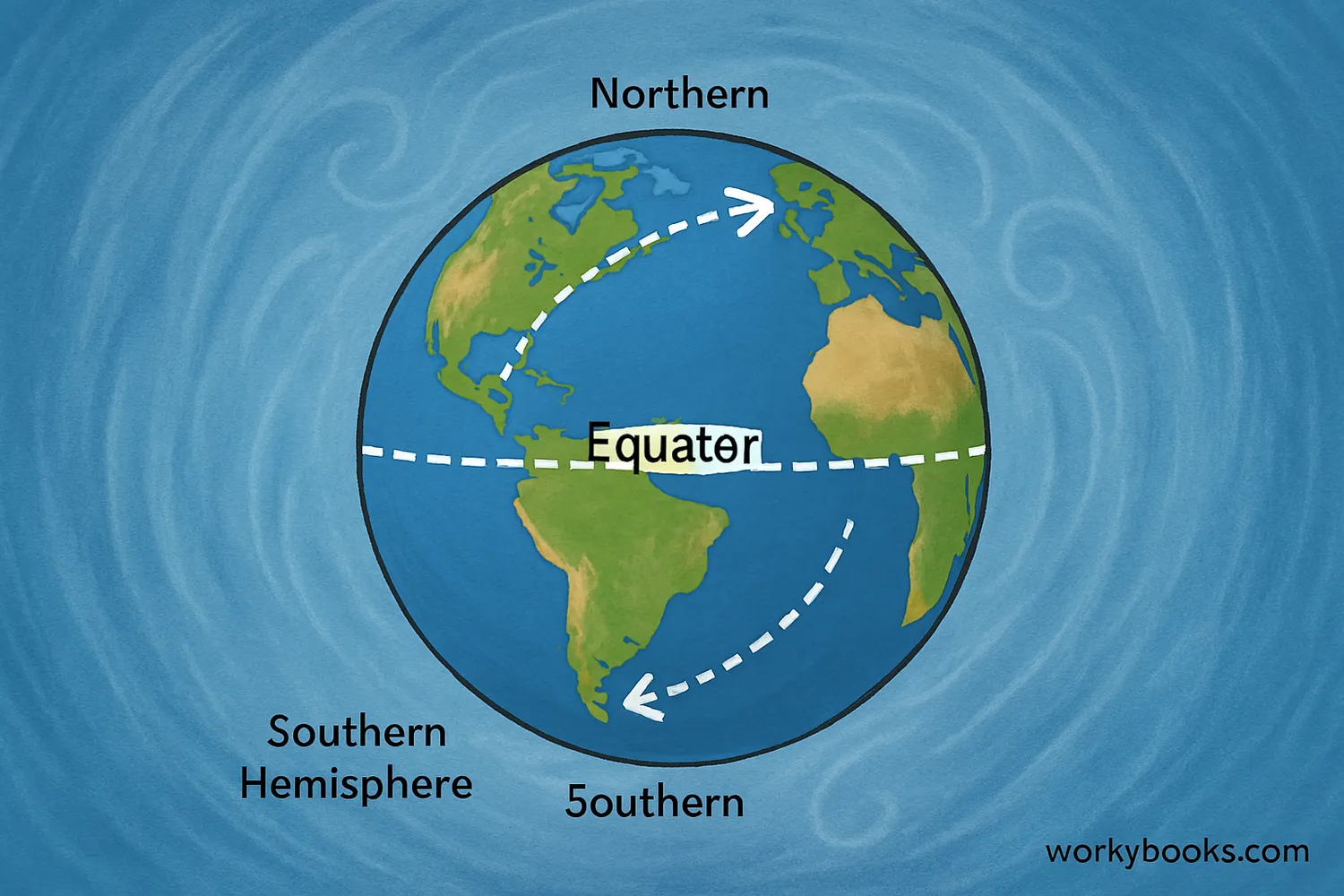
the Coriolis effect deflects the path of moving objects, such as air and ocean currents, to the right in the Northern Hemisphere and to the left in the Southern Hemisphere due to Earth's rotation.
The Coriolis effect is a phenomenon that describes the apparent deflection of moving objects, like air and water, when they travel over long distances on Earth. This effect isn't a true force but rather a result of our planet's rotation. Because the Earth is a sphere that rotates, different latitudes travel at different speeds. The equator moves fastest, covering a greater distance in a 24-hour day, while locations closer to the poles move much more slowly. This difference in rotational speed causes objects moving freely across the surface to appear to curve from our perspective on the ground.
In the Northern Hemisphere, the Coriolis effect causes objects moving long distances to deflect to the right. This deflection is a key factor in the formation of large-scale weather systems. For example, air moving toward a low-pressure area is not able to travel in a straight line. Instead, it is bent to the right, causing it to circulate counterclockwise around the low-pressure center. This is why hurricanes and other cyclones spin counterclockwise north of the equator.
Conversely, in the Southern Hemisphere, the deflection is to the left. Air flowing into a low-pressure system in the Southern Hemisphere is deflected to the left, which causes the storm to spin clockwise. This same principle applies to ocean currents, which form massive, rotating systems called gyres. The Coriolis effect is what makes these gyres circulate clockwise in the Northern Hemisphere and counterclockwise in the Southern Hemisphere, playing a vital role in global heat distribution.
Understanding the Coriolis effect is crucial for fields like meteorology and navigation. Without accounting for it, a long-distance missile or an airplane's flight path would miss its target. The effect is most pronounced near the poles and becomes weaker as you approach the equator, where it is virtually nonexistent.
Fun Fact: The Coriolis effect is too weak to influence small-scale events like the direction water drains in a sink or toilet. This common myth is often disproven by the simple forces of the plumbing itself.
What is the main cause of the Coriolis effect?
Earth's magnetic fieldThe force of gravityEarth's rotationChanges in air pressure
In the Northern Hemisphere, which direction does the Coriolis effect deflect moving objects?
To the rightTo the leftStraight aheadBackwards
How does the rotational speed of Earth's surface differ at various latitudes?
It's fastest at the poles.It's fastest at the equator.It's the same everywhere.It changes with the seasons.
How does the Coriolis effect influence hurricanes in the Northern Hemisphere?
It makes them spin clockwise.It makes them spin counterclockwise.It causes them to move in a straight line.It has no effect on them.
Where on Earth is the Coriolis effect most pronounced?
At the equatorAt the polesIn the middle latitudesNear mountain ranges
Based on the passage, what would likely happen to an ocean current flowing from the equator toward the South Pole?
It would be deflected to the right.It would be deflected to the left.It would not be affected.It would speed up.
The primary purpose of the reading passage is to:
Debunk a common science myth about toilets.Explain the concept of different rotational speeds.Provide a detailed explanation of the Coriolis effect.Describe how weather systems are formed.
Why is it important for pilots and missile engineers to account for the Coriolis effect?
To ensure fuel efficiency.To predict changes in climate.To adjust for changes in gravity.To accurately reach a long-distance target.
Perfect For:
👩🏫 Teachers
• Reading comprehension practice
• Auto-graded assessments
• Literacy skill development
👨👩👧👦 Parents
• Reading practice at home
• Comprehension improvement
• Educational reading time
🏠 Homeschoolers
• Reading curriculum support
• Independent reading practice
• Progress monitoring
Reading Features:
📖
Reading Passage
Engaging fiction or nonfiction text
❓
Comprehension Quiz
Auto-graded questions
📊
Instant Feedback
Immediate results and scoring
📄
Printable Version
Download for offline reading
🔊
Read Aloud
Voice-over with word highlighting
Reviews & Ratings
No reviews yet. Be the first to share your experience!
Related Content
Climate and weather activity
This worksheet is perfect for understanding the differences between climate and weather. Students will read the phrases ...
Climate and Weather — Distinguishing Characterstics
This worksheet highlights the differences between climate and weather. The chart format makes comparing and contrasting ...
Comparing Weather and Climate Texts
This reading comprehension worksheet has 5th graders read two informational texts about Weather and Climate. Students th...
RI.5.9
Tools and Technology in Earth Science
This middle school science reading passage explores the wide range of tools and technologies used in Earth science, from...
MS-ESS2-2MS-ESS3-2MS-ETS1-1MS-PS4-3
What Is Space Weather and How Does It Affect the Earth?
This NGSS-aligned science passage for middle school explains what space weather is and how it affects Earth. Students le...
MS-ESS2-2
What Is Earth Science?
This engaging middle school science passage introduces students to the field of Earth science, aligning with NGSS standa...
MS-ESS1MS-ESS2MS-ESS3SEP
Extreme Weather and Climate Change
This Grade 6-8 science passage, aligned to NGSS standards, explores the impact of climate change on extreme weather even...
What Is The Difference Between Climate Model And Weather Model?
This reading passage delves into the fundamental differences between weather models and climate models, explaining their...
Scientific Inquiry in Earth Science
This passage explores scientific inquiry in Earth science for grades 6-8, aligned with NGSS standards MS-ESS1-4, MS-ESS2...
MS-ESS1-4MS-ESS2-1MS-ESS3-5SEP
Earth's Major Climate Zones Explained
This engaging science passage for grades 6-8 explains Earth's major climate zones, including tropical, temperate, and po...
Climate Through Earth's History
This engaging passage for grades 6-8 explores how Earth's climate has naturally changed over millions of years, highligh...
MS-ESS1-4MS-ESS2-6
Earth: Our Home in Space
This engaging Grade 4-5 science passage, aligned to NGSS, introduces students to Earth's special place in the solar syst...
Weather vs. Climate
This comprehensive passage for grades 6-8 explores the difference between weather and climate, aligning with NGSS standa...
MS-ESS2-6
How is Climate Different from Weather?
This passage distinguishes climate from weather for young readers. It defines climate as the usual weather patterns over...
RI.3.1RI.4.14.ESS2.D
Air Masses and Weather
This audio-integrated passage, "Air Masses and Weather," is designed for 6th-grade students to understand how the moveme...
Antarctica Climate
This engaging science passage for grades 6-8 explores Antarctica, the coldest climate zone on Earth. Students will learn...
Climate Zones Word Sort
This word sort activity helps students understand different climate zones through real-world locations. Students classif...
How Climate Change Affects Weather
This middle school science passage explores how and why weather patterns are changing globally. Students will learn abou...
MS-ESS3-5
Polar Bears and Climate
This informational text on polar bears is a great way to practice reading comprehension. Students will read the passage ...
RI.4.1W.4.72-LS4-1RF.4.4
Escape Velocity and Space Travel
This middle school science passage introduces students to the concept of escape velocity—the minimum speed required to b...