What Is The Difference Between An Aerosol And Water Vapor?
Interactive passage with audio narration, comprehension questions, and printable PDF.
By completing this purchase you agree to our Terms of Use and Privacy Policy. Your subscription renews automatically until you cancel. You can cancel anytime from your account settings. All sales are final and non-refundable. Digital content is available for download in your account immediately upon purchase.
What's included
What Is The Difference Between An Aerosol And Water Vapor? preview and details
About this printable What Is The Difference Between An Aerosol And Water Vapor? science reading passage, NGSS-aligned (Grade 6)
Sample passage and quiz from What Is The Difference Between An Aerosol And Water Vapor?
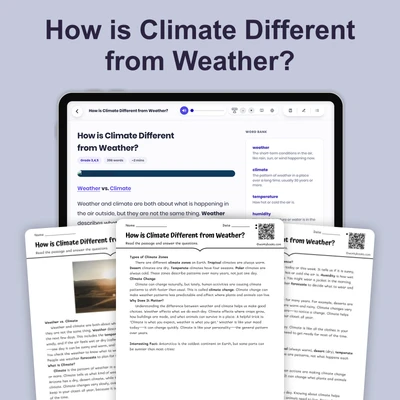
Reading passage and comprehension quiz preview
What Is The Difference Between An Aerosol And Water Vapor?
Imagine tiny invisible particles floating all around us, influencing the weather and even the air we breathe. These aren't just one type of thing; our atmosphere is a complex mix! Two important components, often confused, are aerosols and water vapor. While both are found in the air, they are quite different and play unique roles in Earth's climate system.
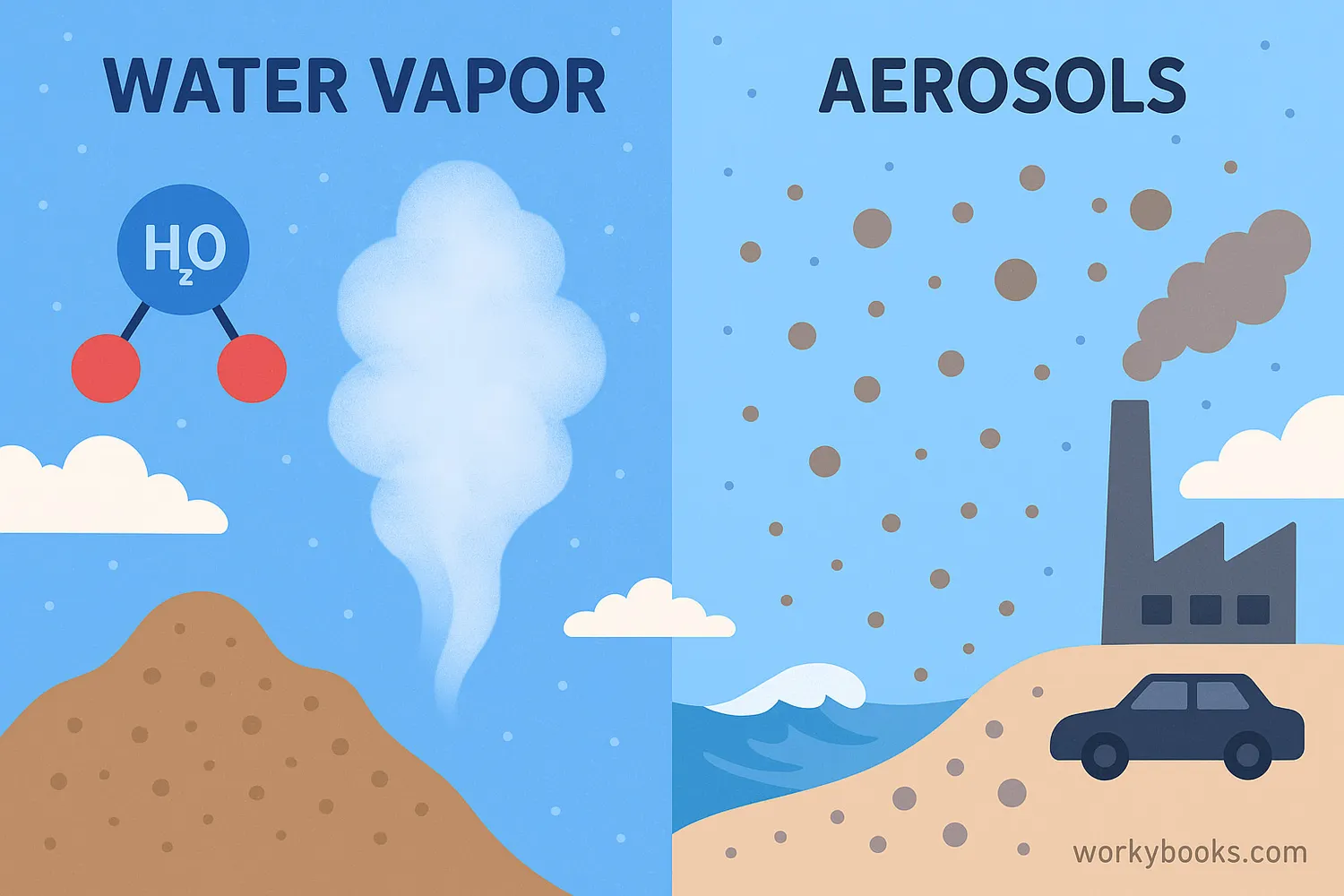
Let's start with water vapor. This is simply water in its gaseous form. Think about a pot of boiling water; the steam you see rising is mostly water vapor, along with tiny liquid water droplets. Water vapor is invisible and is a natural part of our atmosphere, created when water from oceans, lakes, and rivers evaporates. It is a powerful greenhouse gas, meaning it traps heat in the atmosphere, helping to warm our planet. Without water vapor, Earth would be a frozen, uninhabitable place. It's also essential for the water cycle, forming clouds and eventually rain or snow. The amount of water vapor in the air changes constantly, depending on temperature and humidity.
Now, let's look at aerosols. Unlike water vapor, aerosols are not gases. They are tiny solid particles or liquid droplets suspended in a gas, like air. These particles can come from natural sources, such as dust from deserts, sea salt from ocean spray, or smoke from wildfires and volcanoes. Humans also produce aerosols through activities like burning fossil fuels in cars and factories, leading to air pollution. Examples include soot, sulfates, and nitrates. Aerosols are much larger than individual water vapor molecules, though still too small to see with the naked eye.
The main difference lies in their state of matter and how they behave. Water vapor is a pure gas, a single molecule of H2O. Aerosols are collections of different molecules, either solid or liquid, suspended within a gas. Water vapor is always present naturally, trapping heat. Aerosols can either reflect sunlight back into space, causing a cooling effect, or absorb sunlight, causing a warming effect, depending on their type and color. Some aerosols also act as seeds for cloud formation, which can further influence temperature. Understanding the difference between these two atmospheric components is crucial for studying climate change and global warming, as both play a part in how Earth's temperature changes over time.
Interesting Fact: Some volcanic eruptions release massive amounts of aerosols high into the atmosphere, which can temporarily cool the Earth's surface for several years by reflecting sunlight.
Comprehension quiz (10 questions)
1. What is water vapor?
2. Which is a natural source of aerosols?
3. Which statement is true?
4. What effect does water vapor have?
5. How do human activities create aerosols?
6. What distinguishes aerosols from water vapor?
7. What is the primary role of water vapor?
8. Why is studying both important?
9. If a factory releases smoke, what would it produce?
10. Which term means 'water as a gas'?
Perfect for the way you teach
- Build comprehension skills
- Auto-graded quiz
- Differentiated reading
- Read together at home
- Improve fluency
- Quiet reading time
- Reading curriculum support
- Independent practice
- Track Lexile growth