What Is The Difference Between Glacial Ice And Regular Ice? — Reading Comprehension
Rate this
Premium Resource
Present
Present in classroom. No work saved
Assign
Classroom with student accounts, Track progress
Quick Play
No student accounts, assign with a link
Grades
6
PRINT+DIGITAL RESOURCE
This learning resource is available in interactive and printable formats. The interactive worksheet can be played online and assigned to students. The Printable PDF version can be downloaded and printed for completion by hand.
This audio-integrated reading passage, titled 'What Is The Difference Between Glacial Ice And Regular Ice?', is designed for Grade 6 students. It explores the fascinating differences between these two types of ice, focusing on their formation, density, and appearance. Students will learn about the immense pressure involved in forming glacial ice, the presence of air bubbles in regular ice, and how these factors contribute to their distinct characteristics. The passage aligns with NGSS standard MS-ESS2-2, which focuses on understanding how geoscience processes change Earth’s surface. Key concepts like 'glaciers', 'density', and 'compression' are explained in simple terms. This resource aims to enhance scientific literacy and introduce students to concepts related to Earth's dynamic surface.
CONTENT PREVIEW
Expand content preview
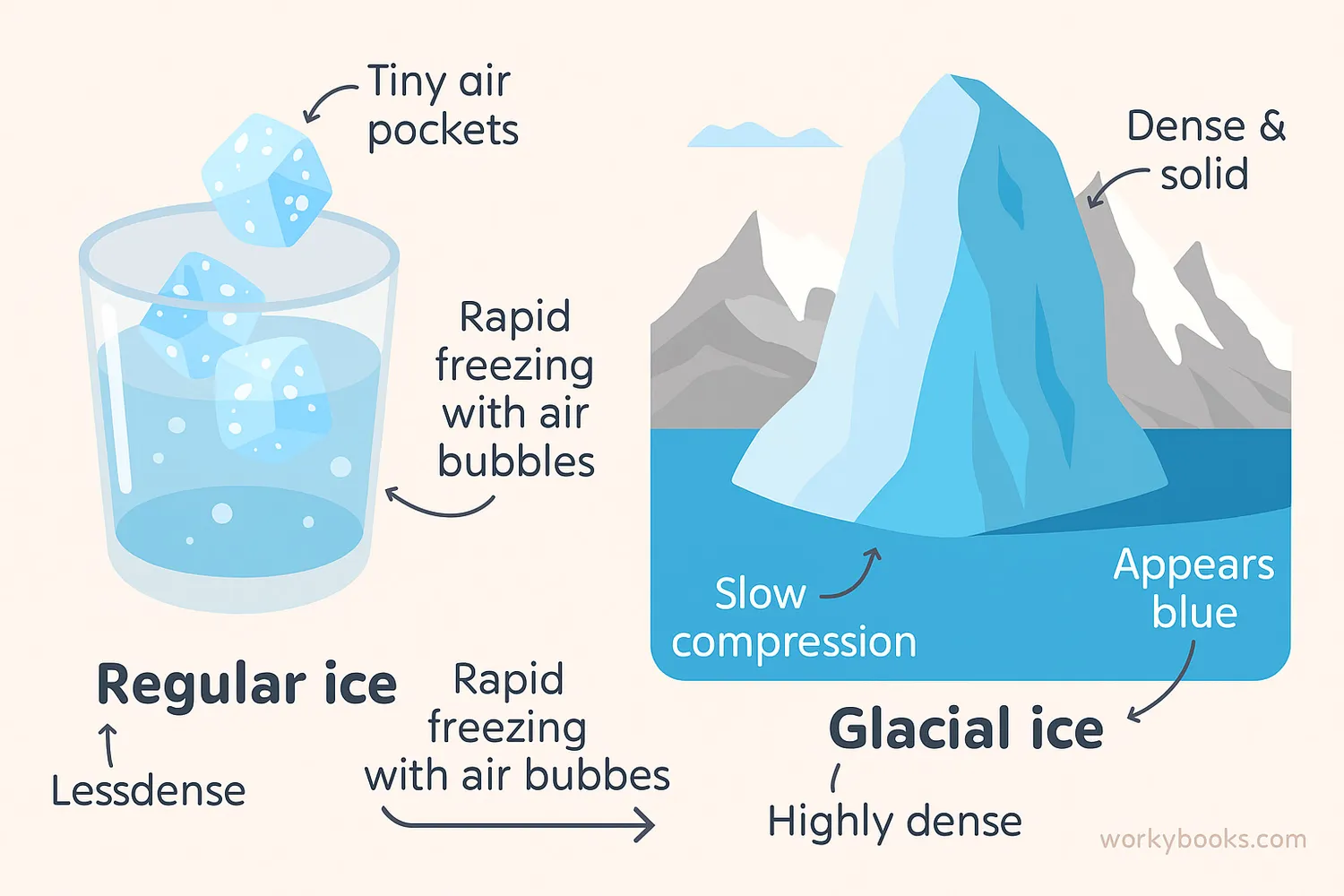
Regular ice vs. glacial ice: formation, density, and visual differences explained for students.
When you put ice cubes in a drink, you're seeing regular ice. But high up in mountains or near the Earth's poles, there's another kind of ice called glacial ice. Both are made of frozen water, but they are very different! Understanding these differences helps us learn about Earth's changing surface.
Regular ice forms when water freezes quickly, like in your freezer. This rapid freezing traps tiny air bubbles inside, making regular ice look cloudy or white. If you look closely at an ice cube, you might see these bubbles. Regular ice is less dense than glacial ice because of these trapped air pockets.
Glacial ice forms in a much slower and more powerful way. It begins as snow that falls and accumulates year after year in cold regions. As more snow piles up, the weight of the new snow presses down on the older layers below. This intense pressure causes the snow crystals to change shape and pack together very tightly. Over hundreds or even thousands of years, this compression pushes out most of the air between the snow crystals, turning them into dense, solid ice.
Because glacial ice has very few air bubbles, it looks different. It often appears blue! This blue color is because when sunlight hits the very dense ice, the ice absorbs red light and reflects blue light. This makes glaciers look incredibly beautiful. Glaciers are massive rivers of ice that slowly move, carving out valleys and shaping Earth's landscape over long periods. They are a major part of Earth's geoscience processes, constantly changing the surface.
Another key difference is density. Glacial ice is much denser than regular ice. Imagine comparing a fluffy snowball (new snow) to a hard, packed snowball (older snow, on its way to becoming glacial ice). The glacial ice is much heavier for its size. This high density allows glacial ice to resist melting for longer and makes it incredibly strong. Studying glaciers helps scientists understand past climates and predict future changes to our planet, including the impact of climate change on these vast ice formations.
Interesting Fact: Some glacial ice can be so old that it contains air bubbles from thousands of years ago, giving scientists clues about Earth's ancient atmosphere!
What makes regular ice look cloudy?
Trapped air bubblesDust particlesBlue colorFast melting
What is glacial ice made from?
Frozen rainCompressed snowSea waterMelted rocks
Glacial ice typically appears blue because it reflects blue light.
TrueFalse
Which type of ice forms faster?
Glacial iceRegular iceBoth same speedDepends on location
What process causes snow to turn into glacial ice?
EvaporationCondensationCompressionSublimation
Why is glacial ice denser than regular ice?
More mineralsLess air trappedFaster freezingMade of saltwater
If you had a block of regular ice and a block of glacial ice of the same size, which would feel heavier?
Regular iceGlacial iceThey would be sameDepends on temperature
The word 'compression' means:
To heat somethingTo break apartTo press togetherTo melt quickly
Which type of ice is more likely to show distinct layers from different snowfalls?
Regular iceGlacial iceBoth typesNeither type
Which of these is a 'geoscience process' mentioned in the passage?
Making ice cubesGlaciers carving valleysBoiling waterPutting snow in a freezer
Perfect For:
👩🏫 Teachers
• Reading comprehension practice
• Auto-graded assessments
• Literacy skill development
👨👩👧👦 Parents
• Reading practice at home
• Comprehension improvement
• Educational reading time
🏠 Homeschoolers
• Reading curriculum support
• Independent reading practice
• Progress monitoring
Reading Features:
📖
Reading Passage
Engaging fiction or nonfiction text
❓
Comprehension Quiz
Auto-graded questions
📊
Instant Feedback
Immediate results and scoring
📄
Printable Version
Download for offline reading
🔊
Read Aloud
Voice-over with word highlighting
Reviews & Ratings
No reviews yet. Be the first to share your experience!
Related Content
Tools and Technology in Earth Science
This middle school science reading passage explores the wide range of tools and technologies used in Earth science, from...
MS-ESS2-2MS-ESS3-2MS-ETS1-1MS-PS4-3
Scientific Inquiry in Earth Science
This passage explores scientific inquiry in Earth science for grades 6-8, aligned with NGSS standards MS-ESS1-4, MS-ESS2...
MS-ESS1-4MS-ESS2-1MS-ESS3-5SEP
What Is Earth Science?
This engaging middle school science passage introduces students to the field of Earth science, aligning with NGSS standa...
MS-ESS1MS-ESS2MS-ESS3SEP
Earth: Our Home in Space
This engaging Grade 4-5 science passage, aligned to NGSS, introduces students to Earth's special place in the solar syst...
Earth's Spheres
This middle school science passage introduces students to Earth's four major spheres: the geosphere, hydrosphere, atmosp...
MS-ESS2-4MS-ESS2-6
What Is Space Weather and How Does It Affect the Earth?
This NGSS-aligned science passage for middle school explains what space weather is and how it affects Earth. Students le...
MS-ESS2-2
Earth's Energy Balance
This engaging, NGSS-aligned science passage for grades 6–8 explores Earth's energy balance, a key process that keeps our...
MS-ESS2-6
Earth's Rotation
This middle school science passage, aligned with NGSS standard MS-ESS1-1, focuses on Earth's rotation—how Earth spins on...
MS-ESS1-1
Earth's Land and Water
This 250-word reading passage introduces fourth-grade students to the fundamental concept of how land and water are dist...
NGSS 4-ESS2-2ESS2.B
Earth's Interior
This comprehensive passage for grades 6-8 explores Earth's layered interior, including the crust, mantle, outer core, an...
MS-ESS2-1MS-ESS2-2
Facts About Earth
This engaging science reading passage introduces Grade 4 and 5 students to Earth, our home planet. Aligned with NGSS sta...
Meteorite Impacts on Earth
This engaging science reading passage for Grades 4-5 explores meteorite impacts on Earth, aligning with NGSS standards. ...
Venus: Earth's Twin?
This comprehensive science passage for grades 6-8 examines Venus—often called Earth's twin—by exploring its similarities...
MS-ESS1-2MS-ESS1-3
Earth Changes Over Millions of Years
This engaging, audio-integrated science passage for Grade 4-5 students explores how Earth has changed over millions of y...
Volcano Patterns on Earth
This Grade 4 science reading passage introduces students to volcano patterns on Earth, aligned with NGSS standard 4-ESS2...
NGSS 4-ESS2-2
Earth's Moon Facts
This engaging science passage, 'The Moon: Earth's Companion,' is designed for Grade 4-5 students and aligns with NGSS ge...
Earth's Quick and Slow Changes
In 'Earth's Quick and Slow Changes,' students categorize 12 Earth events by their speed of occurrence, enhancing underst...
Earth: Our Home Planet
This comprehensive science passage for grades 6-8 explores Earth’s unique characteristics and the interconnected systems...
MS-ESS1-2
Earth's Revolution
This middle school science passage explores the science behind Earth's revolution around the Sun, closely aligned with N...
MS-ESS1-1
Earthquake Patterns on Earth
This engaging 250-word reading passage introduces fourth-grade students to earthquake patterns on Earth, aligned with NG...