What Is The Difference Between Global Temperature And Local Temperature? — Reading Comprehension
Rate this
Premium Resource
Present
Present in classroom. No work saved
Assign
Classroom with student accounts, Track progress
Quick Play
No student accounts, assign with a link
Grades
6
PRINT+DIGITAL RESOURCE
This learning resource is available in interactive and printable formats. The interactive worksheet can be played online and assigned to students. The Printable PDF version can be downloaded and printed for completion by hand.
This engaging and audio-integrated reading passage, titled 'What Is The Difference Between Global Temperature And Local Temperature?', is designed for Grade 6 students. It explores the critical distinction between global and local temperature, fundamental concepts in understanding climate change. The passage defines key terms like 'weather,' 'climate,' 'greenhouse gases,' and 'global warming,' using simple language. It aligns with NGSS standard MS-ESS3-5, prompting students to clarify evidence of factors causing the rise in global temperatures over the past century. Through clear explanations, students will learn how individual weather events differ from long-term climate patterns and the role human activities play in influencing Earth's overall temperature. This passage serves as a foundational resource for understanding environmental science.
CONTENT PREVIEW
Expand content preview
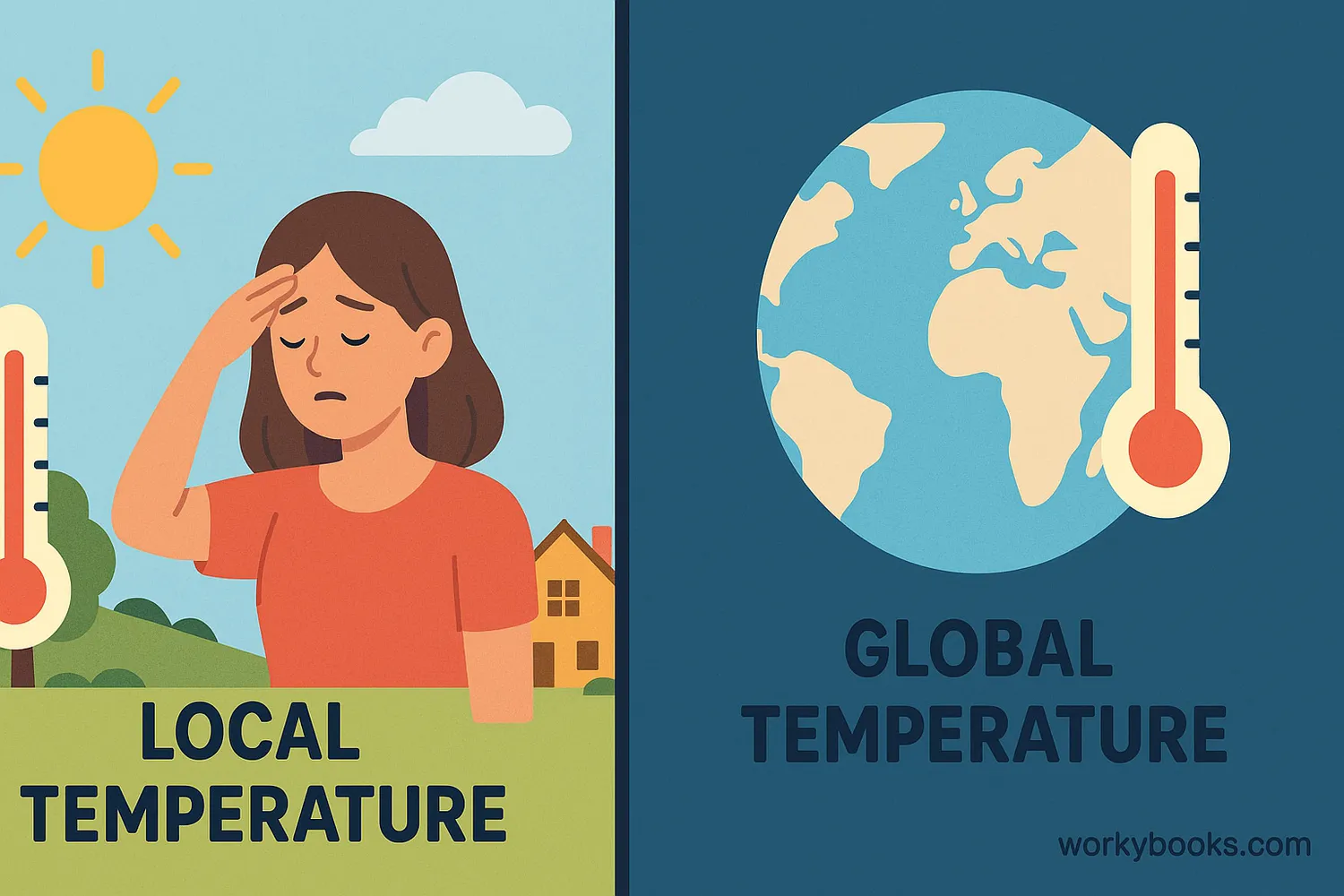
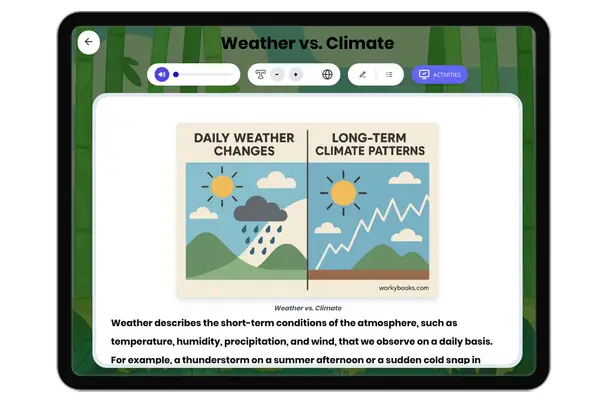
Local weather vs. global climate shown through daily scenes and Earth's long-term temperature trends.
Imagine stepping outside on a sunny day. The air feels warm, and you might think about the heat. But is that feeling of warmth connected to the planet's overall temperature? The answer is both yes and no, and understanding the difference between global temperature and local temperature is key to understanding our changing world.
Let's start with local temperature. This is what you experience every day. It's the temperature in your town, your state, or even your backyard. Local temperature changes constantly. It can be hot one day and cold the next, sunny in the morning and rainy in the afternoon. These short-term atmospheric conditions, including temperature, precipitation, and wind, are what we call weather. Weather patterns are influenced by many factors like the time of day, the season, and geographic features like mountains or oceans.
Now, think about global temperature. This isn't about one specific place on one specific day. Instead, it's the average temperature of the entire Earth over a long period, usually many years. Scientists calculate global temperature by gathering temperature readings from thousands of locations all over the world – land, oceans, and even the atmosphere. They then average these readings to get a single number that tells us how warm the planet is as a whole. This long-term average of weather patterns in a region is known as climate.
So, while a single cold day in your town doesn't mean global warming isn't happening, a long-term trend of rising average temperatures across the entire globe does. Global temperature is a much more stable and important indicator of long-term changes, like climate change. Human activities, such as burning fossil fuels, release greenhouse gases into the atmosphere. These gases trap heat, causing the Earth's average global temperature to rise, a phenomenon known as global warming. This sustained rise in global temperatures affects everything from sea levels to extreme weather events, which are distinct from everyday local weather fluctuations.
Interesting Fact: The warmest year on record for global average temperatures has occurred in the past decade, demonstrating a clear trend of global warming.
What is local temperature?
Temperature of your townAverage Earth temperatureOcean water temperatureTemperature of space
How do scientists calculate global temperature?
From one local readingAverage of worldwide readingsOnly ocean temperaturesJust atmosphere temperatures
Why is understanding global temperature important?
Predict tomorrow's weatherUnderstand long-term changesKnow current local conditionsMonitor daily rainfall
What is the primary difference between weather and climate?
LocationTime scaleHumidityWind speed
Which human activity is linked to global warming?
Planting treesBurning fossil fuelsRecycling plasticUsing solar panels
What do greenhouse gases do in the atmosphere?
Cool the EarthTrap heatProduce oxygenBlock sunlight
If your town has a colder-than-average winter, does it disprove global warming?
Yes, completelyNo, it's local weatherSometimesAlways disproves
The rise in global temperature affects sea levels. True or False?
TrueFalse
What term refers to the long-term average of weather patterns?
WeatherLocal temperatureClimateAtmosphere
Global warming describes what specific phenomenon?
Decrease in ocean levelsEarth's average temperature riseLocal weather changesIncreased sun activity
Perfect For:
👩🏫 Teachers
• Reading comprehension practice
• Auto-graded assessments
• Literacy skill development
👨👩👧👦 Parents
• Reading practice at home
• Comprehension improvement
• Educational reading time
🏠 Homeschoolers
• Reading curriculum support
• Independent reading practice
• Progress monitoring
Reading Features:
📖
Reading Passage
Engaging fiction or nonfiction text
❓
Comprehension Quiz
Auto-graded questions
📊
Instant Feedback
Immediate results and scoring
📄
Printable Version
Download for offline reading
🔊
Read Aloud
Voice-over with word highlighting
Reviews & Ratings
No reviews yet. Be the first to share your experience!
Related Content
Climate and weather activity
This worksheet is perfect for understanding the differences between climate and weather. Students will read the phrases ...
Climate and Weather — Distinguishing Characterstics
This worksheet highlights the differences between climate and weather. The chart format makes comparing and contrasting ...
Comparing Weather and Climate Texts
This reading comprehension worksheet has 5th graders read two informational texts about Weather and Climate. Students th...
RI.5.9
Tools and Technology in Earth Science
This middle school science reading passage explores the wide range of tools and technologies used in Earth science, from...
MS-ESS2-2MS-ESS3-2MS-ETS1-1MS-PS4-3
What Is Space Weather and How Does It Affect the Earth?
This NGSS-aligned science passage for middle school explains what space weather is and how it affects Earth. Students le...
MS-ESS2-2
What Is Earth Science?
This engaging middle school science passage introduces students to the field of Earth science, aligning with NGSS standa...
MS-ESS1MS-ESS2MS-ESS3SEP
Extreme Weather and Climate Change
This Grade 6-8 science passage, aligned to NGSS standards, explores the impact of climate change on extreme weather even...
What Is The Difference Between Climate Model And Weather Model?
This reading passage delves into the fundamental differences between weather models and climate models, explaining their...
Scientific Inquiry in Earth Science
This passage explores scientific inquiry in Earth science for grades 6-8, aligned with NGSS standards MS-ESS1-4, MS-ESS2...
MS-ESS1-4MS-ESS2-1MS-ESS3-5SEP
Earth's Major Climate Zones Explained
This engaging science passage for grades 6-8 explains Earth's major climate zones, including tropical, temperate, and po...
Climate Through Earth's History
This engaging passage for grades 6-8 explores how Earth's climate has naturally changed over millions of years, highligh...
MS-ESS1-4MS-ESS2-6
Earth: Our Home in Space
This engaging Grade 4-5 science passage, aligned to NGSS, introduces students to Earth's special place in the solar syst...
Weather vs. Climate
This comprehensive passage for grades 6-8 explores the difference between weather and climate, aligning with NGSS standa...
MS-ESS2-6
How is Climate Different from Weather?
This passage distinguishes climate from weather for young readers. It defines climate as the usual weather patterns over...
RI.3.1RI.4.14.ESS2.D
Air Masses and Weather
This audio-integrated passage, "Air Masses and Weather," is designed for 6th-grade students to understand how the moveme...
Antarctica Climate
This engaging science passage for grades 6-8 explores Antarctica, the coldest climate zone on Earth. Students will learn...
Climate Zones Word Sort
This word sort activity helps students understand different climate zones through real-world locations. Students classif...
How Climate Change Affects Weather
This middle school science passage explores how and why weather patterns are changing globally. Students will learn abou...
MS-ESS3-5
Polar Bears and Climate
This informational text on polar bears is a great way to practice reading comprehension. Students will read the passage ...
RI.4.1W.4.72-LS4-1RF.4.4
Escape Velocity and Space Travel
This middle school science passage introduces students to the concept of escape velocity—the minimum speed required to b...