Reading PassagePremium

Why Amphibians are Indicator Species for Ecosystem Health

Interactive passage with audio narration, comprehension questions, and printable PDF.

No ratings yet
Grade 6ScienceEnglish · SpanishInteractive · Printable
Just this resource
$1.50
One-time purchase
Best value
Unlock everything
$49.99$29.99/yr
40% off until Aug 1 — 10,000+ resources
Renews at $49.99/year.
Unlock above to use these actions

What's included

Reading passage
Audio narration
Comprehension quiz
Writing activity
Glossary & flashcards
Differentiated version
Spanish translation

Why Amphibians are Indicator Species for Ecosystem Health preview and details

About this printable Why Amphibians are Indicator Species for Ecosystem Health science reading passage, NGSS-aligned (Grade 6)

This audio-integrated reading passage explores the fascinating role of amphibians as indicator species, offering insights into why their health reflects the overall health of an ecosystem. Students will learn about the impact of environmental changes, such as pollution and climate change, on biodiversity and population stability, aligning with NGSS LS2.C: Ecosystem Dynamics. Key terms like 'indicator species,' 'biodiversity,' and 'habitat loss' are explained in simple language. The passage includes engaging activities, multiple-choice questions, and short answer questions to reinforce understanding of this vital ecological concept.
Written by Workybooks TeamPublished by Workybooks
Preview

Sample passage and quiz from Why Amphibians are Indicator Species for Ecosystem Health

Reading passage and comprehension quiz preview

Why Amphibians are Indicator Species for Ecosystem Health
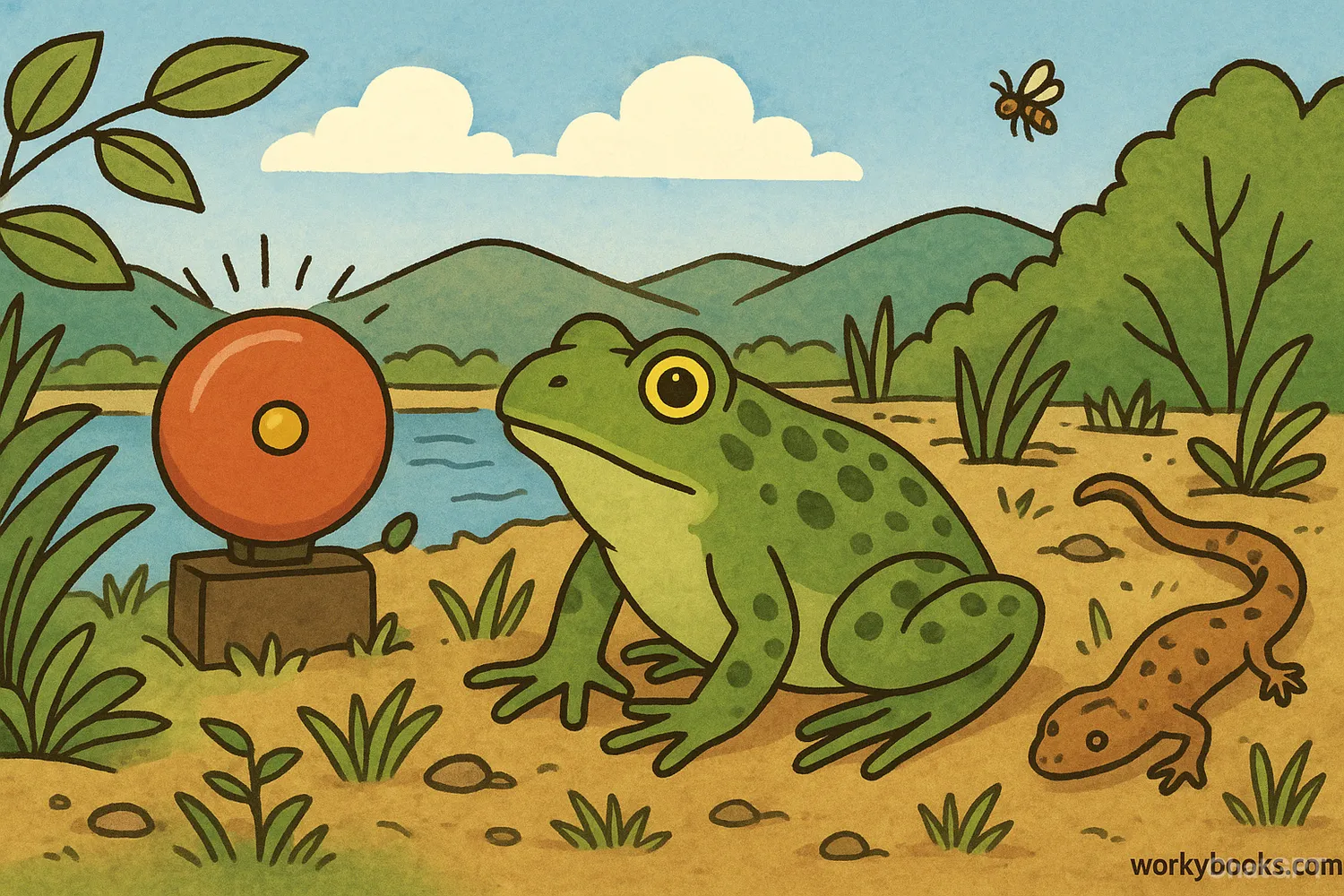
Frog and salamander near alarm bell in a natural landscape.
Amphibians act as nature’s alarm bells, warning us about environmental problems.

Imagine a tiny alarm bell ringing in our natural world, warning us when something is wrong. For many scientists, this alarm bell often takes the form of an amphibian. Amphibians, like frogs, toads, and salamanders, are incredibly important for understanding the health of our planet’s ecosystems. They are known as indicator species, which means their well-being tells us a lot about the condition of their environment.

One key reason amphibians are such good indicators is their unique skin. Unlike mammals or birds, amphibians have thin, moist skin that easily absorbs water and air. While this helps them breathe and stay hydrated, it also makes them very sensitive to changes in their surroundings. If there are pollutants in the water or air, amphibians are often the first to show signs of trouble, such as illness or reproductive problems. This sensitivity makes them like the 'canaries in the coal mine' of our natural world, providing early warnings.

Amphibians also spend parts of their lives in different habitats. Most begin as eggs in water, hatch into larvae (like tadpoles), and then transform into adults that can live on land, near water, or even in trees. This two-part life cycle means they are exposed to both aquatic and terrestrial environments. Therefore, they can indicate problems in both water quality and land quality. For example, if a frog population is shrinking, it could mean the water it breeds in is polluted, or its land habitat is being destroyed.

The loss of amphibians, or their population decline, is a serious concern for environmental scientists. When amphibian numbers drop, it often signals wider problems such as habitat loss, water pollution, climate change, and even new diseases. Since amphibians are a vital part of the food web, both as predators (eating insects) and prey (eaten by birds and snakes), their disappearance can throw an entire ecosystem out of balance. Protecting amphibian populations is not just about saving frogs; it's about safeguarding the health and biodiversity of all living things within an ecosystem.

Understanding why amphibians are indicator species helps us monitor the health of our planet. By paying attention to these sensitive creatures, we can learn more about the environmental challenges facing us and work towards creating healthier, more stable ecosystems for everyone. Conservation efforts focused on amphibians can have a ripple effect, benefiting many other species and their habitats.

Interesting Fact: Some amphibians, like the wood frog, can actually freeze solid during winter and then thaw out in the spring, good as new!

Comprehension quiz (10 questions)

1. Which of these is NOT an amphibian?

Frog
Toad
Salamander
Fish

2. Amphibians are called 'indicator species' because:

They indicate directions
They show ecosystem health
They point out food
They are brightly colored

3. Amphibians have thin, moist skin. True or False?

True
False

4. What does 'biodiversity' mean in the passage?

Different types of weather
Different kinds of life
Different types of rocks
Different types of water

5. Why does their skin make amphibians sensitive?

It keeps them warm
It absorbs substances
It helps them swim
It protects from sun

6. How do amphibians' two-part life cycles help them indicate problems?

They change colors
They live in two places
They eat two foods
They sing two songs

7. A shrinking frog population might signal:

More sunny days
Cleaner air quality
Environmental problems
Increased plant growth

8. What role do amphibians play in the food web?

Only predators
Only prey
Both predator and prey
They don't eat

9. If a river's frog population suddenly disappeared, what might happen to insects nearby?

They would also disappear
Their numbers might increase
They would move away
Nothing would change

10. What could be a possible cause of amphibian decline in a forest pond?

More rain
New park being built
Less sunlight
Decreased algae
Who it's for

Perfect for the way you teach

Teachers
  • Build comprehension skills
  • Auto-graded quiz
  • Differentiated reading
Parents
  • Read together at home
  • Improve fluency
  • Quiet reading time
Homeschoolers
  • Reading curriculum support
  • Independent practice
  • Track Lexile growth
Topics

Reviews & Ratings

No reviews yet. Be the first to share your experience!

More reading you might love

20 more
Passage
Understanding Biological Evolution and Diversity - reading educational content

Understanding Biological Evolution and Diversity

Reading Passage · RI.3.3

Free
Passage
Theory of Evolution  - reading educational content

Theory of Evolution

Reading Passage · MS-LS4-1

$1.50
Passage
The Nature of Life Science - reading educational content

The Nature of Life Science

Reading Passage · MS-LS1-1

$1.50
Passage
The Giant Isopod: Biological Evolution - reading educational content

The Giant Isopod: Biological Evolution

Reading Passage · MS-LS4-4

Free
Worksheet
Science Vocabulary - worksheet educational content

Science Vocabulary

Worksheet · L.3.6

$1.50
Passage
Evidence for Evolution: Comparative Anatomy - reading educational content

Evidence for Evolution: Comparative Anatomy

Reading Passage · MS-LS4-2

$1.50
Passage
Human Evolution - reading educational content

Human Evolution

Reading Passage · MS-LS4-1

$1.50
Worksheet
Simple Machines Science Report - worksheet educational content

Simple Machines Science Report

Worksheet · W.5.4

$1.50
Passage
Evidence for Evolution: The Fossil Record - reading educational content

Evidence for Evolution: The Fossil Record

Reading Passage · MS-LS4-1

$1.50
Passage
What is an amphibian - reading educational content

What is an amphibian

Reading Passage

$1.50
Passage
The Science of Hibernation - reading educational content

The Science of Hibernation

Reading Passage

$1.50
Worksheet
The Pumpkin Life Cycle - worksheet educational content

The Pumpkin Life Cycle

Worksheet · RI.2.3

$1.50
Passage
The Nature of Science - reading educational content

The Nature of Science

Reading Passage · MS-ETS1-4

$1.50
Passage
Citizen Science and Ecological Monitoring - reading educational content

Citizen Science and Ecological Monitoring

Reading Passage · MS-LS2-1

$1.50
Passage
Cryptobiosis: Pausing Life to Survive - reading educational content

Cryptobiosis: Pausing Life to Survive

Reading Passage

$1.50
Passage
What Is Earth Science? - reading educational content

What Is Earth Science?

Reading Passage · MS-ESS1

$1.50
Passage
Tools and Technology in Earth Science - reading educational content

Tools and Technology in Earth Science

Reading Passage · MS-ESS2-2

$1.50
Worksheet
Life Cycles - worksheet educational content

Life Cycles

Worksheet · RI.3.10

$1.50
Passage
History of Life on Earth - reading educational content

History of Life on Earth

Reading Passage · MS-ESS1-4

$1.50
Passage
How Anatomical Structures Provide Evidence for Evolution - reading educational content

How Anatomical Structures Provide Evidence for Evolution

Reading Passage

$1.50
Copyright © 2026 Workybooks. Made with ♥ in California.