Reading PassagePremium

Why Do Deserts Form Next To Tall Mountains?
Interactive passage with audio narration, comprehension questions, and printable PDF.

No ratings yet
Grade 6ScienceEnglish · SpanishInteractive · Printable
Just this resource
$1.50
One-time purchase
Best value
Unlock everything
$49.99$29.99/yr
40% off until Aug 1 — 10,000+ resources
Renews at $49.99/year.
Unlock above to use these actions

What's included

Reading passage
Audio narration
Comprehension quiz
Writing activity
Glossary & flashcards
Differentiated version
Spanish translation

Why Do Deserts Form Next To Tall Mountains? preview and details

About this printable Why Do Deserts Form Next To Tall Mountains? science reading passage, NGSS-aligned (Grade 6)

This engaging passage, 'Why Do Deserts Form Next To Tall Mountains?', delves into the fascinating phenomenon of the rain shadow effect. Students will learn how mountains influence weather patterns and climate, leading to the formation of dry, desert regions. Key concepts like **windward** and **leeward** sides, **moisture**, and **precipitation** are explained in simple language. The passage aligns with NGSS MS-ESS2-5, helping students understand how the motions and complex interactions of air masses result in changes in weather conditions. This educational content includes a reading passage, multiple-choice questions, short answer questions, and a glossary, all designed for Grade 6 students. All content is audio integrated for enhanced learning.
Written by Workybooks TeamPublished by Workybooks
Preview

Sample passage and quiz from Why Do Deserts Form Next To Tall Mountains?

Reading passage and comprehension quiz preview

Why Do Deserts Form Next To Tall Mountains?

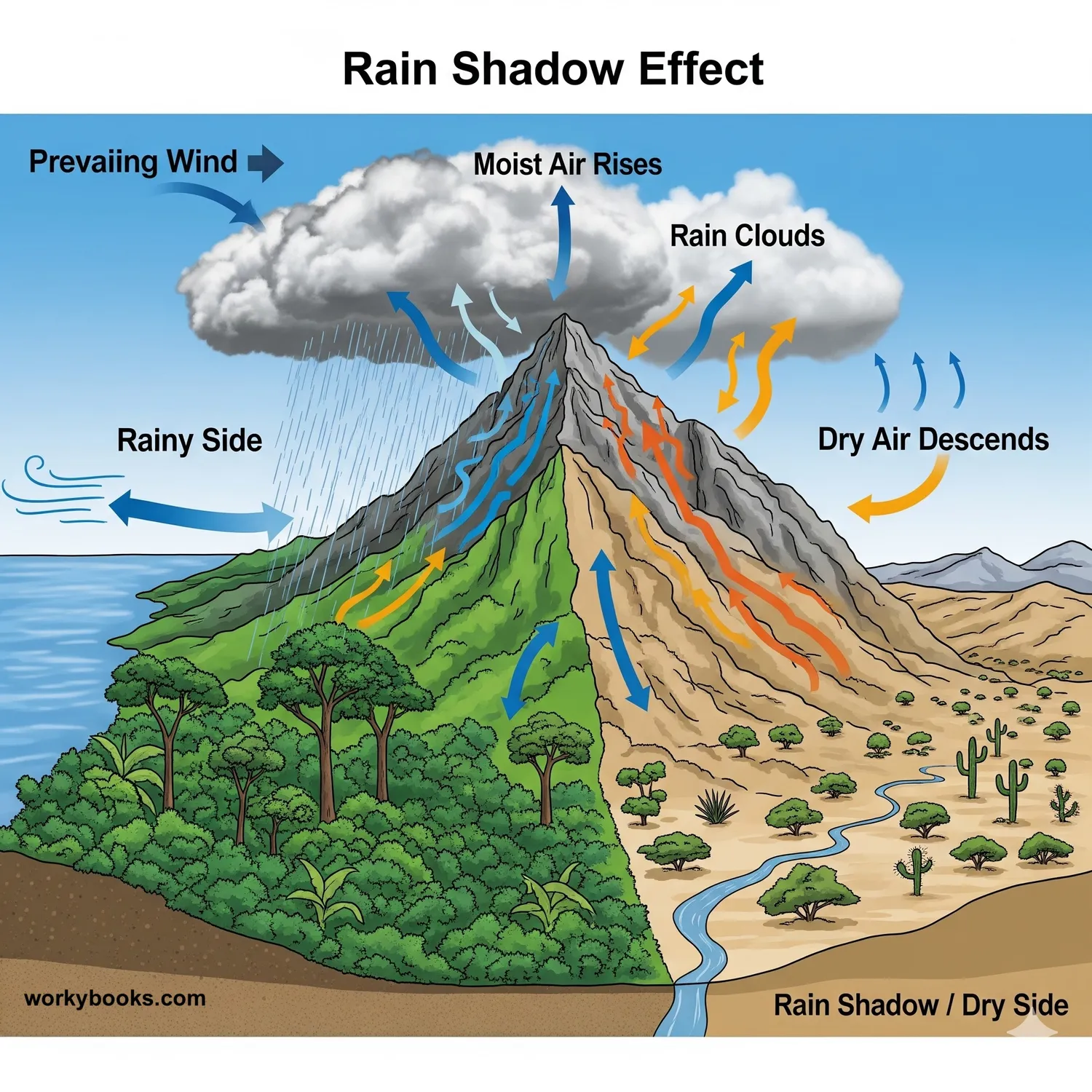
Diagram showing the rain shadow effect with a rainy side and a dry desert side.
Mountains create deserts through the rain shadow effect.

Have you ever wondered why some of the driest places on Earth, like deserts, are often found right next to very tall mountains? It seems strange, doesn't it? This interesting weather pattern is due to something called the rain shadow effect. Understanding this effect helps us see how mountains, air, and moisture interact to create different climates.

It all starts with air that holds a lot of moisture, like air coming from an ocean. When this moist air moves towards a tall mountain range, it's forced to rise. As the air rises, it gets cooler. Think about what happens when warm, moist air cools down – clouds form! This cooling causes the water vapor in the air to condense into tiny water droplets, forming clouds and leading to precipitation, which is rain or snow.

The side of the mountain that faces the incoming moist air is called the windward side. This side gets a lot of rain and is often lush and green. As the air continues to rise over the mountain, it loses most of its moisture through precipitation. By the time the air reaches the top of the mountain and starts to descend down the other side, it's much drier.

The side of the mountain away from the wind, where the dry air descends, is called the leeward side. As this dry air sinks, it warms up. Warm, dry air is not good for making rain. In fact, it tends to pull moisture out of the land, making the ground very dry. This is why the leeward side of mountains often has a dry climate and can become a desert. The Rocky Mountains in North America and the Andes Mountains in South America are great examples of places where you can see the rain shadow effect in action, creating nearby deserts.

So, the next time you see a desert next to a mountain, remember the rain shadow effect and how it changes the weather. It's a powerful example of how Earth's features create unique environments.

Interesting Fact: The Atacama Desert in Chile, one of the driest places on Earth, is located on the leeward side of the Andes Mountains.

Comprehension quiz (10 questions)

1. What is the main topic of the passage?

Ocean currents
Desert animals
Rain shadow effect
Mountain heights

2. Which side of the mountain receives a lot of rain?

Leeward side
Windward side
Top of mountain
Bottom of valley

3. What happens to moist air as it rises over a mountain?

It gets warmer
It gets cooler
It disappears
It speeds up

4. Why does the leeward side of a mountain become dry?

Air collects there
It gets more sun
Dry air descends
It has no plants

5. Deserts are usually found on the leeward side of mountains.

True
False

6. If a region has lush forests next to a mountain, what kind of air mass is likely hitting that side of the mountain?

Warm, dry air
Cold, dry air
Moist, rising air
Still, stagnant air

7. Which factor is most responsible for creating a desert climate on the leeward side?

Earthquakes
Dry, warming air
Tall trees
Ocean proximity

8. What would likely happen if a mountain range was much shorter?

More extreme cold
Less rain shadow
Larger deserts
Stronger winds

9. Imagine you are building a farm. If you want a lot of rain, which side of a mountain should you choose?

Leeward side
Windward side
On the peak
In a valley

10. What does 'precipitation' mean in the passage?

Sunlight
Wind speed
Rain or snow
Cloud height
Who it's for

Perfect for the way you teach

Teachers
  • Build comprehension skills
  • Auto-graded quiz
  • Differentiated reading
Parents
  • Read together at home
  • Improve fluency
  • Quiet reading time
Homeschoolers
  • Reading curriculum support
  • Independent practice
  • Track Lexile growth
Topics

Reviews & Ratings

No reviews yet. Be the first to share your experience!

More reading you might love

20 more
Worksheet
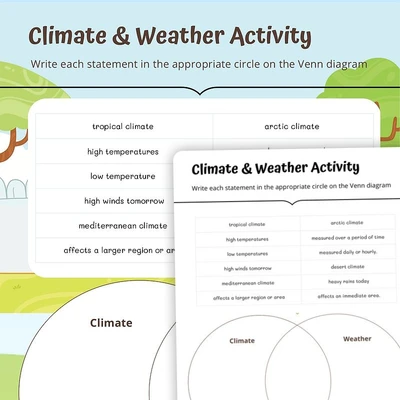
Climate and weather activity - worksheet educational content

Climate and weather activity

Worksheet

$1.50
Interactive
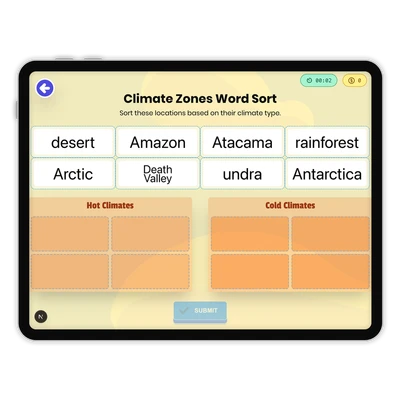
Climate Zones Word Sort - game educational content

Climate Zones Word Sort

Game

$1.50
Passage
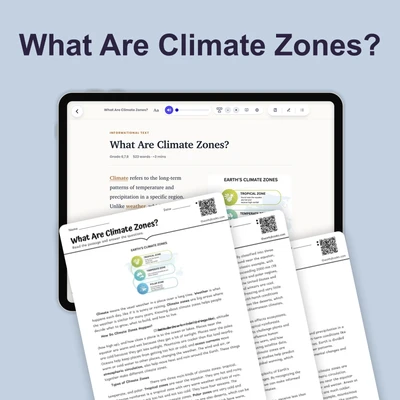
What Are Climate Zones - reading educational content

What Are Climate Zones

Reading Passage · MS-ESS2-6

$1.50
Passage
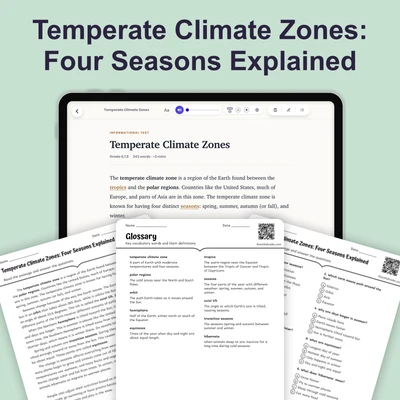
Temperate Climate Zones - reading educational content

Temperate Climate Zones

Reading Passage

$1.50
Worksheet
Climate and Weather — Distinguishing Characterstics - worksheet educational content

Climate and Weather — Distinguishing Characterstics

Worksheet

Free
Passage
How Latitude Affects Climate Zones - reading educational content

How Latitude Affects Climate Zones

Reading Passage

$1.50
Passage
How is Climate Different from Weather? - reading educational content

How is Climate Different from Weather?

Reading Passage · RI.3.1

Free
Passage
Polar Climate Zones: Arctic and Antarctic - reading educational content

Polar Climate Zones: Arctic and Antarctic

Reading Passage

$1.50
Passage
What Is Climate - reading educational content

What Is Climate

Reading Passage · MS-ESS2-6

$1.50
Passage
Understanding the Koppen Climate Classification System - reading educational content

Understanding the Koppen Climate Classification System

Reading Passage · MS-ESS2-6

$1.50
Worksheet
Comparing Weather and Climate Texts - worksheet educational content

Comparing Weather and Climate Texts

Worksheet · RI.5.9

Free
Interactive
Climate Characteristics Word Sort - game educational content

Climate Characteristics Word Sort

Game

$1.50
Passage
Antarctica Climate - reading educational content

Antarctica Climate

Reading Passage

$1.50
Passage
Mountains, Elevation, and Climate - reading educational content

Mountains, Elevation, and Climate

Reading Passage · MS-ESS2-6

$1.50
Passage
How Do Highland Climates Differ from Polar Climates? - reading educational content

How Do Highland Climates Differ from Polar Climates?

Reading Passage · MS-ESS2-6

$1.50
Passage
The Role of Ocean Currents in Climate Patterns - reading educational content

The Role of Ocean Currents in Climate Patterns

Reading Passage

$1.50
Worksheet
Color the Climate Zones - worksheet educational content

Color the Climate Zones

Worksheet · NGSS 3-ESS2-2

$1.50
Passage
Coastal vs. Inland Climate - reading educational content

Coastal vs. Inland Climate

Reading Passage

$1.50
Passage
Humid Continental Climate Countries - reading educational content

Humid Continental Climate Countries

Reading Passage · MS-ESS2-6

Free
Passage
Oceans and Climate Patterns - reading educational content

Oceans and Climate Patterns

Reading Passage · MS-ESS2-6

$1.50
Copyright © 2026 Workybooks. Made with ♥ in California.