This learning resource is available in interactive and printable formats. The interactive worksheet can be played online and assigned to students. The Printable PDF version can be downloaded and printed for completion by hand.
This Grade 4-5 science passage, 'Why Do Things Float? Understanding Buoyancy,' explores the scientific reasons behind floating and sinking. Students will learn about key concepts such as buoyancy, density, and displacement, all aligned with NGSS standards. The passage defines important vocabulary in bold and provides real-world examples, including boats and ice cubes. Activities include a multiple-choice quiz and writing prompts to deepen understanding and encourage scientific thinking. A Spanish translation and glossary are included to support diverse learners. This resource is ideal for classroom or home use, and is audio integrated for accessibility. Targeted at upper elementary, it helps students connect science to everyday life while building comprehension and critical thinking skills.
CONTENT PREVIEW
Expand content preview
Boats are a great real-world example of buoyancy.Image by TheOtherKev, Pixabay.
Density is a property that describes how heavy something is for its size. Some materials are heavy for their size, like a rock. Other materials are light for their size, like a foam pool noodle. Understanding density helps us predict whether objects will float or sink in water.
To understand density, we need to think about two things we already know: mass and volume. Mass is the amount of matter in an object. Volume is how much space an object takes up. When we compare an object's mass to its volume, we can figure out if it's heavy or light for its size. A bowling ball and a beach ball might have similar volumes, but the bowling ball has much more mass packed into that space. The bowling ball is heavy for its size, while the beach ball is light for its size.
Water has its own density. Objects that are lighter for their size than water will float. Objects that are heavier for their size than water will sink. Think about a wooden block and a metal coin. The wooden block floats because wood is light for its size compared to water. The metal coin sinks because metal is heavy for its size compared to water. Even though the coin is smaller, it has more mass packed into less space.
Here's a helpful way to think about it: imagine two boxes that are the same size. One box is filled with feathers, and the other is filled with rocks. The box with rocks is much heavier, even though both boxes take up the same amount of space. The rocks are packed more tightly together, making that box heavier for its size. This is similar to how density works with floating and sinking.
The size of an object doesn't always tell us if it will float. A large log floats because wood is light for its size. A tiny pebble sinks because rock is heavy for its size. What matters is whether the object is lighter or heavier for its size compared to water. This is why huge ships made of steel can float—they are designed with lots of empty space inside, making them light for their overall size.
Interesting Fact: The Dead Sea has water so dense that people float easily without even trying! The water contains so much salt that it becomes heavier for its size than regular water, making it easier for objects and people to float on top.
What is density?
How heavy something is for its sizeHow big something isHow much water something holdsHow fast something moves
What two things help us understand density?
Mass and volumeLength and widthColor and shapeSpeed and temperature
Why does a wooden block float?
It is light for its sizeIt is very smallIt is smoothIt is dry
What happens to objects heavier than water?
They sink to the bottomThey float on topThey stay in the middleThey disappear
Why can huge steel ships float?
They have empty space insideThey are made of woodThey are very smallThey use special paint
Which has more mass: bowling ball or beach ball?
Bowling ballBeach ballThey have the same massNeither has mass
Size always tells us if something will float.
TrueFalse
Volume means:
How much space something takes upHow loud something isHow fast something movesHow hot something is
Perfect For:
👩🏫 Teachers
• Reading comprehension practice
• Auto-graded assessments
• Literacy skill development
👨👩👧👦 Parents
• Reading practice at home
• Comprehension improvement
• Educational reading time
🏠 Homeschoolers
• Reading curriculum support
• Independent reading practice
• Progress monitoring
Reading Features:
📖
Reading Passage
Engaging fiction or nonfiction text
❓
Comprehension Quiz
Auto-graded questions
📊
Instant Feedback
Immediate results and scoring
📄
Printable Version
Download for offline reading
🔊
Read Aloud
Voice-over with word highlighting
Reviews & Ratings
No reviews yet. Be the first to share your experience!
Related Content
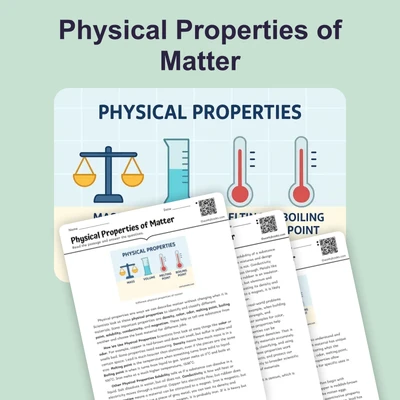
Physical Properties of Matter
This comprehensive reading passage introduces grades 6-8 students to the concept of physical properties of matter, perfe...
MS-PS1-1
Changes in Matter
This engaging science passage introduces Grade 4-5 students to the concept of how matter can change, meeting NGSS standa...
What Are Physical Changes?
This engaging Grade 4-5 science passage introduces students to the concept of physical changes in matter, aligning with ...
Kinetic Theory of Matter
This middle school science reading passage introduces students to the kinetic theory of matter, aligning with NGSS MS-PS...
MS-PS1-4
The Nature of Science
This passage explores the nature of science for middle school students, aligning with NGSS standards MS-ETS1-4, MS-PS1-1...
MS-ETS1-4MS-PS1-1MS-LS1-1
Particle Model of Matter
This comprehensive science reading passage for grades 6-8 explores the particle model of matter, aligning with NGSS stan...
MS-PS1-1MS-PS1-4
Evaporation as Physical Change
This middle school science passage examines the process of evaporation, a fundamental physical change where a liquid tur...
MS-PS1-4
Physical Changes: Deposition
This middle school science passage explores the concept of deposition, a type of physical change where matter transition...
MS-PS1-4
Sublimation as Physical Change
This educational passage for grades 6-8 explores the science of sublimation—a physical change where a solid transforms d...
MS-PS1-4
Physical Changes: Condensation
This middle school science passage explores the process of condensation, the physical change where a gas becomes a liqui...
MS-PS1-4
Is Evaporation a Physical Change
"This reading passage is designed for middle school students to explore the concept of evaporation and its classificatio...
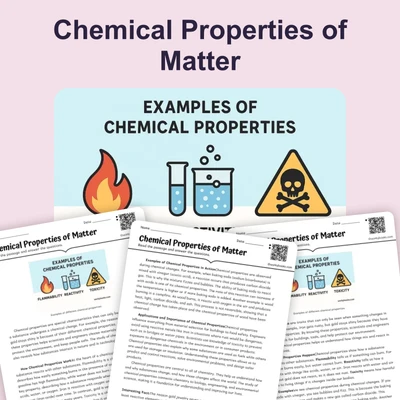
Chemical Properties of Matter
This engaging middle school science passage explores the chemical properties of matter, focusing on how these properties...
MS-PS1-2
Science Vocabulary
This worksheet on domain-specific words will help students learn some science vocabulary. Students will be asked to matc...
L.3.6L.3.4.A
Simple Machines Science Report
This science writing task requires students to clearly explain how three simple machines work using precise domain-speci...
W.5.4
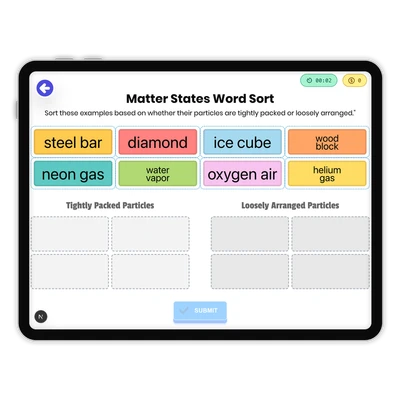
Matter States Word Sort
This interactive word sort focuses on helping students understand the different states of matter through real-world exam...
PS1.A
The Idea of the Atom
This informational science passage introduces middle school students (grades 6-8) to the concept that all matter is made...
MS-PS1-1
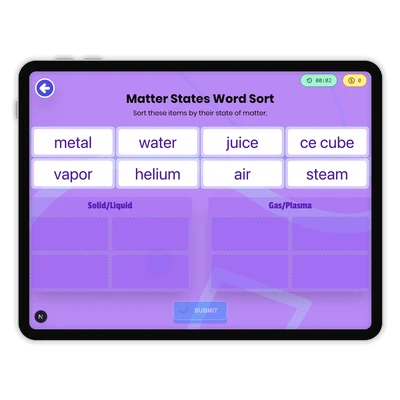
Matter States Word Sort
This classification activity helps students understand how particles are arranged in different states of matter. Student...
5-PS1-1
What Is Density?
This comprehensive science passage introduces middle school students (grades 6-8) to the concept of density, aligned wit...
MS-PS1-1
What Is Earth Science?
This engaging middle school science passage introduces students to the field of Earth science, aligning with NGSS standa...
MS-ESS1MS-ESS2MS-ESS3SEP
Citizen Science and Ecological Monitoring
This engaging passage for grades 6-8 introduces the concept of citizen science and its critical role in ecological monit...