World Civilizations 300 CE
Interactive passage with audio narration, comprehension questions, and printable PDF.
By completing this purchase you agree to our Terms of Use and Privacy Policy. Your subscription renews automatically until you cancel. You can cancel anytime from your account settings. All sales are final and non-refundable. Digital content is available for download in your account immediately upon purchase.
What's included
World Civilizations 300 CE preview and details
About this printable World Civilizations 300 CE reading passage (Grades 5-8)
Sample passage and quiz from World Civilizations 300 CE
Reading passage and comprehension quiz preview
The World in 300 CE
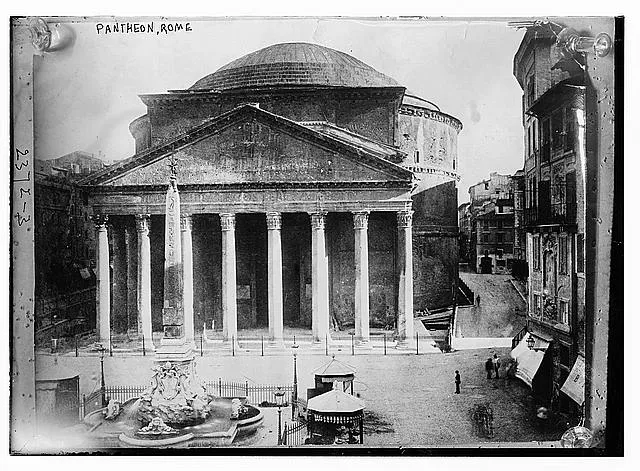
Source: Library of Congress - Bain News Service
The year 300 CE marks a turning point in world history, as civilizations across the globe developed powerful empires, advanced technologies, and complex social hierarchies. In Europe, the Roman Empire controlled vast territories stretching from Britain in the west to Egypt in the south and Mesopotamia in the east. Meanwhile, in Asia, the Han Dynasty ruled China, fostering a golden age of innovation and trade. In the Americas, the Maya civilization began to thrive in the dense jungles of Mesoamerica, creating cities and an early writing system.
In the Roman Empire, daily life varied greatly depending on one’s position in the social hierarchy. Wealthy citizens lived in large houses, wore fine clothing, and often held political power, while most people were farmers or laborers. The Romans built impressive structures such as the Colosseum and aqueducts. Archaeological discoveries, like preserved buildings in Pompeii, reveal details about Roman food, art, and even graffiti. The government was led by an emperor, and the military maintained order across the empire’s roads and cities. Trade flourished, bringing silk from China and spices from India to Roman markets.
At the same time, the Han Dynasty in China was known for its bureaucracy—a system of officials who ran the government by following written laws. The Han emperors encouraged scholarship and built the Silk Road, a trade route connecting China to the West. Primary sources such as the Records of the Grand Historian describe the Han’s inventions, including paper and the seismograph. The Han Dynasty promoted Confucianism, which taught respect for elders and social order. Farmers and artisans supported the economy, while wealthy families owned large estates. The collapse of the Han Dynasty around 220 CE led to political fragmentation, but many cultural traditions continued.
In the Americas, the Maya civilization built cities like Tikal and Copán. They developed a calendar system and one of the earliest forms of writing in the Western Hemisphere. Archaeologists have uncovered stone carvings and pyramids that reveal Maya beliefs about gods, astronomy, and kingship. Maya society was organized into city-states, each ruled by a king. Farming, especially maize (corn), was crucial for survival, and religious ceremonies shaped daily life.
The world in 300 CE was shaped by geography, technology, and human choices. Civilizations rose and fell, adapting to challenges such as invasions, climate changes, and internal conflicts. Some regions, like the Roman and Han empires, experienced both unity and later division, while the Maya continued to develop independently. These societies built legacies that still influence the modern world.
This period is significant because it shows how distant peoples were connected through trade, migration, and ideas. Studying 300 CE helps us understand the roots of today’s cultures, technologies, and global interactions.
Interesting Fact: Did You Know? The Romans used concrete to build large structures like the Pantheon, and this technology helped their cities last for centuries!
Comprehension quiz (8 questions)
1. Who ruled the Roman Empire in 300 CE?
2. Which dynasty ruled China in 300 CE?
3. What was especially important to Maya society?
4. Why did Roman markets have silk and spices?
5. How did geography shape civilizations in 300 CE?
6. What is a social hierarchy?
7. The Romans invented concrete. True or false?
8. What does 'bureaucracy' mean?
Perfect for the way you teach
- Build comprehension skills
- Auto-graded quiz
- Differentiated reading
- Read together at home
- Improve fluency
- Quiet reading time
- Reading curriculum support
- Independent practice
- Track Lexile growth