African American Political Leaders — Reading Comprehension
Rate this
Premium Resource
Present
Present in classroom. No work saved
Assign
Classroom with student accounts, Track progress
Quick Play
No student accounts, assign with a link
Grades
6
7
8
PRINT+DIGITAL RESOURCE
This learning resource is available in interactive and printable formats. The interactive worksheet can be played online and assigned to students. The Printable PDF version can be downloaded and printed for completion by hand.
This passage examines the significant changes for African Americans in the United States during the Reconstruction era after the Civil War, focusing on their right to vote and hold political office. Students will analyze the causes, challenges, and impact of African Americans exercising political power, including the election of twenty-two Black congressmen. The passage is structured to develop historical thinking and ELA skills, includes a primary source quote, and explores multiple perspectives, complexities, and contradictions of the period. Activities include a glossary, timeline, multiple-choice quiz, writing prompts, and graphic organizers, supporting deeper understanding and evidence-based analysis. This history reading passage is aligned with CA HSS 8.11.1, 8.11.3, and Common Core RI.6.3, RI.6.4, W.6.2, featuring both read aloud audio and Spanish translation, as well as a differentiated version for accessibility.
CONTENT PREVIEW
Expand content preview
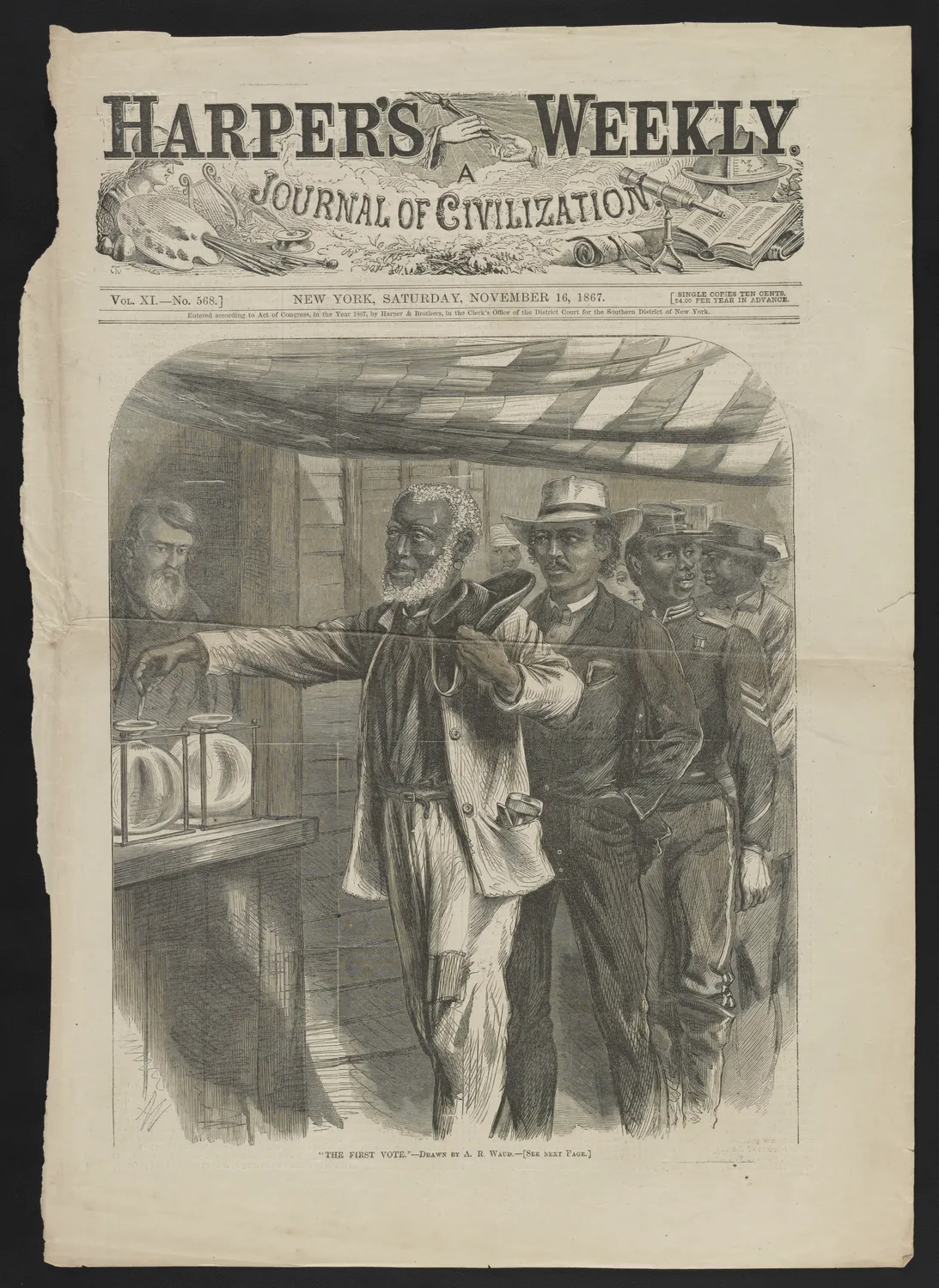
The first vote by Waud, Alfred R. (Alfred Rudolph), 1828-1891, Source: Wikimedia Commons (Public domain).
After the Civil War, the United States entered a period called Reconstruction. This was a time when the nation tried to rebuild from the conflict and address the rights of newly freed African Americans. A major challenge was how to create a society where everyone could participate equally. Before the war, African Americans were largely denied the right to vote or hold public office. However, the passage of the 15th Amendment in 1870 became a turning point. It stated that no citizen could be denied the right to vote based on race, color, or previous condition of servitude. This significant change in the Constitution opened opportunities for African American men to take part in the political process.
For the first time, African Americans began to vote in large numbers. They attended meetings, formed political organizations, and learned about the workings of government. In some Southern states, Black voters became a strong force. They worked together to elect candidates who supported equality and education. More than 2,000 African American men served in elected office during Reconstruction. They held positions from local government, such as city council and sheriff, to higher roles in state legislatures and even the United States Congress. Notably, Hiram Revels and Blanche K. Bruce became the first Black U.S. Senators.
Despite these advances, African Americans faced serious obstacles. Many white Southerners resisted these changes. Groups like the Ku Klux Klan used violence and threats to prevent Black citizens from voting. New laws, called Black Codes and later Jim Crow laws, were created to restrict African American participation. Even so, African American leaders continued to push for representation and worked to protect their rights through legal and political means.
The presence of African Americans in government brought important changes. They supported public education, equal rights, and fairer legal systems. Schools were built for Black children, and laws were passed to protect civil rights. However, these gains were not permanent. By the late 1870s, federal troops withdrew from the South, and many protections were removed. Through disenfranchisement—the process of taking away voting rights—and other barriers, most African Americans were once again excluded from political life for many decades.
Nevertheless, the Reconstruction era showed that progress was possible, even in the face of opposition. The experience of voting and holding office gave African Americans valuable skills and a sense of political identity. Their courage and determination laid the foundation for future movements for equality, such as the Civil Rights Movement of the 20th century.
Interesting Fact: Over 600 African Americans served in state legislatures during Reconstruction, and at least 16 served in the U.S. Congress between 1870 and 1877.
What was Reconstruction?
A period after the Civil WarThe start of the Civil WarA law about voting rightsA type of school
What did the 15th Amendment do?
Gave Black men the right to voteEnded the Civil WarBanned slavery in all statesCreated Jim Crow laws
Who were Hiram Revels and Blanche K. Bruce?
First Black U.S. SenatorsLeaders of the Ku Klux KlanWriters of the ConstitutionCivil War generals
How did some white Southerners resist change?
By using violence and threatsBy building more schoolsBy supporting equal rightsBy voting for Black leaders
What did African American leaders support?
Public education and civil rightsSegregation and unfair lawsEnding all government jobsRemoving voting rights
Why did most African Americans lose voting rights after 1877?
Disenfranchisement and new barriersThey moved to the NorthThey stopped wanting to voteThe Civil War started again
Reconstruction ended in 1877.
TrueFalse
What does 'representation' mean in this passage?
Having leaders speak for a groupVoting in every electionBuilding new schoolsWriting laws alone
Perfect For:
👩🏫 Teachers
• Reading comprehension practice
• Auto-graded assessments
• Literacy skill development
👨👩👧👦 Parents
• Reading practice at home
• Comprehension improvement
• Educational reading time
🏠 Homeschoolers
• Reading curriculum support
• Independent reading practice
• Progress monitoring
Reading Features:
📖
Reading Passage
Engaging fiction or nonfiction text
❓
Comprehension Quiz
Auto-graded questions
📊
Instant Feedback
Immediate results and scoring
📄
Printable Version
Download for offline reading
🔊
Read Aloud
Voice-over with word highlighting
Reviews & Ratings
No reviews yet. Be the first to share your experience!
Related Content
Civil War Causes
This comprehensive U.S. history reading passage investigates the complex causes of the Civil War, focusing on the debate...
D2.HIS.2.3-5D2.HIS.3.3-5RI.4.3RI.4.4
Women's Roles in Civil War
This reading passage explores the critical roles women played during the U.S. Civil War, highlighting how they managed f...
HSS 8.10.7RI.6-8.1RI.6-8.2
Challenges After the Civil War
This engaging history reading passage explores the key challenges Americans faced after the Civil War, such as rebuildin...
D2.HIS.1-6.3-5RI.4.3RI.4.4W.4.2
African American Soldiers in Civil War
This engaging history reading passage examines the pivotal role African American soldiers played in the American Civil W...
D2.HIS.2.3-5D2.HIS.3.3-5RI.4.3RI.4.4
Children and Women During the Civil War
This engaging history reading passage explores the important roles of children and women during the Civil War. Aligned w...
D2.HIS.2.3-5D2.HIS.3.3-5D2.HIS.16.3-5RI.4.1
Sharecropping System After Civil War
This engaging U.S. history reading passage examines the rise of the sharecropping system in the South after the Civil Wa...
D2.HIS.2.3-5D2.HIS.3.3-5RI.4.3RI.4.4
Home Front Life Civil War
This engaging U.S. history reading passage explores daily life on the home front during the Civil War, focusing on how c...
The Civil War Finally Ends
This engaging reading passage explores the end of the Civil War, focusing on the events of 1865 when General Robert E. L...
D2.HIS.1-6.3-5RI.4.3RI.4.4RI.4.10
Fort Sumter 1861: Civil War Begins
This passage explores the pivotal events at Fort Sumter in April 1861, marking the beginning of the American Civil War. ...
D2.HIS.2.3-5D2.HIS.3.3-5RI.4.3RI.4.4
Clara Barton: Civil War Nurse and Founder
This comprehensive U.S. history reading passage explores the life and legacy of Clara Barton, a pivotal figure during th...
D2.HIS.2.3-5D2.HIS.3.3-5RI.4.3RI.4.4
Surrender at Appomattox
This reading passage explores the historic surrender at Appomattox Court House in April 1865, which marked the conclusio...
HSS 8.10.7RI.6-8.1RI.6-8.6
Rebuilding the South
This engaging history reading passage explores the challenges and debates over the future of the South after the U.S. Ci...
Civil Rights Act of 1964
This reading passage explores the Civil Rights Act of 1964, a landmark piece of U.S. legislation that outlawed discrimin...
HSS 11.10.5RI.6-8.1RI.6-8.6
Advantages and Disadvantages: North vs. South
This history reading passage examines the contrasting strengths of the Union and Confederacy during the U.S. Civil War. ...
HSS 8.10.5RI.6-8.1RI.6-8.3
Segregation in America After World War II
This rigorous U.S. history reading passage explores the persistence of segregation and continued inequality in the Unite...
D2.HIS.2.3-5D2.HIS.3.3-5RI.4.3RI.4.4
African Americans Fight for the Union
This engaging U.S. history reading passage explores the important role African Americans played in helping the Union dur...
D2.HIS.2.3-5D2.HIS.14.3-5RI.4.3RI.4.4
New York Draft Riots 1863
This engaging reading passage explores the 1863 New York City Draft Riots, one of the most turbulent moments in American...
D2.HIS.2.3-5D2.HIS.3.3-5RI.4.3RI.4.4
New Schools in the South
This U.S. history reading passage explores the creation of new public schools in the Southern United States during and a...
Soldiers' Letters from the Battlefield
This passage examines the experiences of Civil War soldiers by analyzing their letters from the battlefield. Students wi...