Segregation in America After World War II
Interactive passage with audio narration, comprehension questions, and printable PDF.
By completing this purchase you agree to our Terms of Use and Privacy Policy. Your subscription renews automatically until you cancel. You can cancel anytime from your account settings. All sales are final and non-refundable. Digital content is available for download in your account immediately upon purchase.
What's included
Segregation in America After World War II preview and details
About this printable Segregation in America After World War II reading passage (Grades 6-8)
Sample passage and quiz from Segregation in America After World War II
Reading passage and comprehension quiz preview
Postwar Segregation in America
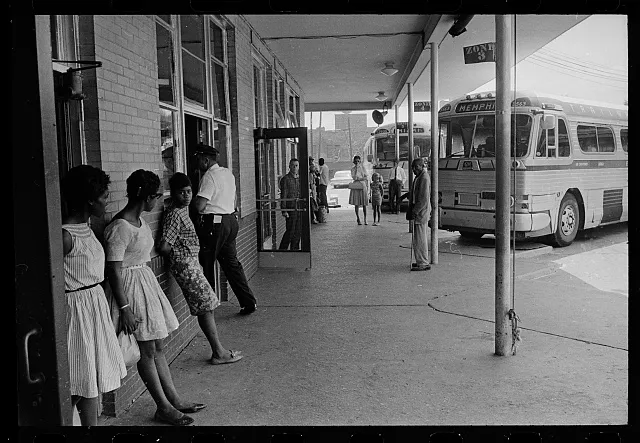
"Segregation in Albany, Georgia - Trailways bus terminal" by Leffler, Warren K. / Library of Congress.
After World War II, African American soldiers returned to the United States having served their country with courage and sacrifice. Many people expected that their bravery would help to end the system of racial segregation that had divided American society for decades. However, the reality was much more complicated. Despite their service, Black veterans and their families continued to face discrimination in many aspects of daily life, especially during the postwar period.
In the late 1940s and 1950s, legal and social barriers kept African Americans separated from white Americans in schools, public transportation, restaurants, and even neighborhoods. These practices were part of a system known as Jim Crow, which enforced unequal treatment through both laws and customs. African Americans were often denied good jobs and fair housing. Some local governments and businesses openly refused to serve Black customers, further deepening the divide.
The irony was striking because African Americans had fought for freedom abroad, yet could not enjoy basic freedoms at home. The contradiction between American democratic ideals and the reality of segregation became a powerful motivator for change. Many Black veterans and their allies began to organize and demand equal rights. Their efforts sparked a new wave of activism during the Civil Rights Movement. Organizations like the NAACP used legal challenges to fight unjust laws, while others protested peacefully in the streets.
One of the main challenges was integration, or the process of bringing people of different races together in schools and public spaces. Many white communities resisted, sometimes with violence, but activists persisted. In 1948, President Harry Truman ordered the desegregation of the military, setting an important example. Landmark court cases, such as Brown v. Board of Education in 1954, declared school segregation unconstitutional. These victories did not end all discrimination, but they showed that change was possible.
While legal progress was made, social attitudes changed more slowly. Many African Americans still faced barriers to voting, better jobs, and equal treatment. Nevertheless, the momentum of the Civil Rights Movement grew, inspiring people across the country to join the fight for justice. The activism and resilience of Black veterans and civil rights leaders helped pave the way for future generations.
Postwar segregation in America reveals how deeply systemic racism was woven into society, and how hard people had to work to challenge it. The struggle for equality did not end with the war, but the determination of those who fought for justice brought the nation closer to its ideals.
Interesting Fact: More than one million African Americans served in the U.S. military during World War II, yet most returned to segregated communities and limited opportunities at home.
Comprehension quiz (8 questions)
1. What is segregation?
2. Who ordered military desegregation in 1948?
3. What did Brown v. Board of Education decide?
4. Why were Black veterans disappointed postwar?
5. What was one main goal of activism?
6. How did society respond to integration?
7. The Civil Rights Movement grew after WWII. True or false?
8. What does 'systemic' mean in the passage?
Common Core standards for Segregation in America After World War II
Explain events, procedures, ideas, or concepts in a historical, scientific, or technical text, including what happened and why, based on specific information in the text.
Determine the meaning of general academic and domain-specific words or phrases in a text relevant to a grade 4 topic or subject area.
Write informative/explanatory texts to examine a topic and convey ideas and information clearly.
Perfect for the way you teach
- Build comprehension skills
- Auto-graded quiz
- Differentiated reading
- Read together at home
- Improve fluency
- Quiet reading time
- Reading curriculum support
- Independent practice
- Track Lexile growth