This learning resource is available in interactive and printable formats. The interactive worksheet can be played online and assigned to students. The Printable PDF version can be downloaded and printed for completion by hand.
This engaging reading passage explores the 1863 New York City Draft Riots, one of the most turbulent moments in American urban history. Students will analyze the causes, motivations, and consequences of the riots, examining multiple perspectives including working-class immigrants, African Americans, and government officials. The passage incorporates rich academic vocabulary, a primary source quote, and a clear argument about the significance of this event. Activities include a timeline, reading quiz, writing prompts, and a T-Chart graphic organizer to deepen understanding. A Spanish translation and glossary support language learners. This resource aligns with C3 Framework (D2.His.2.3-5, D2.His.3.3-5) and Common Core (RI.4.3, RI.4.4, W.4.2) standards. Features read aloud audio and Spanish translation, making it ideal for diverse classrooms studying the Civil War era, social conflict, and civic engagement.
CONTENT PREVIEW
Expand content preview
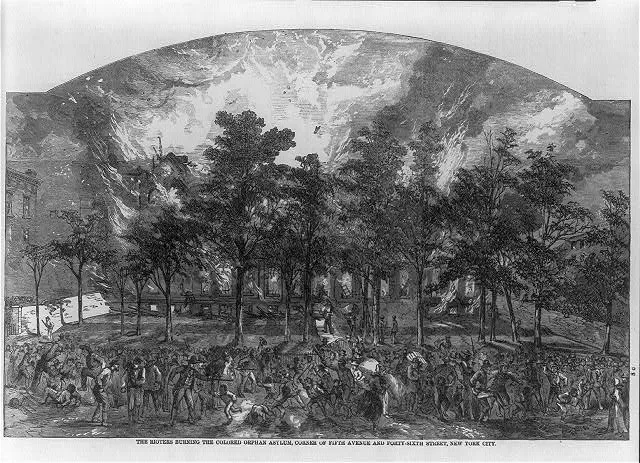
[New York (City) - Draft riot, 1863: "The rioters burning the Colored Orphan Asylum...5th Ave. & 46th St."]. Source: Library of Congress
The New York Draft Riots of 1863 erupted in Manhattan during the American Civil War. These riots began on July 13, 1863, when the federal government started enforcing a new law called the Conscription Act. This law required men to join the Union Army through a process known as military conscription. Many working-class New Yorkers, especially Irish immigrants, felt the draft was unfair. Wealthier citizens could pay a fee to avoid service, but poor men had no such option. As a result, resentment and anger grew quickly among the city’s laborers.
The main problem that led to the riots was the conflict between social classes. The draft system appeared to favor the rich, creating economic and social tension. The working class feared losing their jobs to newly freed African Americans, as the Emancipation Proclamation had recently declared enslaved people in Confederate states free. This fear intensified the existing competition for work and housing. These issues combined to create a climate ripe for protest and violence.
On the morning of July 13, a crowd gathered to protest the draft at the city’s provost marshal’s office, where conscription was organized. What began as a peaceful protest quickly turned violent. Rioters attacked government buildings, set fires, and fought with police officers. Over the following days, mobs targeted homes and businesses, particularly those belonging to African Americans and abolitionists. The violence spread through many neighborhoods, leading to widespread destruction.
Authorities struggled to control the situation. Local police forces were overwhelmed by the size and fury of the crowds. The federal government responded by sending in Union Army regiments, some of whom had recently fought at the Battle of Gettysburg. With the arrival of the military, order was gradually restored, but not before more than 100 people had been killed and many more injured. The damage to property and the loss of life made the New York Draft Riots one of the worst incidents of civil unrest in American history.
The riots revealed deep divisions in American society. They demonstrated how economic inequality, racial prejudice, and political disagreement could combine to create explosive situations. The events forced lawmakers and citizens to consider how to address such conflicts in the future. The long-term impact of the riots was significant, leading to changes in how the government managed the draft and how communities responded to social unrest.
Interesting Fact: The Colored Orphan Asylum, a home for African American children, was burned down by rioters during the New York Draft Riots, but many children escaped thanks to the efforts of the staff.
When did the New York Draft Riots begin?
July 13, 1863April 12, 1861May 8, 1865June 17, 1862
Which law caused the riots?
Conscription ActHomestead ActCivil Rights ActMissouri Compromise
Who could pay to avoid the draft?
Wealthy citizensAll menPolice officersImmigrants
Why did working-class New Yorkers protest?
They felt the draft was unfairThey supported the draftThey wanted more taxesThey wanted new leaders
What made the riots especially violent?
Attacks on African AmericansPeaceful marches onlyFewer police on dutyNo property damage
How did authorities end the riots?
Sent Union Army regimentsHeld more protestsClosed schoolsChanged city laws
The riots showed deep divisions in society. True or false?
TrueFalse
What does 'conscription' mean?
Forcing people to join the armyBuilding new homesVoting in electionsMaking peace agreements
Perfect For:
👩🏫 Teachers
• Reading comprehension practice
• Auto-graded assessments
• Literacy skill development
👨👩👧👦 Parents
• Reading practice at home
• Comprehension improvement
• Educational reading time
🏠 Homeschoolers
• Reading curriculum support
• Independent reading practice
• Progress monitoring
Reading Features:
📖
Reading Passage
Engaging fiction or nonfiction text
❓
Comprehension Quiz
Auto-graded questions
📊
Instant Feedback
Immediate results and scoring
📄
Printable Version
Download for offline reading
🔊
Read Aloud
Voice-over with word highlighting
Reviews & Ratings
No reviews yet. Be the first to share your experience!
Related Content
Native American Tribes Across America
This engaging history reading passage introduces students to Native American tribes across America, focusing on their da...
D2.HIS.1.3-5D2.HIS.2.3-5RI.4.1RI.4.2
Teepees: Homes on the Great Plains
This engaging history reading passage introduces students to teepees, the unique homes of Native American tribes on the ...
D2.HIS.2.3-5D2.HIS.14.3-5RI.4.1RI.4.2RI.4.4
Traditional Native American Clothing
This engaging history passage explores traditional Native American clothing and how it reflected the environment, values...
D2.HIS.2.3-5D2.HIS.3.3-5RI.4.3RI.4.4
The Iroquois Confederacy: A System of Peace
This engaging U.S. History reading passage introduces students to the Iroquois Confederacy, a powerful alliance of Nativ...
D2.HIS.2.3-5D2.HIS.3.3-5RI.4.3RI.4.4
The Cherokee Nation: History and Culture
This reading passage explores the rich history and culture of the Cherokee Nation, one of the largest Native American tr...
D2.HIS.2.3-5D2.HIS.14.3-5RI.4.3RI.4.4RI.4.10
The Sioux: Warriors and Tribal Leaders
This history reading passage explores the Sioux Nation, focusing on their roles as warriors and tribal leaders. Students...
D2.HIS.1.3-5D2.HIS.2.3-5RI.4.1RI.4.3
Native American Respect for Nature
This engaging history reading passage explores Native American respect for nature, emphasizing the close relationship be...
D2.HIS.2.3-5D2.HIS.3.3-5RI.4.3RI.4.4
Jamestown: The First Permanent English Colony
This engaging history passage explores the founding of Jamestown, the first permanent English colony in America. Aligned...
D2.HIS.1.3-5D2.HIS.2.3-5RI.4.3RI.4.4
Pocahontas and the Powhatan People
This engaging reading passage explores the life of Pocahontas and the Powhatan people and their important role in early ...
D2.HIS.1.3-5D2.HIS.2.3-5RI.4.1RI.4.3
Colonial Children: School and Chores
This reading passage explores the daily lives of colonial children, focusing on their experiences at school and their ma...
D2.HIS.2.3-5D2.HIS.3.3-5RI.4.1RI.4.2RI.4.4
Colonial Clothing and Homemade Goods
This engaging U.S. history passage explores the daily life of early American colonists with a focus on colonial clothing...
D2.HIS.2.3-5RI.4.3RI.4.4
Colonial Jobs: Blacksmiths, Bakers, and Craftsmen
This engaging history reading passage explores the vital roles of blacksmiths, bakers, and craftsmen in colonial America...
D2.HIS.2.3-5D2.HIS.3.3-5RI.4.3RI.4.4
Colonial Towns and Village Life
This engaging history reading passage explores the daily life, work, and unity found in colonial towns and villages. Ali...
D2.HIS.1.3-5D2.HIS.2.3-5RI.4.3RI.4.4
Colonial Trade with England and Africa
This history reading passage explores colonial trade between the American colonies, England, and Africa, focusing on the...
D2.HIS.2.3-5D2.HIS.14.3-5RI.4.3RI.4.4
Benjamin Franklin: Printer, Inventor, and Leader
This history reading passage explores the life and achievements of Benjamin Franklin, one of America's most important ea...
D2.HIS.2.3-5D2.HIS.3.3-5RI.4.1RI.4.3
George Washington Leads the Army
This engaging history reading passage explores how George Washington bravely led the Continental Army during the America...
D2.HIS.1.3-5D2.HIS.2.3-5RI.4.3RI.4.4
Women and Children During the Revolutionary War
This reading passage explores the important roles women and children played during the Revolutionary War. Students will ...
D2.HIS.2.3-5RI.4.3RI.5.3
African Americans Fight for Freedom
This educational passage explores the brave and inspiring story of how African Americans fought for freedom in the Unite...
D2.HIS.2.3-5D2.HIS.3.3-5RI.4.3RI.4.4
The Battle of Yorktown Ends War
This engaging U.S. history reading passage explores the Battle of Yorktown, a key event that ended the American Revoluti...
D2.HIS.1.3-5D2.HIS.2.3-5RI.4.1RI.4.3
Loyalists vs. Patriots: Divided Families
This engaging U.S. history reading passage explores the division between Loyalists and Patriots during the American Revo...