Fort Sumter 1861: Civil War Begins
Interactive passage with audio narration, comprehension questions, and printable PDF.
By completing this purchase you agree to our Terms of Use and Privacy Policy. Your subscription renews automatically until you cancel. You can cancel anytime from your account settings. All sales are final and non-refundable. Digital content is available for download in your account immediately upon purchase.
What's included
Fort Sumter 1861: Civil War Begins preview and details
About this printable Fort Sumter 1861: Civil War Begins reading passage (Grades 6-8)
Sample passage and quiz from Fort Sumter 1861: Civil War Begins
Reading passage and comprehension quiz preview
Fort Sumter 1861: Civil War Begins
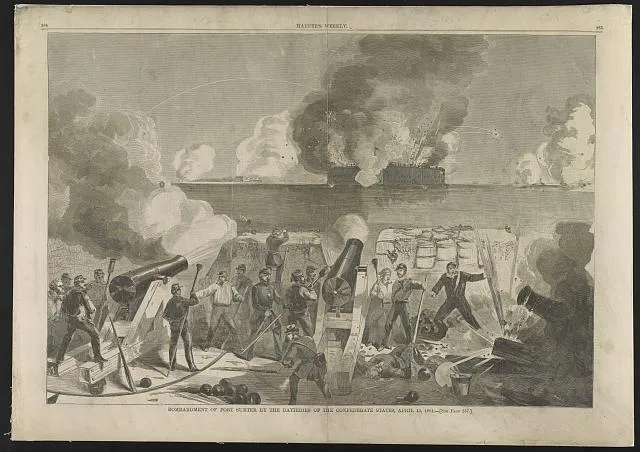
"Bombardment of Fort Sumter by the batteries of the Confederate states, April 13, 1861" / Library of Congress.
In April 1861, the first shots of the American Civil War were fired at Fort Sumter, a federal fort located in Charleston Harbor, South Carolina. The conflict at Fort Sumter was not just a battle over a small island fort. It represented a deep national debate over sovereignty, the power of the federal government, and the future of slavery in the United States.
The immediate cause of the standoff at Fort Sumter was the recent election of Abraham Lincoln as President of the United States. Many Southern states viewed Lincoln's election as a threat to their right to allow slavery. As a result, South Carolina and six other states declared their secession from the Union. These states formed the Confederate States of America in early 1861. The U.S. government, however, did not accept secession as legal. This created a situation where two governments both claimed authority over the same land and people.
The crisis at Fort Sumter quickly became a symbol of this larger national conflict. The Union troops at the fort, led by Major Robert Anderson, were running low on supplies. President Lincoln faced a difficult decision. He could either abandon the fort, which would show weakness, or resupply it, which might provoke war. Lincoln chose to send a supply ship, stating in a letter to the governor of South Carolina, "The Government will not use force unless force is used against it." This quote shows Lincoln's careful attempt to avoid blame for starting a war, while still defending federal property.
From the Southern perspective, allowing the Union to resupply Fort Sumter would mean accepting federal control in their newly declared nation. Confederate leaders, including General P.G.T. Beauregard, decided to demand the fort's surrender. When Anderson refused, Confederate guns began bombarding Fort Sumter on April 12, 1861. After 34 hours of shelling, Major Anderson surrendered. No soldiers were killed during the battle, but the event had enormous consequences.
The attack on Fort Sumter unified the North against the Confederacy. Lincoln immediately called for 75,000 volunteers to put down the rebellion. Four more states, including Virginia, then joined the Confederacy, making the conflict even larger. The bombardment also revealed the complex motivations of ordinary people. Some in the South celebrated what they saw as a victory for their rights and way of life. Others, including many in the North, saw the attack as an assault on the Union and democracy itself.
Though both sides believed they were defending their own principles, the result was a long and bloody conflict that would last four years and cost hundreds of thousands of lives. The events at Fort Sumter showed that peaceful solutions had failed, and that the debate over slavery, states' rights, and federal power would be settled by war.
Analyzing the Fort Sumter crisis reveals the complexity of American history. The decisions made by leaders on both sides were shaped by fear, pride, and their own views of legitimacy. The consequences went far beyond one fort, changing the nation forever.
Interesting Fact: The U.S. flag that Major Anderson lowered in surrender at Fort Sumter was later flown again when the Union retook the fort in 1865, symbolizing the restoration of the United States.
Comprehension quiz (8 questions)
1. Where is Fort Sumter located?
2. Who was President during Fort Sumter?
3. When did the bombardment of Fort Sumter begin?
4. Why did Lincoln send a supply ship?
5. What did the attack on Fort Sumter cause?
6. What was Lincoln's goal in his letter?
7. The Union surrendered Fort Sumter. True or false?
8. What does 'secession' mean?
Common Core standards for Fort Sumter 1861: Civil War Begins
Explain events, procedures, ideas, or concepts in a historical, scientific, or technical text, including what happened and why, based on specific information in the text.
Determine the meaning of general academic and domain-specific words or phrases in a text relevant to a grade 4 topic or subject area.
Write informative/explanatory texts to examine a topic and convey ideas and information clearly.
Perfect for the way you teach
- Build comprehension skills
- Auto-graded quiz
- Differentiated reading
- Read together at home
- Improve fluency
- Quiet reading time
- Reading curriculum support
- Independent practice
- Track Lexile growth