This learning resource is available in interactive and printable formats. The interactive worksheet can be played online and assigned to students. The Printable PDF version can be downloaded and printed for completion by hand.
This engaging U.S. history reading passage explores daily life on the home front during the Civil War, focusing on how civilians in both the North and South faced hardships, shortages, and loss. Students will analyze the causes and effects of war on ordinary people, compare experiences across regions, and interpret primary source evidence. The passage is accompanied by a glossary of academic vocabulary, differentiated and Spanish versions, and reading comprehension activities that support critical thinking. Graphic organizers and timelines help students organize cause and effect relationships and chronological developments. This resource aligns with California HSS 8.10 and Common Core RI.6.3, W.6.2, supporting the development of historical reasoning skills. It also includes a read aloud audio feature and Spanish translation, making it accessible to a wide range of learners, including English language learners. Ideal for classroom instruction or independent study, this resource challenges students to analyze history like historians while developing key literacy skills.
CONTENT PREVIEW
Expand content preview
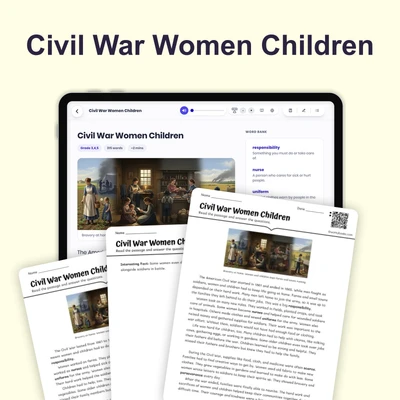
"Men and women making war materials during Civil War - by U.S. Army Materials and Mechanics Research Center. Public Affairs Office / Wikimedia Commons (Public domain).
The Civil War dramatically changed daily life for people living in both the North and South. While soldiers fought on the battlefields, families and civilians at home faced new challenges. The absence of fathers, sons, and brothers meant that women and children had to take on more responsibilities. These included running farms and businesses, which required learning new skills and adapting quickly.
Because resources were redirected to the war effort, shortages of food, clothing, and other goods became common. In the South, the Union blockade cut off supplies, leading to scarcities of everyday items such as salt, coffee, and fabric. In the North, factories focused on producing military equipment, which sometimes limited the availability of consumer goods. Both sides experienced rising prices, known as inflation. As money lost its value, families found it hard to afford basic necessities.
The emotional impact of the war was significant. Many families lived in constant anxiety over the safety of loved ones fighting far away. Letters became an important means of communication, but news often arrived late or not at all. Children grew up quickly, helping with chores and sometimes even working outside the home to support their families.
Despite these hardships, communities found ways to support the war effort. Women formed aid societies that organized fundraising events and collected supplies for soldiers. They sewed uniforms, knitted socks, and gathered food. Supply drives brought people together to donate blankets, bandages, and other essentials. These efforts showed the importance of sacrifice and cooperation on the home front.
The war also changed roles and expectations. Women, in particular, demonstrated new levels of resilience as they managed households and took leadership roles in their communities. Some even worked as nurses or in government offices, positions previously unavailable to them. After the war, many women continued to seek greater independence and rights.
Life on the home front was filled with uncertainty. The outcomes of battles affected morale, and rumors about the war’s progress often spread quickly. Yet, people found ways to adapt and persevere. Their efforts kept armies supplied and spirits strong, influencing the conflict’s outcome in subtle but important ways.
Interesting Fact: During the Civil War, some children served as messengers or helped raise money by organizing fairs, showing that even the youngest civilians played a role in supporting the war effort.
What caused shortages in the South?
Union blockadeHeavy rainfallTrade with EuropeGold rush
Who took on more responsibilities at home?
Women and childrenSoldiersPoliticiansForeign workers
What helped keep armies supplied?
Community effortsForeign aidFactories in EuropeGold mining
Why did families experience inflation?
Money lost valueToo much rainMore gold foundFewer factories
How did communities support soldiers?
Aid societies and drivesStopped workingTraveled to battlefieldsClosed businesses
What is resilience?
Recovering from difficultiesMaking more moneyBuying suppliesWriting letters
True or False: Only adults helped at home.
TrueFalse
What is a supply drive?
Collecting items for soldiersA marching paradeA business meetingA letter-writing contest
Perfect For:
👩🏫 Teachers
• Reading comprehension practice
• Auto-graded assessments
• Literacy skill development
👨👩👧👦 Parents
• Reading practice at home
• Comprehension improvement
• Educational reading time
🏠 Homeschoolers
• Reading curriculum support
• Independent reading practice
• Progress monitoring
Reading Features:
📖
Reading Passage
Engaging fiction or nonfiction text
❓
Comprehension Quiz
Auto-graded questions
📊
Instant Feedback
Immediate results and scoring
📄
Printable Version
Download for offline reading
🔊
Read Aloud
Voice-over with word highlighting
Reviews & Ratings
No reviews yet. Be the first to share your experience!
Related Content
Civil War Causes
This comprehensive U.S. history reading passage investigates the complex causes of the Civil War, focusing on the debate...
D2.HIS.2.3-5D2.HIS.3.3-5RI.4.3RI.4.4
Women's Roles in Civil War
This reading passage explores the critical roles women played during the U.S. Civil War, highlighting how they managed f...
HSS 8.10.7RI.6-8.1RI.6-8.2
Challenges After the Civil War
This engaging history reading passage explores the key challenges Americans faced after the Civil War, such as rebuildin...
D2.HIS.1-6.3-5RI.4.3RI.4.4W.4.2
African American Soldiers in Civil War
This engaging history reading passage examines the pivotal role African American soldiers played in the American Civil W...
D2.HIS.2.3-5D2.HIS.3.3-5RI.4.3RI.4.4
Children and Women During the Civil War
This engaging history reading passage explores the important roles of children and women during the Civil War. Aligned w...
D2.HIS.2.3-5D2.HIS.3.3-5D2.HIS.16.3-5RI.4.1
Sharecropping System After Civil War
This engaging U.S. history reading passage examines the rise of the sharecropping system in the South after the Civil Wa...
D2.HIS.2.3-5D2.HIS.3.3-5RI.4.3RI.4.4
The Civil War Finally Ends
This engaging reading passage explores the end of the Civil War, focusing on the events of 1865 when General Robert E. L...
D2.HIS.1-6.3-5RI.4.3RI.4.4RI.4.10
Fort Sumter 1861: Civil War Begins
This passage explores the pivotal events at Fort Sumter in April 1861, marking the beginning of the American Civil War. ...
D2.HIS.2.3-5D2.HIS.3.3-5RI.4.3RI.4.4
Clara Barton: Civil War Nurse and Founder
This comprehensive U.S. history reading passage explores the life and legacy of Clara Barton, a pivotal figure during th...
D2.HIS.2.3-5D2.HIS.3.3-5RI.4.3RI.4.4
Surrender at Appomattox
This reading passage explores the historic surrender at Appomattox Court House in April 1865, which marked the conclusio...
HSS 8.10.7RI.6-8.1RI.6-8.6
Rebuilding the South
This engaging history reading passage explores the challenges and debates over the future of the South after the U.S. Ci...
Civil Rights Act of 1964
This reading passage explores the Civil Rights Act of 1964, a landmark piece of U.S. legislation that outlawed discrimin...
HSS 11.10.5RI.6-8.1RI.6-8.6
Advantages and Disadvantages: North vs. South
This history reading passage examines the contrasting strengths of the Union and Confederacy during the U.S. Civil War. ...
HSS 8.10.5RI.6-8.1RI.6-8.3
Segregation in America After World War II
This rigorous U.S. history reading passage explores the persistence of segregation and continued inequality in the Unite...
D2.HIS.2.3-5D2.HIS.3.3-5RI.4.3RI.4.4
New York Draft Riots 1863
This engaging reading passage explores the 1863 New York City Draft Riots, one of the most turbulent moments in American...
D2.HIS.2.3-5D2.HIS.3.3-5RI.4.3RI.4.4
African Americans Fight for the Union
This engaging U.S. history reading passage explores the important role African Americans played in helping the Union dur...
D2.HIS.2.3-5D2.HIS.14.3-5RI.4.3RI.4.4
New Schools in the South
This U.S. history reading passage explores the creation of new public schools in the Southern United States during and a...
Soldiers' Letters from the Battlefield
This passage examines the experiences of Civil War soldiers by analyzing their letters from the battlefield. Students wi...
War Bonds: Financing World War II
This passage examines the critical role of war bonds in financing World War II, focusing on how the U.S. government enco...