Surrender at Appomattox
Interactive passage with audio narration, comprehension questions, and printable PDF.
By completing this purchase you agree to our Terms of Use and Privacy Policy. Your subscription renews automatically until you cancel. You can cancel anytime from your account settings. All sales are final and non-refundable. Digital content is available for download in your account immediately upon purchase.
What's included
Surrender at Appomattox preview and details
About this printable Surrender at Appomattox reading passage (Grades 6-8)
Sample passage and quiz from Surrender at Appomattox
Reading passage and comprehension quiz preview
Surrender at Appomattox
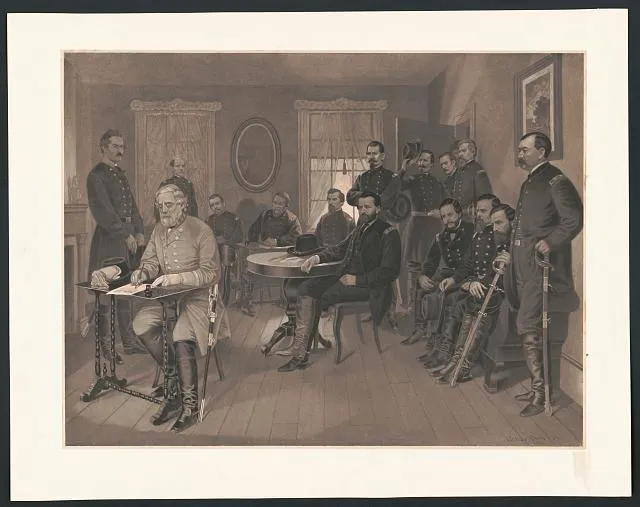
""The surrender of Lee," Appomattox C.H., Va., April 9th, 1865" / Library of Congress.
The conclusion of the American Civil War occurred on April 9, 1865, at Appomattox Court House in Virginia. On this historic day, General Robert E. Lee, the leader of the Confederate Army of Northern Virginia, surrendered to General Ulysses S. Grant, commander of the Union Army. The surrender signaled not only the end of a brutal four-year conflict, but also the beginning of the nation’s long and challenging reunification process.
Leading up to the surrender, the Confederate Army faced major obstacles. Their supplies were dangerously low, soldiers were exhausted, and many men had deserted. The Union Army, under Grant’s leadership, had gained control over critical railroads and cities, making it nearly impossible for the Confederacy to continue fighting. The collapse of Confederate defenses in Richmond, the Confederate capital, forced Lee’s army to retreat westward, hoping to join with other Southern forces. Yet, relentless Union pursuit cut off these plans.
When Lee recognized that further fighting would only cause more unnecessary suffering, he made the difficult decision to surrender. On April 9, 1865, Lee and Grant met in the parlor of Wilmer McLean’s house at Appomattox Court House. The atmosphere was tense but respectful. Lee wore his best uniform, showing respect for the significance of the event. Grant, understanding the dignity of his opponent, offered honorable terms for surrender.
Grant’s generosity played a crucial role in shaping the nation's future. The terms allowed Confederate soldiers to return home without punishment, as long as they laid down their arms and pledged loyalty to the United States. Officers could keep their sidearms and personal possessions, and all men were permitted to keep their horses for spring planting. These conditions helped prevent further hostility and encouraged peaceful reconciliation.
The surrender at Appomattox did not immediately end all fighting, but it marked a turning point. Other Confederate armies soon surrendered, and by June 1865, the Civil War had effectively ended. However, the process of reconstruction—rebuilding the South and addressing the rights of freed African Americans—would require years of effort and debate.
The events at Appomattox highlight both the devastation of war and the possibilities of peace. Instead of seeking revenge, Grant’s approach promoted healing and set an example for the future. The meeting between Lee and Grant has become a symbol of respect, forgiveness, and the difficult work of national reunification.
Interesting Fact: After the meeting, Union soldiers began to celebrate, but Grant ordered them to stop out of respect for the defeated Confederates, reminding everyone that peace depended on mutual respect.
Comprehension quiz (8 questions)
1. When did Lee surrender to Grant?
2. Where did the surrender take place?
3. Who was the Union commander?
4. Why did Lee decide to surrender?
5. How did Grant show generosity?
6. What was a result of the surrender?
7. The surrender at Appomattox ended the Civil War. (True/False)
8. What does 'reunification' mean?
Perfect for the way you teach
- Build comprehension skills
- Auto-graded quiz
- Differentiated reading
- Read together at home
- Improve fluency
- Quiet reading time
- Reading curriculum support
- Independent practice
- Track Lexile growth