New Schools in the South
Interactive passage with audio narration, comprehension questions, and printable PDF.
By completing this purchase you agree to our Terms of Use and Privacy Policy. Your subscription renews automatically until you cancel. You can cancel anytime from your account settings. All sales are final and non-refundable. Digital content is available for download in your account immediately upon purchase.
What's included
New Schools in the South preview and details
About this printable New Schools in the South reading passage (Grades 6-8)
Sample passage and quiz from New Schools in the South
Reading passage and comprehension quiz preview
New Southern Schools
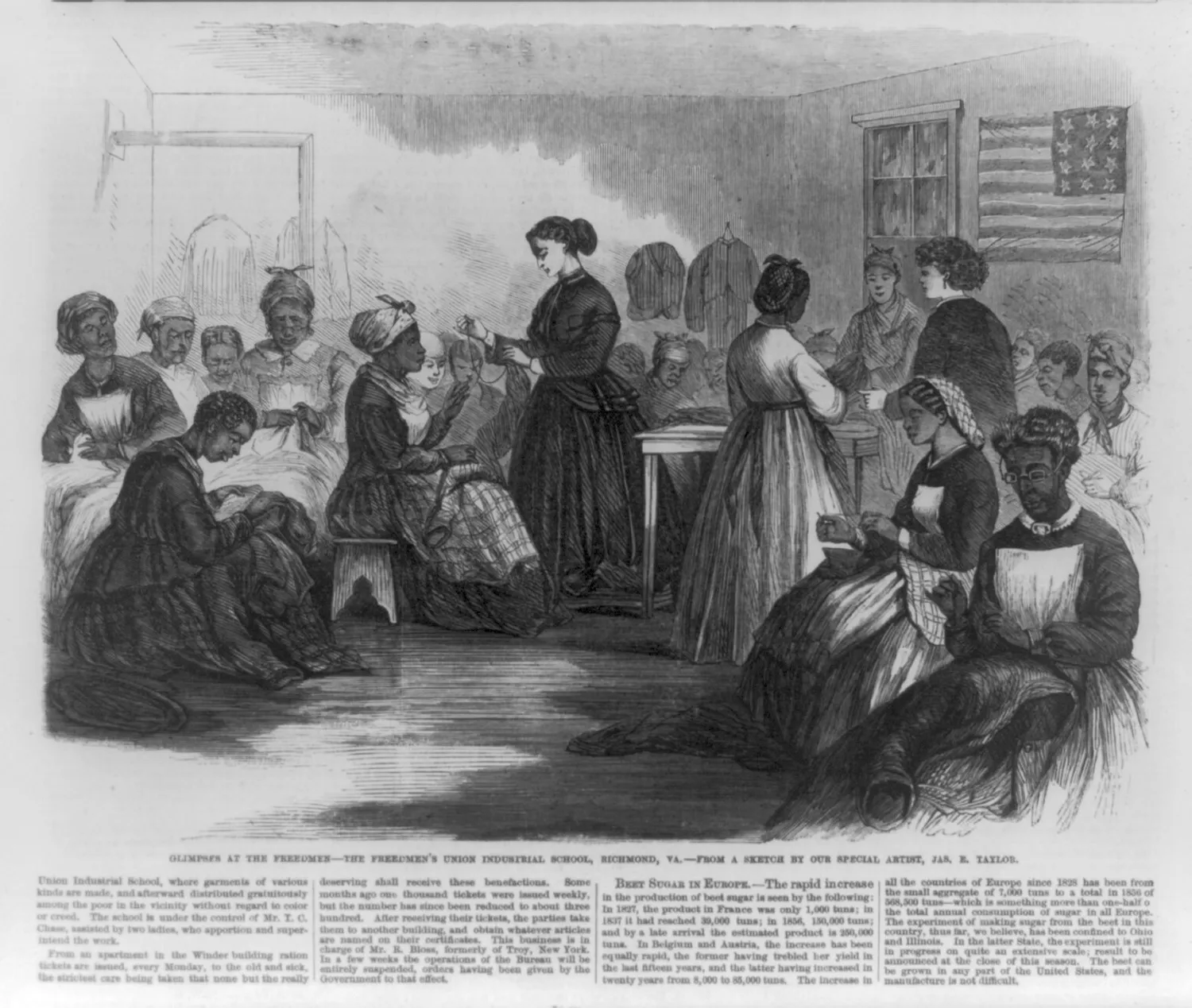
"Glimpses at the Freedmen - The Freedmen's Union Industrial School, Richmond, Va. - from a sketch by Jas E. Taylor. LCCN98501491" by Taylor, James E., 1839-1901, artist /
Source: Wikimedia Commons (Public domain).
The end of the Civil War marked a turning point for education in the American South. During Reconstruction, new institutions called Freedmen's schools were created to address the South's widespread lack of education. Before the war, most African Americans were enslaved and denied the right to learn. Poor white children also had limited access to formal schooling. After emancipation, the newly freed population urgently needed literacy skills to participate in society and pursue better opportunities.
The federal government responded by establishing the Freedmen's Bureau in 1865. This organization was designed to help formerly enslaved people and war refugees adjust to freedom. One of its key goals was to promote education. The Freedmen's Bureau worked with Northern religious groups and philanthropic organizations to open hundreds of schools throughout the South. Churches often provided buildings, while teachers came from both the North and the local Black community. These efforts led to the creation of a new educational system that was very different from what existed before the war.
Despite these advances, many challenges threatened the success of Southern schools. Local governments sometimes opposed the new schools, seeing them as a threat to traditional power structures. White landowners and politicians often resisted funding or supporting schools for Black students. Teachers and students sometimes faced violence or intimidation. In spite of this opposition, many families believed so strongly in the value of education that they risked their safety to attend classes. The drive for opportunity was stronger than the dangers they faced.
Schoolrooms were usually crowded and supplies were limited. Teachers had to be resourceful and creative, often using slates and chalk instead of textbooks. Nevertheless, students made remarkable progress. Within a decade, tens of thousands of African Americans learned to read and write. Schools also taught practical skills and civic values, helping graduates become leaders in their communities.
New Southern schools were open to all, but in reality, most were segregated by race. The struggle for true equality in education continued for many years. Still, the creation of these schools marked a significant step toward expanding access to knowledge and giving people tools for a better future. The institutions established during Reconstruction laid the foundation for public education in the South for generations to come.
Interesting Fact: By 1877, more than 600,000 African American children were attending schools in the South, even though many faced daily obstacles and prejudice.
Comprehension quiz (8 questions)
1. What was the Freedmen's Bureau?
2. When was the Freedmen's Bureau established?
3. Which group helped build Southern schools?
4. Why did some oppose the new schools?
5. How did families value education?
6. What was a challenge for teachers?
7. Schools were always open to all races. True or false?
8. What does 'literacy' mean?
Perfect for the way you teach
- Build comprehension skills
- Auto-graded quiz
- Differentiated reading
- Read together at home
- Improve fluency
- Quiet reading time
- Reading curriculum support
- Independent practice
- Track Lexile growth