America Becomes an Industrial Giant
Interactive passage with audio narration, comprehension questions, and printable PDF.
By completing this purchase you agree to our Terms of Use and Privacy Policy. Your subscription renews automatically until you cancel. You can cancel anytime from your account settings. All sales are final and non-refundable. Digital content is available for download in your account immediately upon purchase.
What's included
America Becomes an Industrial Giant preview and details
About this printable America Becomes an Industrial Giant reading passage (Grades 6-8)
Sample passage and quiz from America Becomes an Industrial Giant
Reading passage and comprehension quiz preview
America Becomes an Industrial Giant
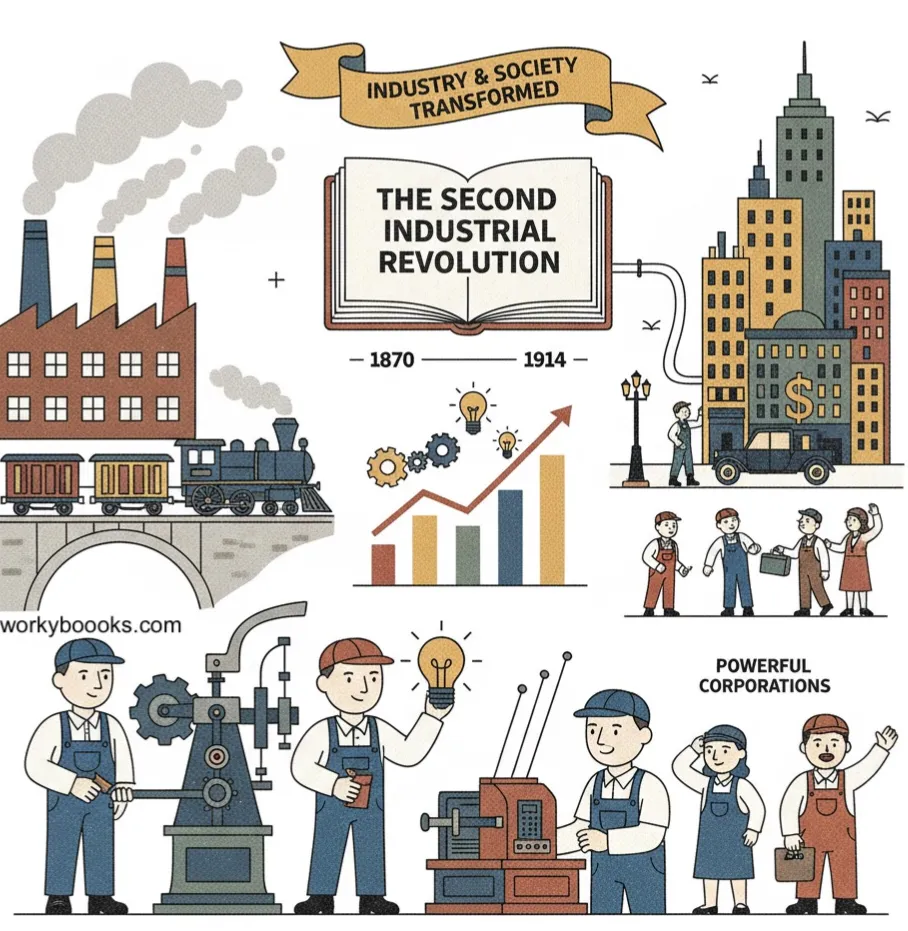
By the end of the 1800s, the United States had become the world’s leading industrial nation. In 1900, America produced more manufactured goods than both Britain and Germany. This remarkable growth was not accidental. Instead, it resulted from a powerful combination of abundant natural resources, an increasing supply of immigrant labor, and bold business innovation. America’s rise as an industrial giant forever changed its economy, society, and role in the world.
Several key factors contributed to America’s rapid growth. The country was rich in natural resources such as coal, iron, oil, and timber. These materials were essential for production in factories, railroads, and new technologies. At the same time, millions of immigrants arrived from Europe and Asia. Many found jobs in urban factories, where they worked long hours for low wages. Their labor helped drive the mass production of goods, making American industries more competitive.
The business world also changed. Large companies, or corporations, began to dominate industries like steel, oil, and railroads. Powerful business leaders, such as Andrew Carnegie and John D. Rockefeller, used new ideas to improve efficiency. For example, Carnegie used the Bessemer process to make steel faster and cheaper. Rockefeller made deals with railroads to lower shipping costs for his oil. These strategies made American companies more profitable and allowed industries to expand rapidly.
This economic boom was not without problems. Factory workers, including children, often worked in dangerous conditions for little pay. Labor unions formed to fight for safer workplaces and better wages. There were frequent strikes and protests, sometimes leading to violence. The government responded with new regulations, such as laws to improve safety and limit child labor. These changes marked the beginning of the Progressive Era, a time of reform and effort to solve social problems caused by rapid industrialization.
The rise of American industry had global consequences. The nation’s growing production capacity allowed it to export goods around the world. Cities grew quickly, and new inventions like the telephone and electric light transformed daily life. However, these changes brought conflicts over wealth, working conditions, and the environment. Americans debated what kind of society they wanted as the country’s economy became more complex.
In summary, America’s transformation into an industrial giant was fueled by its resources, people, and new business methods. This period of growth set the stage for the United States to become a world leader in the twentieth century, but it also forced Americans to confront important questions about fairness, opportunity, and the meaning of progress.
Interesting Fact: By 1900, the United States produced one-third of the world’s manufactured goods, more than any other country at the time.
Comprehension quiz (8 questions)
1. Who was a major steel industry leader?
2. Which two countries did the US surpass?
3. What did labor unions want?
4. Why did corporations grow quickly?
5. What is one effect of industrialization?
6. What does 'regulation' mean?
7. The Progressive Era began after industrial growth. True or false?
8. What does 'abundant' mean?
Common Core standards for America Becomes an Industrial Giant
Explain events, procedures, ideas, or concepts in a historical, scientific, or technical text, including what happened and why, based on specific information in the text.
Determine the meaning of general academic and domain-specific words or phrases in a text relevant to a grade 4 topic or subject area.
Write informative/explanatory texts to examine a topic and convey ideas and information clearly.
Perfect for the way you teach
- Build comprehension skills
- Auto-graded quiz
- Differentiated reading
- Read together at home
- Improve fluency
- Quiet reading time
- Reading curriculum support
- Independent practice
- Track Lexile growth