American Revolution Economic Effects
Interactive passage with audio narration, comprehension questions, and printable PDF.
By completing this purchase you agree to our Terms of Use and Privacy Policy. Your subscription renews automatically until you cancel. You can cancel anytime from your account settings. All sales are final and non-refundable. Digital content is available for download in your account immediately upon purchase.
What's included
American Revolution Economic Effects preview and details
About this printable American Revolution Economic Effects reading passage (Grades 6-8)
Sample passage and quiz from American Revolution Economic Effects
Reading passage and comprehension quiz preview
American Revolution Economic Effects
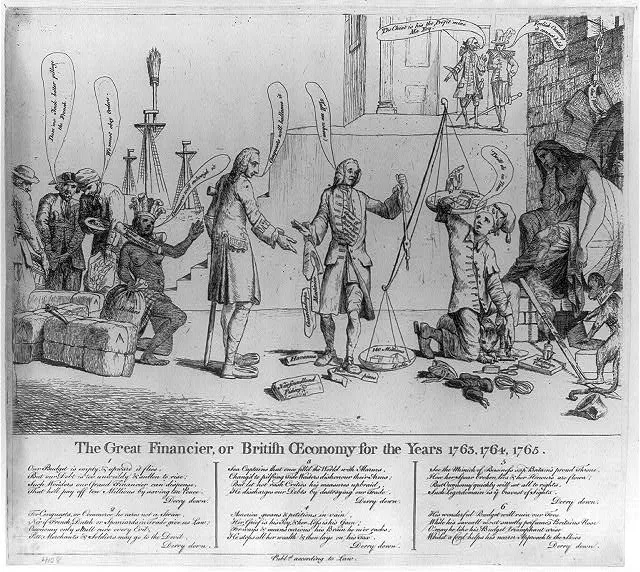
"The great financier, or British economy for the years 1763, 1764, 1765" / Library of Congress.
The American Revolution created the United States, but it also left the young nation facing severe debt. The war cost millions of dollars, which the Continental Congress borrowed from American citizens and foreign countries. After the fighting stopped in 1783, the United States government owed vast sums of money to France, the Netherlands, private lenders, and its own soldiers. This debt was a burden that threatened the country’s stability and future.
To pay for supplies and soldiers during the war, Congress printed large amounts of paper currency called Continental dollars. Unfortunately, the government did not have enough gold or silver to back this currency. As a result, people soon realized that these dollars were nearly worthless. Prices for goods soared, and this rapid increase, known as inflation, made it difficult for families to buy essentials like food and clothing. Soldiers and suppliers who were paid in paper money often found they had lost much of their earnings.
Economic depression followed the war. Many businesses closed, and trade slowed dramatically. British trade policies hurt American merchants by blocking access to important markets in the West Indies and raising tariffs on American goods. Farmers suffered because they could not sell their crops or pay their own debts. Unemployment grew, and poverty increased in both cities and rural areas.
The government’s financial crisis was made worse by the weakness of the Articles of Confederation, the nation’s first plan of government. Congress did not have the power to collect taxes, so it struggled to raise money. States often disagreed about how to pay the war debt and set their own trade rules, adding confusion and conflict between regions. Some states even printed their own currency, which made trade and economic recovery even harder.
Individuals were affected in different ways. Many Revolutionary War soldiers were never fully paid for their service. Some lost their farms or went into bankruptcy. Angry and desperate, some veterans joined protests like Shays’ Rebellion, demanding relief from high taxes and debt collection. These challenges showed the urgent need for a stronger national government that could manage the country’s finances.
In response to these economic hardships, leaders met in 1787 at the Constitutional Convention. They created a new system that gave the government the power to tax, regulate trade, and create a stable currency. Over time, these changes helped the United States recover and grow, but the early years after the Revolution were marked by economic uncertainty and struggle.
Interesting Fact: George Washington once paid his soldiers with land rather than money, because the government had so little cash after the war.
Comprehension quiz (8 questions)
1. What did Congress print during the war?
2. Who did the U.S. owe money to after the war?
3. What rebellion did some unpaid veterans join?
4. Why did the currency lose value?
5. How did British trade policies affect America?
6. Why couldn’t Congress collect taxes?
7. The war left America in debt. True or false?
8. What is inflation?
Common Core standards for American Revolution Economic Effects
Explain events, procedures, ideas, or concepts in a historical, scientific, or technical text, including what happened and why, based on specific information in the text.
Determine the meaning of general academic and domain-specific words or phrases in a text relevant to a grade 4 topic or subject area.
Write informative/explanatory texts to examine a topic and convey ideas and information clearly.
Perfect for the way you teach
- Build comprehension skills
- Auto-graded quiz
- Differentiated reading
- Read together at home
- Improve fluency
- Quiet reading time
- Reading curriculum support
- Independent practice
- Track Lexile growth