American Revolution Patriots — Reading Comprehension
Rate this|
21
Premium Resource
Present
Present in classroom. No work saved
Assign
Classroom with student accounts, Track progress
Quick Play
No student accounts, assign with a link
Grades
6
7
8
Standards
D2.HIS.2.3-5
D2.HIS.3.3-5
RI.4.3
RI.4.4
W.4.2
PRINT+DIGITAL RESOURCE
This learning resource is available in interactive and printable formats. The interactive worksheet can be played online and assigned to students. The Printable PDF version can be downloaded and printed for completion by hand.
This engaging passage explores the motivations, conflicts, and consequences of the Patriots’ fight for independence during the American Revolution. Students will analyze the causes of the Patriot movement, examine different perspectives including those of Loyalists and enslaved people, and learn about the complex choices faced by colonists. Primary sources and vocabulary are woven throughout to build critical reading and historical thinking skills. Activities include a multiple-choice quiz, writing prompts, and a graphic organizer to extend understanding. The passage is aligned with C3 Framework history standards (D2.His.2.3-5, D2.His.3.3-5) and Common Core (RI.4.3, RI.4.4, W.4.2). Read aloud audio support and a full Spanish translation are included to ensure accessibility for all learners. With a focus on nuance and historical reasoning, this resource is perfect for students seeking a deeper look at the American Revolution, the Patriots’ quest for liberty, and its lasting impact on the United States.
CONTENT PREVIEW
Expand content preview
[Scenes from events and battles leading up to and during the American Revolution, 1775-1783, as depicted in 12 illustrations]. Source: Library of Congress - Berger, D. (Daniel), 1744-1825
The American Revolution was a turning point in U.S. history, marked by colonists fighting for independence from British rule. Those who supported the struggle for freedom were called Patriots. Their decision was not simple. Choosing to join the cause put their lives, families, and property at risk. These Patriots came from many backgrounds, including merchants, farmers, and artisans. They were united by a shared hope for independence and a vision of self-government.
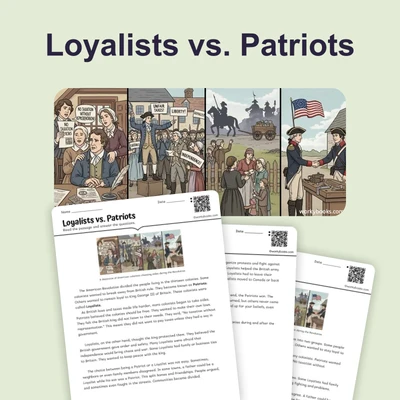
Colonial society was divided. Not everyone wanted to break away from Britain. Some, called Loyalists, remained faithful to the king. This division created tension and even violence between neighbors. Patriots faced the difficult problem of persuading others to join their cause. Through pamphlets, speeches, and town meetings, Patriots argued that British laws and taxes were unfair and violated their rights as English subjects. These efforts built unity but sometimes led to conflict within families and communities.
The motivations for becoming a Patriot were complex. Some colonists were angered by new taxes like the Stamp Act and the Tea Act, which they saw as unjust. Others were inspired by Enlightenment ideas about liberty and government by the people. A few hoped for economic gain or social advancement. For many, the principle of representation—the belief that colonists should have a voice in their own laws—was crucial. The risk was great: Patriots who failed could be punished as traitors.
The war demanded enormous sacrifice. Patriots volunteered as soldiers, supplied food and clothing, and sheltered fighters. Women played vital roles by managing businesses, nursing the wounded, and spreading news. African Americans and Native Americans also participated, though their reasons and experiences varied. Patriots used both peaceful protest and armed rebellion to challenge British authority. Each victory inspired more colonists to join, but losses brought hardship and fear of retribution.
Patriots relied on networks of communication to organize resistance. The Committees of Correspondence shared news and strategies between towns and colonies. When events like the Boston Tea Party and the battles of Lexington and Concord occurred, these networks helped spread the call to action. Over time, the movement for independence grew stronger and more coordinated, leading to the Declaration of Independence in 1776.
The legacy of the Patriots is complex. Their courage helped create a new nation based on the ideals of liberty and self-government. However, their struggle also exposed deep divisions and left lasting challenges. By studying the choices and sacrifices of ordinary people, historians better understand the true cost and meaning of the American Revolution.
Interesting Fact: Some Patriots, such as Paul Revere, were also skilled artisans, using their craft—like silversmithing—to support the cause and spread messages of revolution.
Who were Patriots?
Colonists who wanted independenceBritish soldiersNative Americans onlyPeople loyal to the king
What did Loyalists support?
Independence from BritainStaying loyal to BritainFrench ruleColonial self-government
When was the Declaration of Independence adopted?
1765177617891800
Why did Patriots use pamphlets?
To spread ideasTo collect taxesTo make lawsTo farm
What was a major risk for Patriots?
Losing property and livesGaining new landBecoming LoyalistsGetting rich
How did Patriots organize resistance?
Through Committees of CorrespondenceBy moving to BritainBy ignoring British lawsBy trading with France
Patriots were only farmers. True or false?
TrueFalse
What does "sacrifice" mean in this passage?
Giving up for a causeMaking lawsGaining wealthVoting for king
Perfect For:
👩🏫 Teachers
• Reading comprehension practice
• Auto-graded assessments
• Literacy skill development
👨👩👧👦 Parents
• Reading practice at home
• Comprehension improvement
• Educational reading time
🏠 Homeschoolers
• Reading curriculum support
• Independent reading practice
• Progress monitoring
Reading Features:
📖
Reading Passage
Engaging fiction or nonfiction text
❓
Comprehension Quiz
Auto-graded questions
📊
Instant Feedback
Immediate results and scoring
📄
Printable Version
Download for offline reading
🔊
Read Aloud
Voice-over with word highlighting
Reviews & Ratings
No reviews yet. Be the first to share your experience!
Related Content
Native American Tribes Across America
This engaging history reading passage introduces students to Native American tribes across America, focusing on their da...
D2.HIS.1.3-5D2.HIS.2.3-5RI.4.1RI.4.2
Teepees: Homes on the Great Plains
This engaging history reading passage introduces students to teepees, the unique homes of Native American tribes on the ...
D2.HIS.2.3-5D2.HIS.14.3-5RI.4.1RI.4.2RI.4.4
Traditional Native American Clothing
This engaging history passage explores traditional Native American clothing and how it reflected the environment, values...
D2.HIS.2.3-5D2.HIS.3.3-5RI.4.3RI.4.4
The Iroquois Confederacy: A System of Peace
This engaging U.S. History reading passage introduces students to the Iroquois Confederacy, a powerful alliance of Nativ...
D2.HIS.2.3-5D2.HIS.3.3-5RI.4.3RI.4.4
The Cherokee Nation: History and Culture
This reading passage explores the rich history and culture of the Cherokee Nation, one of the largest Native American tr...
D2.HIS.2.3-5D2.HIS.14.3-5RI.4.3RI.4.4RI.4.10
The Sioux: Warriors and Tribal Leaders
This history reading passage explores the Sioux Nation, focusing on their roles as warriors and tribal leaders. Students...
D2.HIS.1.3-5D2.HIS.2.3-5RI.4.1RI.4.3
Native American Respect for Nature
This engaging history reading passage explores Native American respect for nature, emphasizing the close relationship be...
D2.HIS.2.3-5D2.HIS.3.3-5RI.4.3RI.4.4
Jamestown: The First Permanent English Colony
This engaging history passage explores the founding of Jamestown, the first permanent English colony in America. Aligned...
D2.HIS.1.3-5D2.HIS.2.3-5RI.4.3RI.4.4
Pocahontas and the Powhatan People
This engaging reading passage explores the life of Pocahontas and the Powhatan people and their important role in early ...
D2.HIS.1.3-5D2.HIS.2.3-5RI.4.1RI.4.3
Colonial Children: School and Chores
This reading passage explores the daily lives of colonial children, focusing on their experiences at school and their ma...
D2.HIS.2.3-5D2.HIS.3.3-5RI.4.1RI.4.2RI.4.4
Colonial Clothing and Homemade Goods
This engaging U.S. history passage explores the daily life of early American colonists with a focus on colonial clothing...
D2.HIS.2.3-5RI.4.3RI.4.4
Colonial Jobs: Blacksmiths, Bakers, and Craftsmen
This engaging history reading passage explores the vital roles of blacksmiths, bakers, and craftsmen in colonial America...
D2.HIS.2.3-5D2.HIS.3.3-5RI.4.3RI.4.4
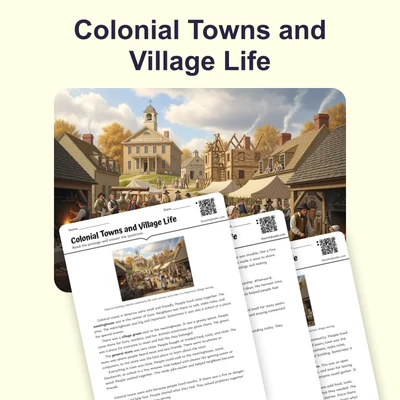
Colonial Towns and Village Life
This engaging history reading passage explores the daily life, work, and unity found in colonial towns and villages. Ali...
D2.HIS.1.3-5D2.HIS.2.3-5RI.4.3RI.4.4
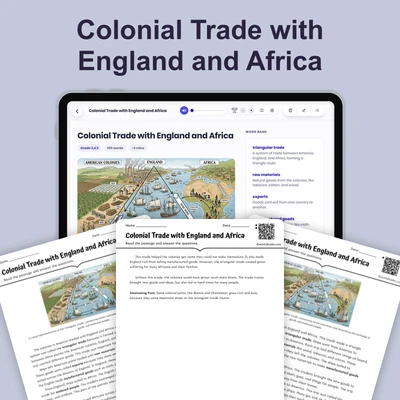
Colonial Trade with England and Africa
This history reading passage explores colonial trade between the American colonies, England, and Africa, focusing on the...
D2.HIS.2.3-5D2.HIS.14.3-5RI.4.3RI.4.4
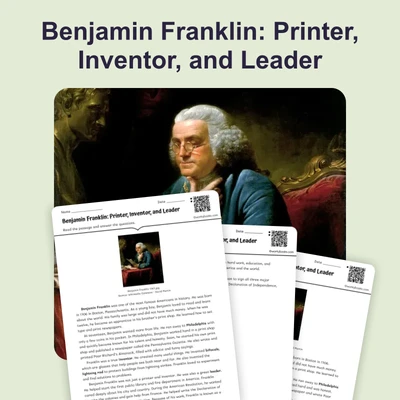
Benjamin Franklin: Printer, Inventor, and Leader
This history reading passage explores the life and achievements of Benjamin Franklin, one of America's most important ea...
D2.HIS.2.3-5D2.HIS.3.3-5RI.4.1RI.4.3
George Washington Leads the Army
This engaging history reading passage explores how George Washington bravely led the Continental Army during the America...
D2.HIS.1.3-5D2.HIS.2.3-5RI.4.3RI.4.4
Women and Children During the Revolutionary War
This reading passage explores the important roles women and children played during the Revolutionary War. Students will ...
D2.HIS.2.3-5RI.4.3RI.5.3
African Americans Fight for Freedom
This educational passage explores the brave and inspiring story of how African Americans fought for freedom in the Unite...
D2.HIS.2.3-5D2.HIS.3.3-5RI.4.3RI.4.4
The Battle of Yorktown Ends War
This engaging U.S. history reading passage explores the Battle of Yorktown, a key event that ended the American Revoluti...
D2.HIS.1.3-5D2.HIS.2.3-5RI.4.1RI.4.3
Loyalists vs. Patriots: Divided Families
This engaging U.S. history reading passage explores the division between Loyalists and Patriots during the American Revo...