Americanization Movement: Forced Assimilation Policy
Interactive passage with audio narration, comprehension questions, and printable PDF.
By completing this purchase you agree to our Terms of Use and Privacy Policy. Your subscription renews automatically until you cancel. You can cancel anytime from your account settings. All sales are final and non-refundable. Digital content is available for download in your account immediately upon purchase.
What's included
Americanization Movement: Forced Assimilation Policy preview and details
About this printable Americanization Movement: Forced Assimilation Policy reading passage (Grades 6-8)
Sample passage and quiz from Americanization Movement: Forced Assimilation Policy
Reading passage and comprehension quiz preview
Americanization Movement: Immigrant Integration
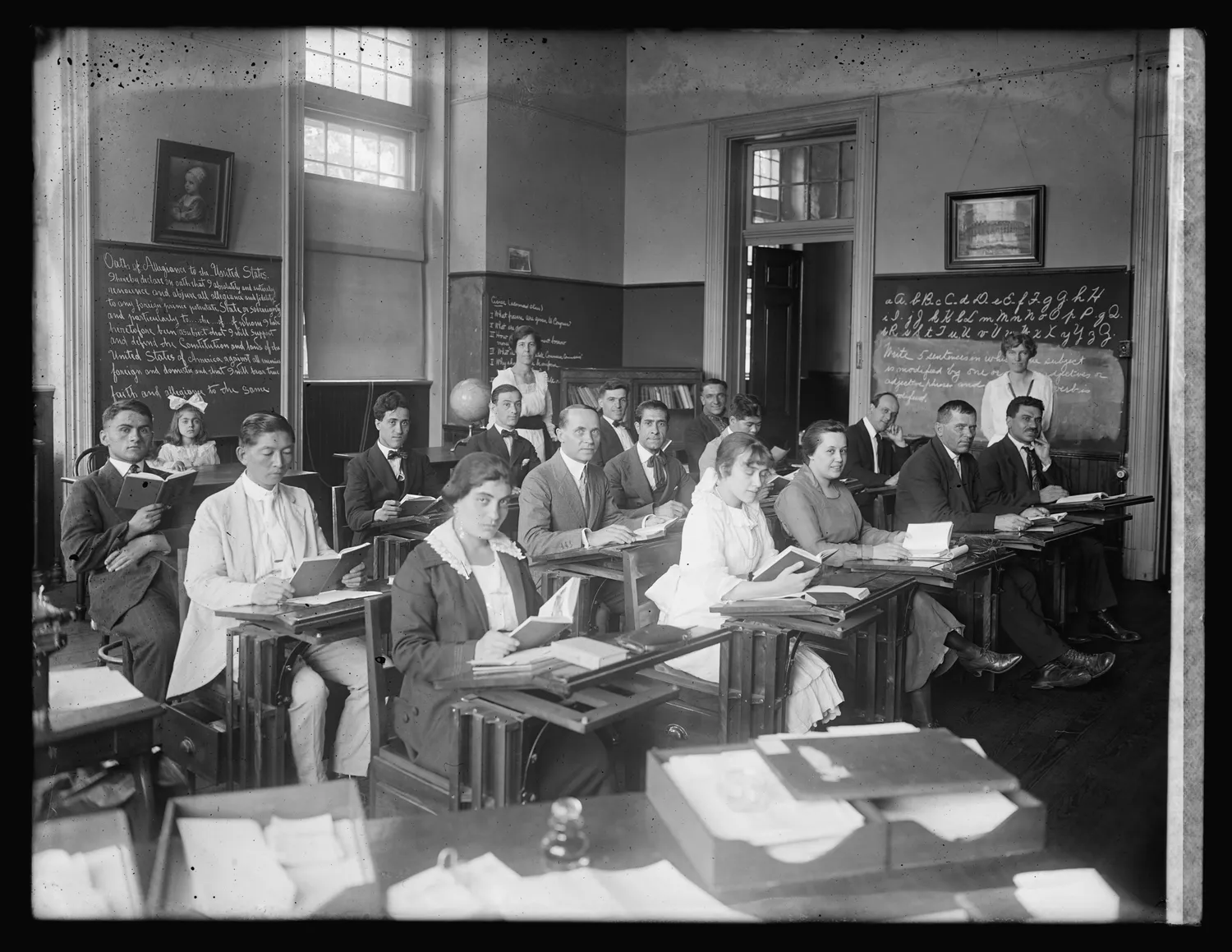
"Americanization class LCCN2016852098" by National Photo Company Collection / Wikimedia Commons (Public domain).
During the Progressive Era in the United States, the Americanization movement sought to help immigrants adapt to their new country. Millions of people arrived from Europe, Asia, and other regions between the late 1800s and early 1900s. Many Americans believed that for society to function smoothly, newcomers should learn English and adopt American customs, values, and practices. The movement aimed to promote assimilation, which means absorbing newcomers into the dominant society, but it also raised important questions about identity and cultural change.
One major problem was how immigrants could succeed in the United States while keeping their own cultural traditions. Organizations such as settlement houses and public schools became centers for teaching English, American history, and civics. Teachers and social workers encouraged integration, meaning bringing people of different backgrounds together into society. Lessons often focused on obeying laws, respecting American holidays, and understanding what it means to be a citizen. Employers also offered classes, hoping workers would become more productive if they understood English and workplace rules.
However, not all immigrants wanted to give up their native languages or customs. Some families blended old and new traditions, celebrating both American holidays and those from their home countries. Others formed ethnic neighborhoods, where they could speak their native language and practice familiar customs. This process of balancing old and new identities created both cooperation and conflict. For example, some Americans feared that immigrants who did not fully assimilate would threaten national unity, while others valued the diversity immigrants brought to American culture.
Despite these tensions, many immigrants saw learning English and U.S. history as essential for success. Gaining citizenship was an important goal, giving immigrants the right to vote and participate in American democracy. Becoming a citizen required passing tests in English and civics. Settlement houses, like Jane Addams’s Hull House in Chicago, played a major role in supporting immigrant families, providing not only education but also food, housing, and job assistance. These efforts showed the dual goals of the Americanization movement: helping immigrants succeed and creating a more unified nation.
The Americanization movement changed both immigrants and the United States. While many newcomers did adopt American customs, they also influenced the broader society with their foods, music, and ideas. Over time, the definition of what it means to be "American" became more flexible, shaped by the cultures of many different people. Today, debates about assimilation and integration continue, as new groups arrive and add to the nation’s diversity.
Interesting Fact: By 1920, more than 2 million immigrants were attending Americanization classes in schools, factories, and community centers across the country.
Comprehension quiz (8 questions)
1. What was the main goal of Americanization?
2. Which group helped immigrants the most?
3. What was needed for citizenship?
4. Why did some immigrants keep old traditions?
5. How did Americanization affect U.S. society?
6. What was a challenge for immigrants?
7. The Americanization movement started in the 1800s.
8. What does 'assimilation' mean?
Common Core standards for Americanization Movement: Forced Assimilation Policy
Explain events, procedures, ideas, or concepts in a historical, scientific, or technical text, including what happened and why, based on specific information in the text.
Determine the meaning of general academic and domain-specific words or phrases in a text relevant to a grade 4 topic or subject area.
Write informative/explanatory texts to examine a topic and convey ideas and information clearly.
Perfect for the way you teach
- Build comprehension skills
- Auto-graded quiz
- Differentiated reading
- Read together at home
- Improve fluency
- Quiet reading time
- Reading curriculum support
- Independent practice
- Track Lexile growth