Anaconda Plan: Union Strategy Explained
Interactive passage with audio narration, comprehension questions, and printable PDF.
By completing this purchase you agree to our Terms of Use and Privacy Policy. Your subscription renews automatically until you cancel. You can cancel anytime from your account settings. All sales are final and non-refundable. Digital content is available for download in your account immediately upon purchase.
What's included
Anaconda Plan: Union Strategy Explained preview and details
About this printable Anaconda Plan: Union Strategy Explained reading passage (Grades 6-8)
Sample passage and quiz from Anaconda Plan: Union Strategy Explained
Reading passage and comprehension quiz preview
Anaconda Plan
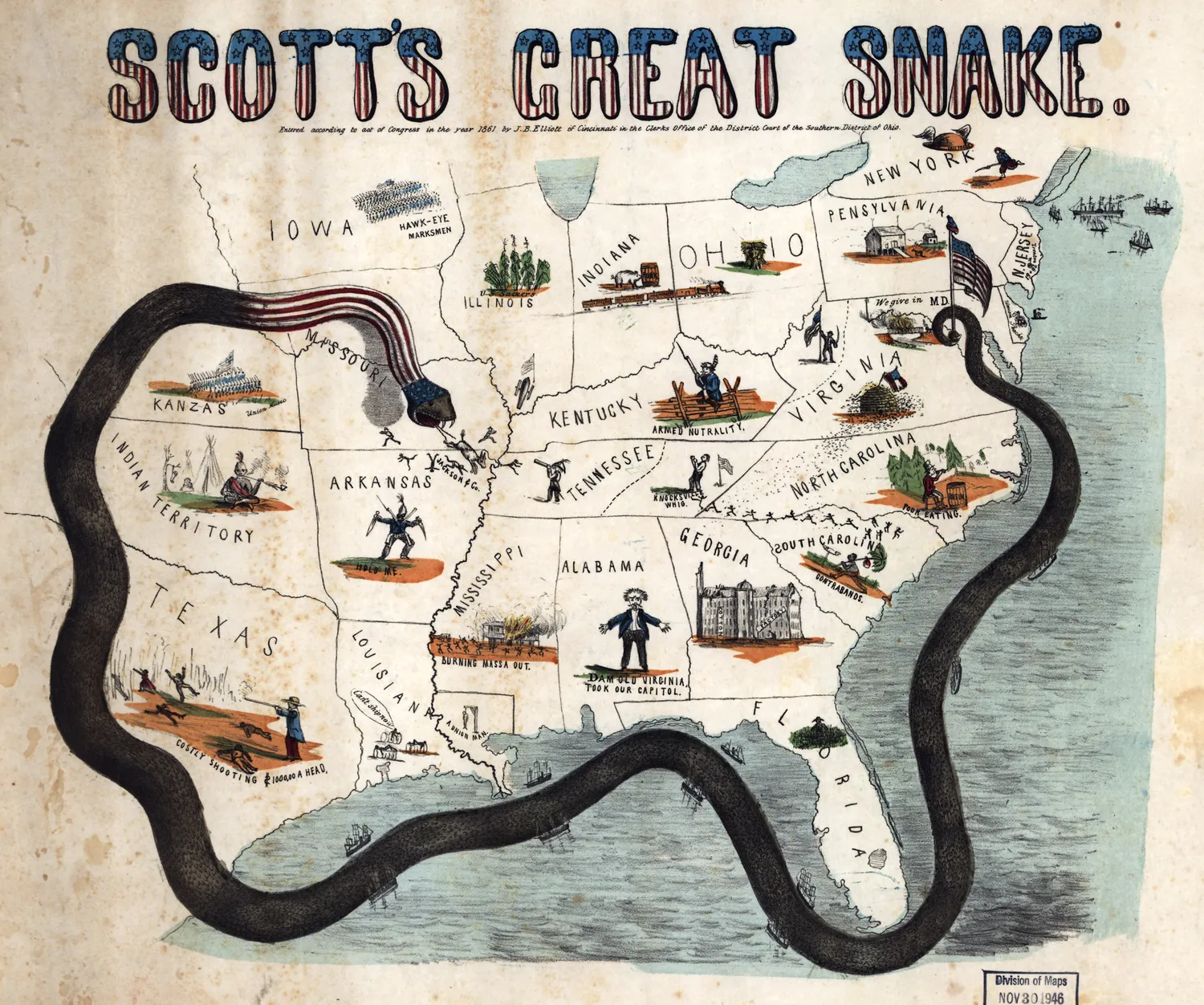
Scott-anaconda by J.B. Elliott / Wikimedia Commons
The Anaconda Plan was the main military strategy used by the Union during the American Civil War. Designed by General Winfield Scott in 1861, the plan aimed to defeat the Confederacy by cutting off its supplies and weakening its economy. The name 'Anaconda' came from the idea of slowly squeezing the South, just like an anaconda snake squeezes its prey. This plan focused on two major goals: creating a blockade of Southern ports and gaining control of the Mississippi River.
One major challenge facing the Union was the vast size of the Confederacy and its many miles of coastline. Southern states relied heavily on trade, especially the export of cotton to Europe, to support their war effort. By blocking these ports, the Union hoped to prevent goods, weapons, and supplies from reaching Confederate soldiers. The blockade required a strong navy and advanced ships, which the Union worked hard to build and deploy. Although it was difficult to stop every ship, the blockade gradually reduced the flow of supplies to the South.
Controlling the Mississippi River was the second part of the Anaconda Plan. The river was a critical transportation route for people and goods. By capturing key cities like Vicksburg and New Orleans, the Union could split the Confederacy in two. This would make it much harder for the Southern states to support each other, move troops, or transfer resources. The Union navy and army coordinated closely in several major campaigns to achieve this objective.
At first, some Union leaders doubted the effectiveness of the Anaconda Plan. They believed the war would be decided quickly by large battles instead. However, as the conflict dragged on and direct attacks failed to end the war, the importance of economic pressure became clear. The slow but steady blockade and river operations began to cripple the Southern infrastructure and morale. Factories closed, railroads were damaged, and shortages increased for both soldiers and civilians.
The Anaconda Plan was not perfect and faced significant difficulties. Southern blockade runners sometimes managed to sneak past Union ships, bringing in much-needed supplies. Still, by 1863, the Union had captured key positions along the Mississippi River, and the blockade was much tighter. This contributed to the eventual surrender of the Confederacy in 1865 and shaped the outcome of the Civil War.
In conclusion, the Anaconda Plan combined military action with economic tactics to slowly defeat the South. Its success demonstrated the importance of strategy, coordination, and patience in wartime. The Union's ability to adapt and improve the plan over time played a major role in winning the war.
Interesting Fact: The Anaconda Plan was criticized at first for being too slow, but in the end, its gradual approach played a crucial part in the Union's victory.
Comprehension quiz (8 questions)
1. Who created the Anaconda Plan?
2. What river was key to the plan?
3. When did the Confederacy surrender?
4. Why did the Union blockade Southern ports?
5. What was the effect of controlling the Mississippi River?
6. How did the Union achieve the blockade?
7. The Anaconda Plan used economic tactics.
8. What does 'blockade' mean in the passage?
Common Core standards for Anaconda Plan: Union Strategy Explained
Explain events, procedures, ideas, or concepts in a historical, scientific, or technical text, including what happened and why, based on specific information in the text.
Determine the meaning of general academic and domain-specific words or phrases in a text relevant to a grade 4 topic or subject area.
Write informative/explanatory texts to examine a topic and convey ideas and information clearly.
Perfect for the way you teach
- Build comprehension skills
- Auto-graded quiz
- Differentiated reading
- Read together at home
- Improve fluency
- Quiet reading time
- Reading curriculum support
- Independent practice
- Track Lexile growth