Ancient Engineering Marvels
Interactive passage with audio narration, comprehension questions, and printable PDF.
By completing this purchase you agree to our Terms of Use and Privacy Policy. Your subscription renews automatically until you cancel. You can cancel anytime from your account settings. All sales are final and non-refundable. Digital content is available for download in your account immediately upon purchase.
What's included
Ancient Engineering Marvels preview and details
About this printable Ancient Engineering Marvels reading passage (Grades 6-8)
Sample passage and quiz from Ancient Engineering Marvels
Reading passage and comprehension quiz preview
Ancient Engineering Marvels
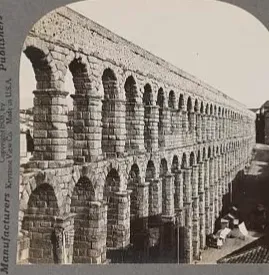
"The old Roman aqueduct, Segovia, Spain" by Keystone View Company / Library of Congress.
Ancient civilizations developed remarkable infrastructure to improve daily life, protect their people, and expand their power. From the Great Wall of China to Roman roads and aqueducts, these engineering achievements reveal how societies used knowledge and teamwork to solve complex problems. These structures not only shaped the landscape, but also influenced trade, military defense, and social organization.
One of the best-known engineering feats is the Great Wall of China. Construction began in the 7th century BCE and continued for centuries, with much of the wall built during the Ming dynasty (1368–1644 CE). The wall stretches over 13,000 miles and was designed to protect Chinese empires from invasions by northern tribes. Archaeological evidence, such as ancient bricks and watchtowers, shows the use of local materials and the labor of soldiers, peasants, and prisoners. The wall also served as a symbol of imperial authority and demonstrated the government’s ability to mobilize large numbers of people for a common cause.
Another extraordinary achievement was the Roman system of roads and aqueducts. By 200 CE, the Romans had constructed over 50,000 miles of roads across Europe, North Africa, and the Middle East. These roads enabled the swift movement of armies, goods, and information. Some Roman roads, like the Via Appia, are still visible today. Roman aqueducts, such as the Pont du Gard in France, carried fresh water over great distances to cities and baths. Engineers used arches and precise measurements to ensure water flowed smoothly. Written records by authors like Frontinus, a Roman water commissioner, document the importance of these systems for public health and the growth of cities.
In Mesopotamia and Egypt, ancient peoples created irrigation networks to control rivers and support agriculture. Archaeological findings, such as old canal remains and cuneiform tablets, show that farmers built dikes, canals, and reservoirs as early as 3000 BCE. These innovations allowed civilizations to produce surplus food, which supported population growth and increased social complexity. Control of water became linked to political power, as leaders organized labor and made decisions about resource distribution.
These engineering marvels were not only technical achievements but also social and political tools. They reflected the priorities of rulers and the needs of ordinary people. Over time, such innovations spread between cultures through conquest, trade, and cultural diffusion. The legacy of ancient engineering is still visible today and reminds us of the human capacity to shape the environment.
In studying these structures, historians see how geography, resources, and leadership influenced the rise and fall of civilizations. Understanding ancient engineering connects to broader themes of world history, such as the development of technology, the growth of empires, and the interaction between people and the environment.
Interesting Fact: The Roman aqueducts were so well built that some, like the Aqua Virgo, still supply water to fountains in modern Rome today.
Comprehension quiz (8 questions)
1. When did the Ming dynasty build much of the Great Wall?
2. Which structure carried water to Roman cities?
3. What was one purpose of Roman roads?
4. How did irrigation help ancient societies?
5. Why was the Great Wall built?
6. What does cultural diffusion mean?
7. Roman aqueducts still supply water today.
8. What is infrastructure?
Perfect for the way you teach
- Build comprehension skills
- Auto-graded quiz
- Differentiated reading
- Read together at home
- Improve fluency
- Quiet reading time
- Reading curriculum support
- Independent practice
- Track Lexile growth