Are Constellation Stars Really Together
Interactive passage with audio narration, comprehension questions, and printable PDF.
By completing this purchase you agree to our Terms of Use and Privacy Policy. Your subscription renews automatically until you cancel. You can cancel anytime from your account settings. All sales are final and non-refundable. Digital content is available for download in your account immediately upon purchase.
What's included
Are Constellation Stars Really Together preview and details
About this printable Are Constellation Stars Really Together science reading passage, NGSS-aligned (Grades 5-8)
Sample passage and quiz from Are Constellation Stars Really Together
Reading passage and comprehension quiz preview
Are Constellation Stars Really Together
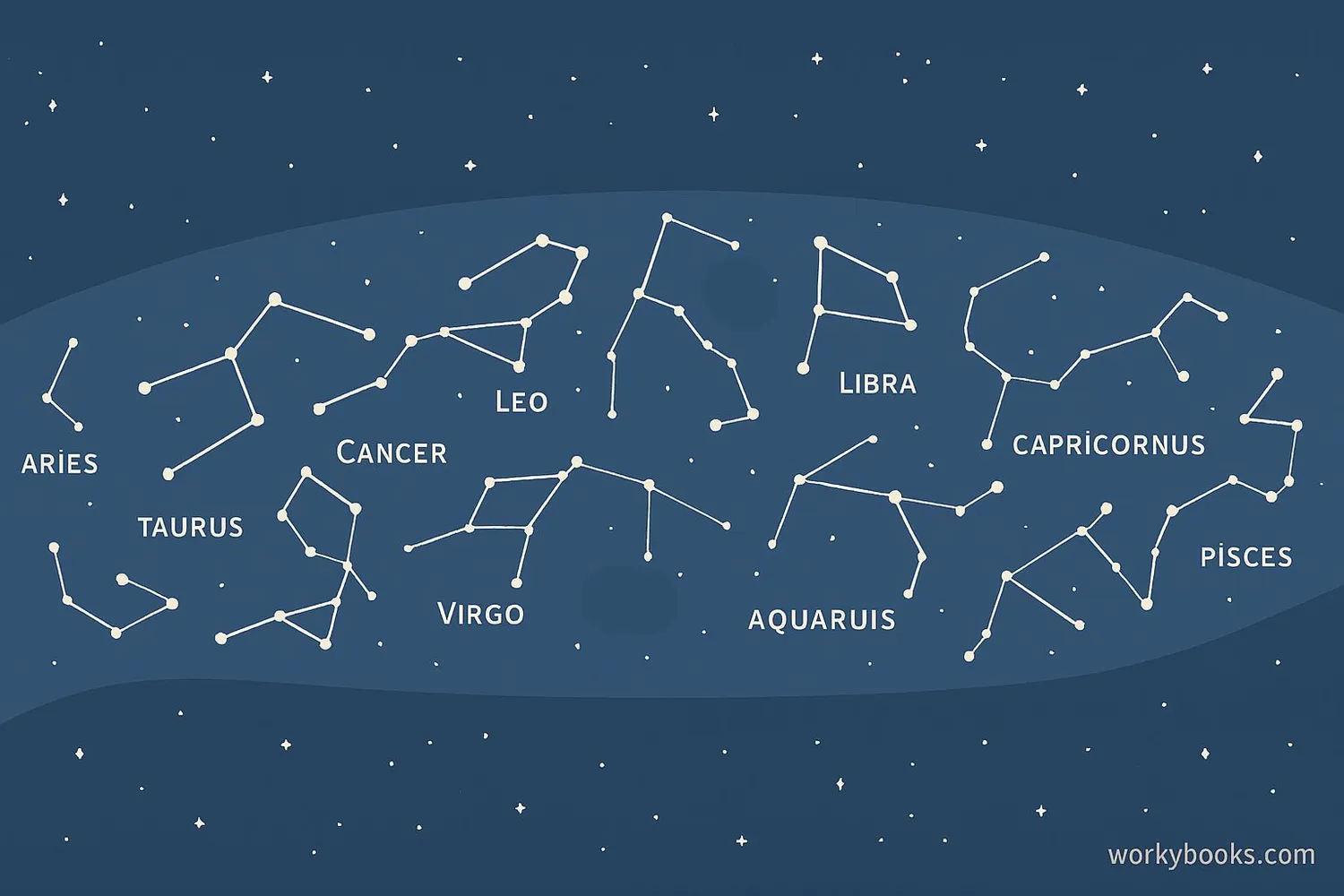
When you look up at the night sky, you might see patterns of stars that form shapes. These patterns are called constellations. Many people think the stars in a constellation are close together in space. However, this is not true. The stars only appear close from Earth's view.
Scientists explain that stars in a constellation sit at vastly different distances from Earth. Some stars may be hundreds or thousands of light-years apart from each other. A light-year is the distance light travels in one year. This equals about 6 trillion miles. When we observe stars from Earth, we see them on a flat sky. This creates an illusion of closeness. In reality, one star might be much closer to us than another.
The reason constellations exist is because of perspective. Perspective is how things appear from a particular viewing point. Imagine standing on a road and looking at telephone poles stretching into the distance. The poles appear to get closer together as they move away from you. They are not actually moving closer. Your viewing angle creates this effect. The same thing happens with stars. From Earth, distant stars can appear next to nearby stars.
Evidence shows that humans naturally see patterns in random arrangements. This tendency helped ancient cultures organize and remember the night sky. Different civilizations created their own constellations based on their myths and stories. For example, the constellation Orion contains seven bright stars. The star Betelgeuse is about 550 light-years from Earth. The star Rigel is roughly 860 light-years away. The star Bellatrix sits around 250 light-years from us. These stars are not a true group in space. They just happen to line up from our view on Earth.
Understanding that constellations are illusions helps scientists study the universe more accurately. Astronomers measure actual distances to stars using special tools and methods. They map the three-dimensional positions of celestial objects. This work reveals the true structure of our galaxy. It shows that what we see in the sky can be very different from what actually exists in space. Recognizing this difference is important for understanding how the universe is organized.
Interesting Fact: If you could travel to another planet far from Earth, the constellations would look completely different. The familiar patterns we see would disappear because your viewing perspective would change.
Comprehension quiz (10 questions)
1. What are constellations?
2. According to the passage, why do constellation stars appear close together from Earth?
3. What is a light-year?
4. In the passage, the word 'perspective' means:
5. Which example from the passage demonstrates that constellation stars are at different distances?
6. Why did ancient cultures create constellations?
7. If you traveled to a planet far from Earth, what would happen to the constellation patterns you see?
8. How do astronomers study the true positions of stars in space?
9. True or False: Stars in a constellation are physically grouped together in space.
10. True or False: Humans naturally see patterns even in random arrangements of objects.
Perfect for the way you teach
- Build comprehension skills
- Auto-graded quiz
- Differentiated reading
- Read together at home
- Improve fluency
- Quiet reading time
- Reading curriculum support
- Independent practice
- Track Lexile growth