This learning resource is available in interactive and printable formats. The interactive worksheet can be played online and assigned to students. The Printable PDF version can be downloaded and printed for completion by hand.
This comprehensive science passage for grades 6-8 delves into the fascinating end stages of massive stars, aligning closely with NGSS standard MS-ESS1-1. Students will explore how massive stars evolve rapidly, fusing elements in layered shells until they reach iron, which triggers a core collapse and a dramatic supernova explosion. The passage explains the mechanisms behind these processes, the types of supernovae, and the formation of neutron stars or black holes depending on the star’s mass. It also highlights the crucial role supernovae play in creating and spreading heavy elements necessary for life across the universe—summed up in the famous phrase, "We are star stuff." Supporting activities include a glossary, comprehension quiz, writing prompts, and graphic organizers to help students deepen their understanding. Integrated audio features make learning accessible for all students.
CONTENT PREVIEW
Expand content preview
Death of Massive Stars
Massive stars are among the brightest and most influential objects in the universe. Unlike lower-mass stars like our Sun, these giants end their lives in dramatic and powerful ways. Astronomers have discovered that the deaths of massive stars are crucial for creating the elements that make planets, technology, and even our bodies. Understanding the end stages of massive stars helps explain how the universe evolves and why life exists.
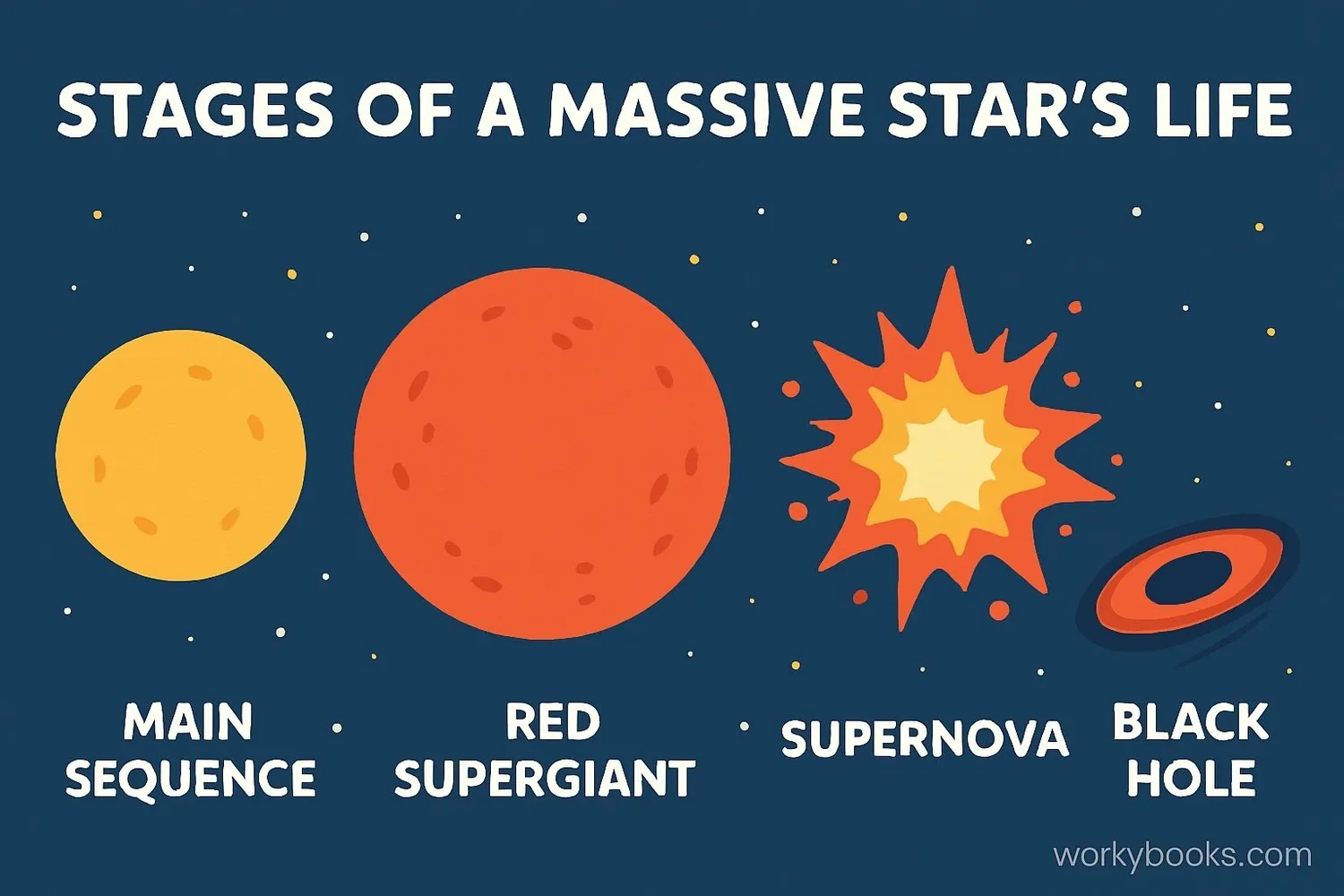
How Massive Stars Die: The Fusion Process Massive stars live fast and die young. Because of their huge mass—at least eight times the mass of the Sun—they burn through their fuel much more quickly than smaller stars. Inside their cores, nuclear fusion reactions turn lighter elements into heavier ones, releasing enormous amounts of energy. These stars first fuse hydrogen into helium, then progress through a series of fusion stages: helium to carbon, then to neon, oxygen, silicon, and finally iron. Each stage forms a new layer, creating an 'onion-like' structure with different elements fusing in shells. However, when the core fills with iron, fusion stops producing energy—iron fusion actually absorbs energy instead of releasing it. Without outward pressure to balance gravity, the star’s core collapses in less than a second.
Supernova Explosions and Their Outcomes The sudden core collapse causes the core to implode and then rebound, creating a shockwave. This violent event triggers a supernova—a massive explosion that can briefly outshine an entire galaxy. Supernovae disperse heavy elements like gold, silver, and uranium into space, enriching the universe and making new solar systems possible. The type of remnant left behind depends on the star’s original mass: stars with 8–20 solar masses form neutron stars, while those greater than 20 solar masses can become black holes. Astronomers categorize supernovae by their light and spectra; Type II supernovae show hydrogen, while Type Ia involve white dwarfs and have a different cause.
Why the Death of Massive Stars Matters Supernovae are not just spectacular—they are essential for life. The heavy elements created and spread by these explosions are necessary for making planets, water, and living things. Without supernovae, the universe would lack the raw materials for biology and technology. Scientists know about these processes through the study of light, spectra, and cosmic debris from past supernovae. This evidence shows that every atom of gold or oxygen on Earth was forged in the heart of a dying star. The famous astronomer Carl Sagan summed it up: “We are star stuff.”
Interesting Fact: In 1987, astronomers observed a supernova in a nearby galaxy that was visible to the naked eye, helping confirm how stars explode and spread elements through space.
What is the main reason massive stars die much faster than smaller stars?
They use their fuel much more quickly.They are colder than small stars.They are closer to Earth.They do not contain hydrogen.
What happens in the core of a massive star when it fills with iron?
Fusion stops making energy and the core collapses.The star gets cooler and expands slowly.Helium fusion begins for the first time.The star turns into a planet.
What is a supernova?
A huge explosion marking the death of a massive star.A type of small planet orbiting a star.A stage when a star turns into hydrogen.A layer inside a star where fusion happens.
What is a neutron star?
A very dense remnant of a massive star after a supernova.A type of planet with a strong magnetic field.A layer of helium inside a star.A star that is smaller than the Sun.
What is meant by an 'onion-like' structure in massive stars?
Layers of different elements fusing in shells.Stars that are shaped like onions.A core full of water and carbon dioxide.A star that is made only of hydrogen.
What does the word 'fusion' mean in the passage?
Combining small atoms to make heavier atoms and release energy.Breaking apart heavy atoms into smaller pieces.A type of explosion that destroys stars.The process of cooling down a star's core.
Which process spreads heavy elements like gold and uranium into space?
A supernova explosion.Slow burning of fuel in a small star.The cooling of a black hole.Formation of onion-like layers.
Why is the death of massive stars important to life on Earth?
Supernovae create and spread elements needed for life and planets.They help stars live longer.They make stars colder and older.They absorb all the energy in the universe.
True or False: When a massive star's core is full of iron, fusion absorbs energy instead of releasing it.
TrueFalse
True or False: Only small stars can become black holes after they die.
TrueFalse
Perfect For:
👩🏫 Teachers
• Reading comprehension practice
• Auto-graded assessments
• Literacy skill development
👨👩👧👦 Parents
• Reading practice at home
• Comprehension improvement
• Educational reading time
🏠 Homeschoolers
• Reading curriculum support
• Independent reading practice
• Progress monitoring
Reading Features:
📖
Reading Passage
Engaging fiction or nonfiction text
❓
Comprehension Quiz
Auto-graded questions
📊
Instant Feedback
Immediate results and scoring
📄
Printable Version
Download for offline reading
🔊
Read Aloud
Voice-over with word highlighting
Reviews & Ratings
No reviews yet. Be the first to share your experience!
Related Content
What is Solar Radiation
This NGSS-aligned science reading passage for middle school students explores the concept of solar radiation. Solar radi...
MS-ESS1-1
How Incoming Solar Radiation Changes with Latitude
This NGSS-aligned science reading passage helps middle school students understand how solar radiation, or insolation, ch...
MS-ESS1-1
Tides and Tidal Forces
This middle school science passage explores the mechanisms of tides and tidal forces, aligning with NGSS standards MS-ES...
MS-ESS1-1MS-ESS1-2
The Night Sky
This comprehensive science reading passage for grades 6-8 aligns with NGSS standard MS-ESS1-1 and explores the systems a...
MS-ESS1-1
Ancient Astronomy
This engaging passage for grades 6-8 explores the history of astronomy through the lens of ancient observations. Student...
MS-ESS1-1
Tools of Modern Astronomy
This passage introduces middle school students to modern astronomy, aligning with NGSS standard MS-ESS1-1. It explains h...
MS-ESS1-1
How Astronomy Became a Science
This passage explores the transformative period known as the Scientific Revolution, with a special focus on the history ...
MS-ESS1-1
Earth's Rotation
This middle school science passage, aligned with NGSS standard MS-ESS1-1, focuses on Earth's rotation—how Earth spins on...
MS-ESS1-1
Earth's Revolution
This middle school science passage explores the science behind Earth's revolution around the Sun, closely aligned with N...
MS-ESS1-1
Why We Have Seasons
This comprehensive middle school science reading passage explains the mechanisms behind Earth's seasons, directly addres...
MS-ESS1-1
Earth's Seasons
This comprehensive reading passage for grades 6-8 explains why Earth has seasons, revealing the scientific mechanisms be...
MS-ESS1-1
Phases of the Moon
This comprehensive middle school science passage explains the phases of the Moon, focusing on the mechanisms behind the ...
MS-ESS1-1
Tides
This comprehensive middle school science reading passage explores the phenomenon of ocean tides, aligned to NGSS standar...
MS-ESS1-1MS-ESS1-2
Eclipses
This comprehensive passage for grades 6-8 explores the science behind eclipses, including solar and lunar eclipses, thei...
MS-ESS1-1
The Moon's Characteristics
This comprehensive science reading passage for grades 6-8 examines the Moon's physical characteristics, including its si...
MS-ESS1-1MS-ESS1-2
Lunar Eclipses
This passage introduces middle school students to the phenomenon of lunar eclipses, connecting observable events to the ...
MS-ESS1-1
The Sun's Characteristics
This engaging science passage introduces middle school students to the Sun’s key characteristics, such as its classifica...
MS-ESS1-1MS-ESS1-2
What Is a Galaxy?
This comprehensive middle school science passage answers the question: What is a galaxy? Aligned to NGSS standard MS-ESS...
MS-ESS1-1
The Milky Way: Our Home Galaxy
This comprehensive science passage introduces middle school students to the Milky Way, the barred spiral galaxy that is ...
MS-ESS1-1
Types of Galaxies
This comprehensive middle school science passage introduces students to the classification and characteristics of galaxi...