Tools of Modern Astronomy
Interactive passage with audio narration, comprehension questions, and printable PDF.
By completing this purchase you agree to our Terms of Use and Privacy Policy. Your subscription renews automatically until you cancel. You can cancel anytime from your account settings. All sales are final and non-refundable. Digital content is available for download in your account immediately upon purchase.
What's included
Tools of Modern Astronomy preview and details
About this printable Tools of Modern Astronomy science reading passage, NGSS-aligned (Grades 5-8)
Sample passage and quiz from Tools of Modern Astronomy
Reading passage and comprehension quiz preview
Tools of Modern Astronomy
Astronomy is the science that studies everything beyond Earth's atmosphere, from planets to distant galaxies. Today, astronomy relies on a wide range of tools and methods to answer some of the universe’s biggest questions, such as how galaxies form and whether life exists elsewhere. The way we study space has changed dramatically over the past century, allowing us to see and understand the cosmos in new ways.
Exploring the Electromagnetic Spectrum
The most important tool in modern astronomy is the electromagnetic spectrum. This spectrum includes all types of energy that travel as waves, such as radio, infrared, visible light, ultraviolet, X-rays, and gamma rays. Visible light—the kind our eyes can see—makes up only a tiny part of this spectrum. Each type of wave reveals different information about space. For example, radio waves can travel through clouds of gas that block visible light, while X-rays show energetic events like explosions near black holes. By observing the same object in multiple wavelengths, astronomers can build a complete picture of its structure, temperature, and activity. This approach, called multi-wavelength astronomy, is crucial for understanding cosmic phenomena.
Technological Advances
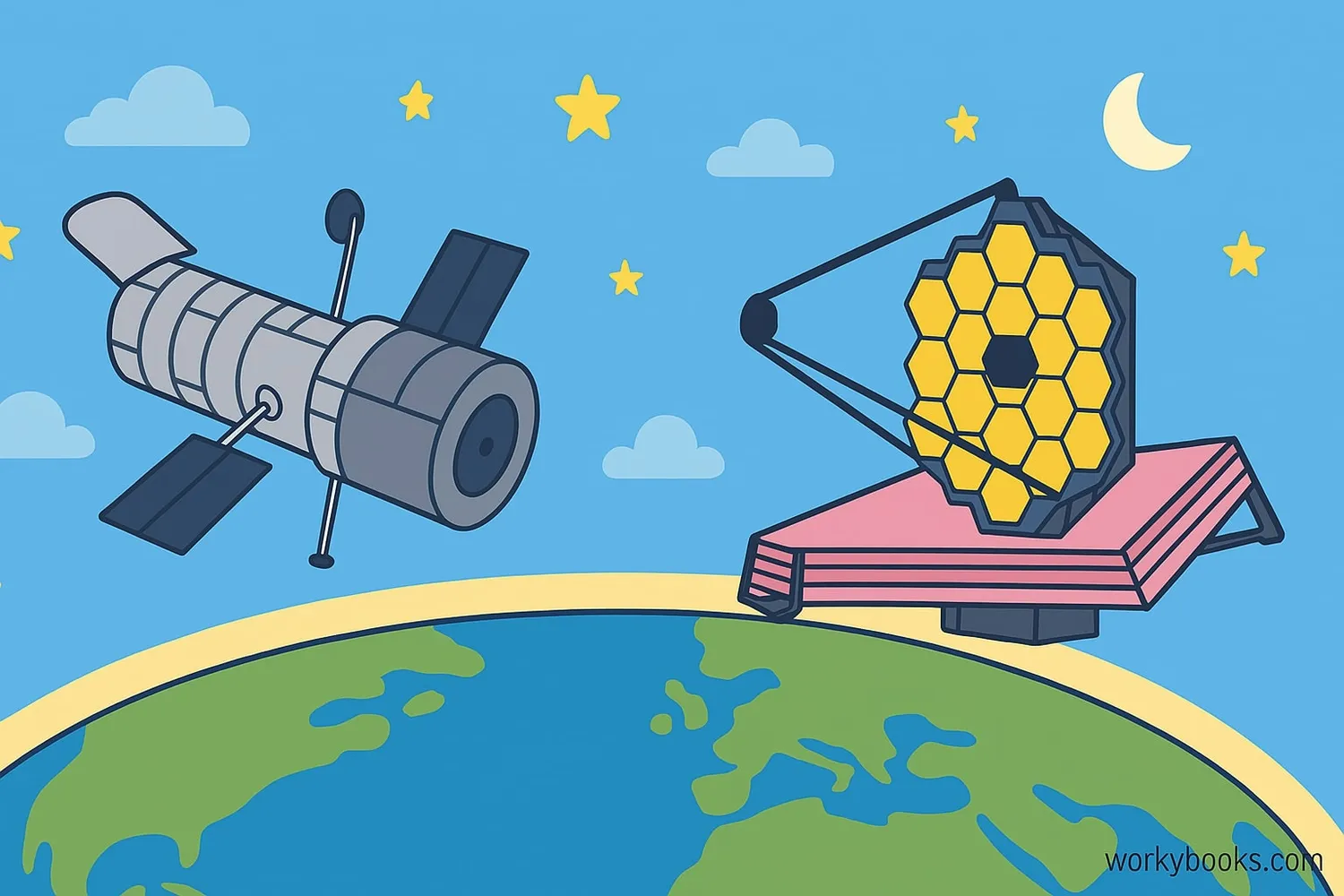
Modern astronomy uses both ground-based telescopes and space-based telescopes. Ground-based telescopes, often built on high mountains, have become larger and more precise, capturing faint light from distant galaxies. However, Earth's atmosphere blocks or distorts some wavelengths, especially ultraviolet, X-rays, and most infrared. Space-based telescopes, like the Hubble Space Telescope, the James Webb Space Telescope, and Chandra X-ray Observatory, orbit above the atmosphere. This allows them to observe the universe in wavelengths that cannot reach the ground. Computer modeling is another essential tool. Astronomers use computer programs to simulate how stars, galaxies, and even the universe itself evolve over time. This helps scientists test ideas and predict what they should observe.
Discoveries and Collaboration
Using these advanced methods, astronomers have made remarkable discoveries. In 1992, the first exoplanets—planets orbiting other stars—were confirmed. Now, thousands have been found, some in the “habitable zone” where liquid water could exist. Scientists have also detected dark matter and dark energy, mysterious substances that make up most of the universe but do not emit light. The cosmic microwave background, the faint glow left from the Big Bang, was mapped in detail, giving clues about the universe’s origins. International collaboration is essential, with observatories around the world sharing data and working together. Computer networks allow astronomers to analyze massive amounts of information and even invite the public to help. Citizen science projects, like Galaxy Zoo and Planet Hunters, let students and amateur astronomers contribute to real discoveries.
Modern astronomy continues to ask big questions, such as: What is dark matter? How do galaxies form and change? Are we alone in the universe? Each new discovery leads to new mysteries, ensuring that the science of astronomy will keep evolving.
Interesting Fact: In 2015, scientists detected gravitational waves—ripples in space-time predicted by Einstein—which confirmed a century-old theory and opened a new way to observe the cosmos.
Comprehension quiz (10 questions)
1. What is the electromagnetic spectrum?
2. Why are space-based telescopes important for astronomy?
3. Which of the following is NOT mentioned as a discovery made by modern astronomers?
4. What does 'multi-wavelength astronomy' mean in the passage?
5. What is the main reason astronomers use computer modeling?
6. Which of these best describes 'citizen science'?
7. According to the passage, why is international collaboration important in astronomy?
8. Which of these statements is true according to the passage?
9. The Hubble Space Telescope can observe some wavelengths that ground-based telescopes cannot. (True/False)
10. Exoplanets are planets that orbit our Sun. (True/False)
Perfect for the way you teach
- Build comprehension skills
- Auto-graded quiz
- Differentiated reading
- Read together at home
- Improve fluency
- Quiet reading time
- Reading curriculum support
- Independent practice
- Track Lexile growth