The Sun's Characteristics
Interactive passage with audio narration, comprehension questions, and printable PDF.
By completing this purchase you agree to our Terms of Use and Privacy Policy. Your subscription renews automatically until you cancel. You can cancel anytime from your account settings. All sales are final and non-refundable. Digital content is available for download in your account immediately upon purchase.
What's included
The Sun's Characteristics preview and details
About this printable The Sun's Characteristics science reading passage, NGSS-aligned (Grades 5-8)
Sample passage and quiz from The Sun's Characteristics
Reading passage and comprehension quiz preview
The Sun's Characteristics
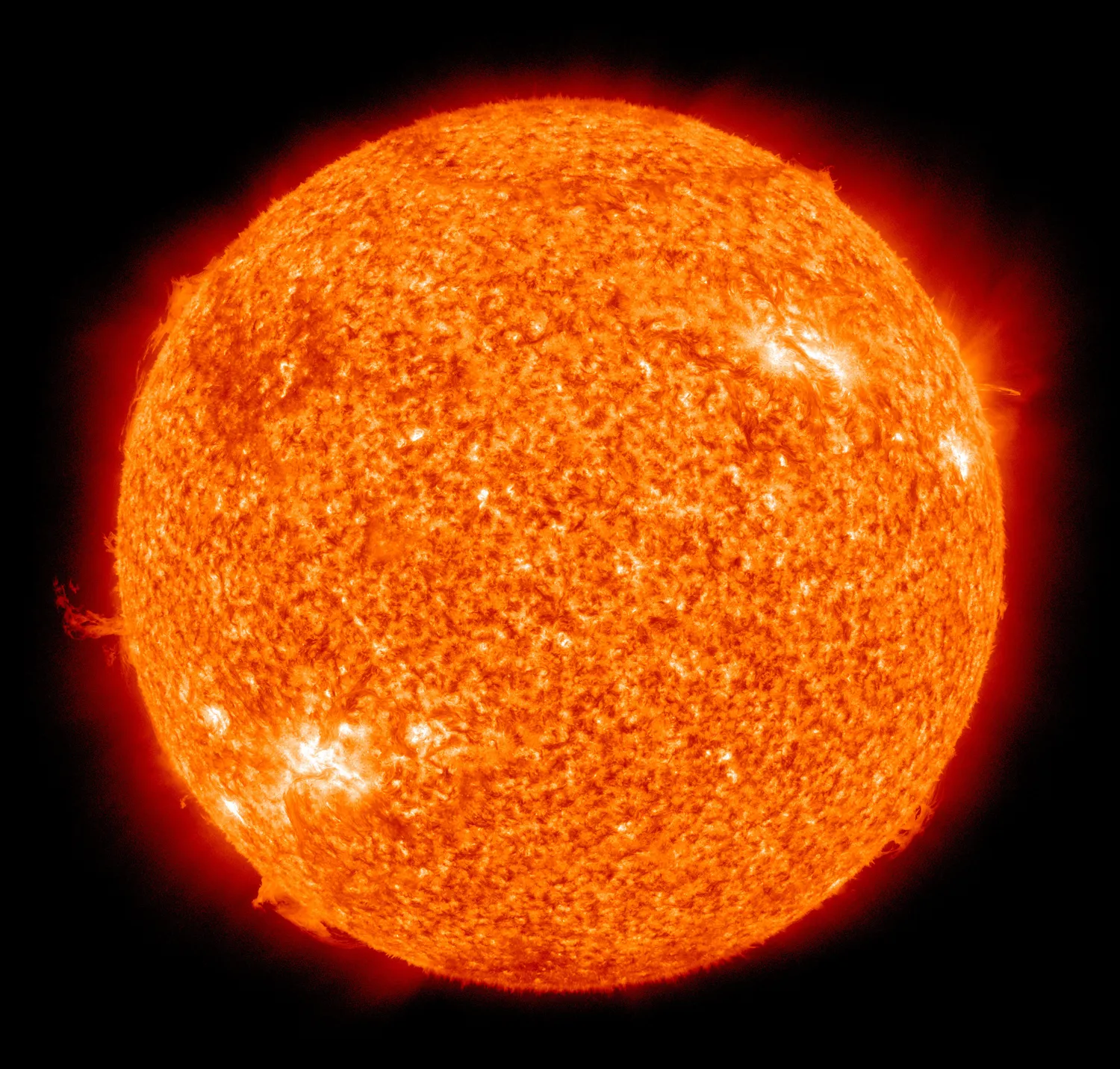
"The Sun" by NASA / Wikimedia Commons (Public domain).
The Sun is the largest and most important object in our solar system. It provides the energy necessary for life on Earth and drives many natural processes, including weather and photosynthesis. Scientists classify the Sun as a G-type main sequence star, also known as a yellow dwarf. Understanding the Sun’s characteristics helps us learn more about our place in the universe and how Earth is able to support life.
Structure and Composition of the Sun
The Sun is a medium-sized star, but its scale is immense compared to planets. Its diameter is about 1.4 million kilometers, which is roughly 109 times that of Earth. The Sun’s volume could fit approximately 1.3 million Earths inside. Its mass is about 333,000 times Earth’s, making up 99.86% of all the mass in the solar system. The Sun is made up of about 73% hydrogen, 25% helium, and 2% other, heavier elements. This composition is critical because hydrogen atoms fuse together under intense pressure and temperature in the Sun’s core, producing the enormous energy that lights and heats our planet.
Energy, Temperature, and Rotation
The Sun’s energy comes from nuclear fusion in its core, where temperatures reach about 15 million degrees Celsius. The surface, called the photosphere, is cooler at around 5,500°C (9,900°F). The Sun outputs about 400 trillion trillion watts of energy, and its light takes about 8 minutes to travel the 150 million kilometers (1 Astronomical Unit) to Earth. One interesting feature is the Sun’s differential rotation. Because the Sun is made of gas, not solid material, its equator completes a rotation in about 25 days, while the poles take about 35 days. Scientists measure these properties using telescopes, satellites, and mathematical models, helping them understand the Sun’s behavior and predict space weather.
The Sun and Life on Earth
The Sun is about 4.6 billion years old and is considered middle-aged for a star. Its stable energy output and the right distance from Earth have allowed life to develop. Too much or too little energy would prevent life as we know it. The Sun’s size and temperature put it in the perfect range for supporting complex ecosystems. Studying the Sun also helps us understand the life cycles of stars, the formation of planets, and the potential for life elsewhere in the universe. The balance between the Sun’s gravity and energy output is essential for maintaining the orbits of planets and the structure of the solar system.
In summary, the Sun’s unique combination of mass, composition, temperature, and distance from Earth makes it the perfect star for supporting life. Ongoing scientific research continues to uncover new details about our closest star, deepening our understanding of astronomy and our place in the cosmos.
Interesting Fact:
Every second, the Sun converts about 600 million tons of hydrogen into helium, releasing energy that powers our entire solar system!
Comprehension quiz (10 questions)
1. What type of star is the Sun classified as?
2. What percentage of the Sun’s mass is hydrogen?
3. How long does it take for sunlight to reach Earth from the Sun?
4. What is the process called that powers the Sun?
5. In the passage, what does 'differential rotation' mean?
6. What is the Sun’s approximate age?
7. Why is the Sun’s size and temperature important for life on Earth?
8. True or False: The Sun is made mostly of hydrogen and helium.
9. True or False: The Sun is a solid object.
10. What evidence do scientists use to study the Sun’s properties?
Perfect for the way you teach
- Build comprehension skills
- Auto-graded quiz
- Differentiated reading
- Read together at home
- Improve fluency
- Quiet reading time
- Reading curriculum support
- Independent practice
- Track Lexile growth