How Astronomy Became a Science
Interactive passage with audio narration, comprehension questions, and printable PDF.
By completing this purchase you agree to our Terms of Use and Privacy Policy. Your subscription renews automatically until you cancel. You can cancel anytime from your account settings. All sales are final and non-refundable. Digital content is available for download in your account immediately upon purchase.
What's included
How Astronomy Became a Science preview and details
About this printable How Astronomy Became a Science science reading passage, NGSS-aligned (Grades 5-8)
Sample passage and quiz from How Astronomy Became a Science
Reading passage and comprehension quiz preview
History of Astronomy: The Scientific Revolution
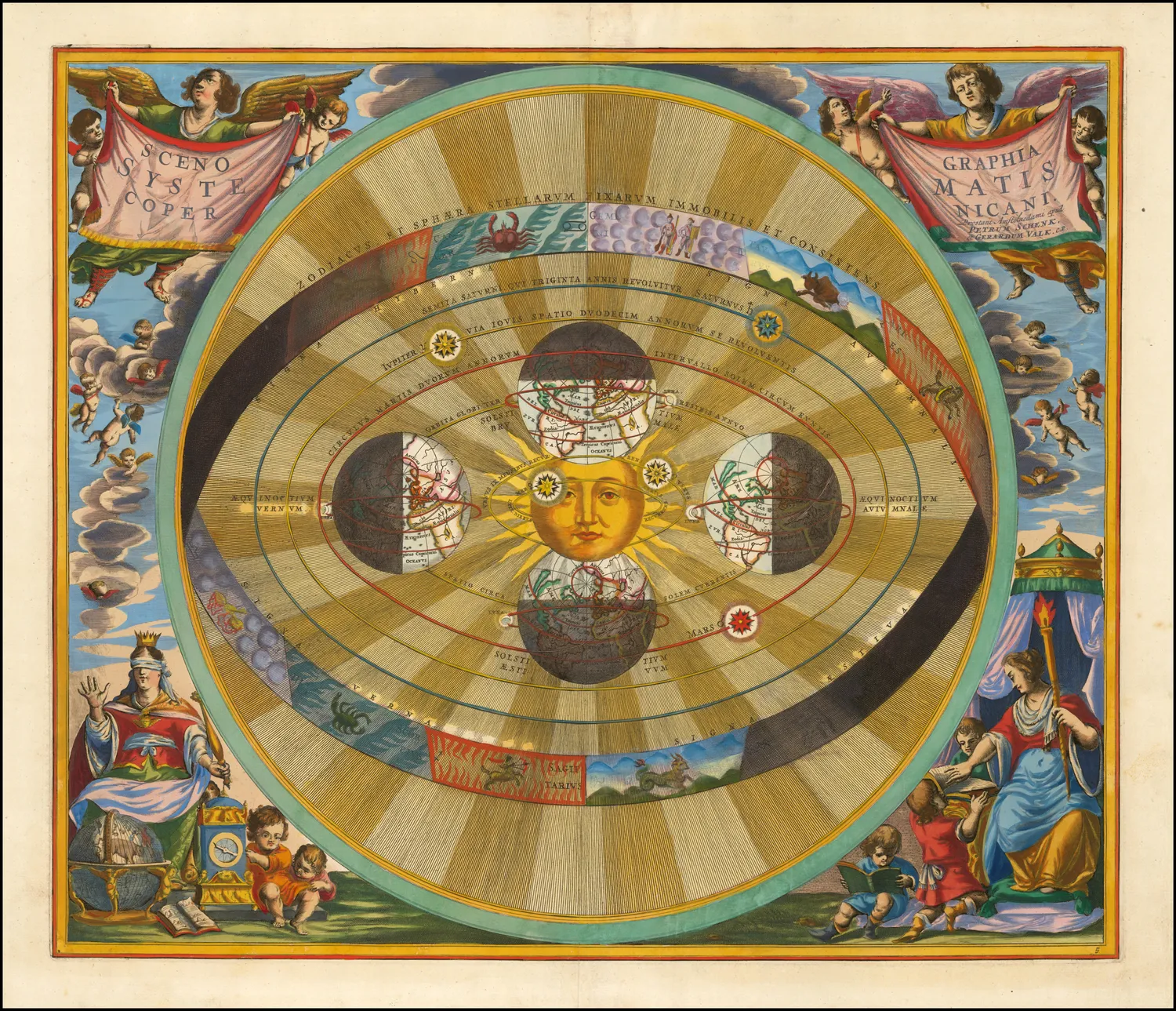
"1661 Cellarius's chart illustrating a heliocentric model of the universe, as proposed by Nicolaus Copernicus" by Andreas Cellarius / Wikimedia Commons (Public domain).
The Scientific Revolution was a period of major change in science during the 1500s and 1600s. During this time, astronomers began to question the old idea that Earth was the center of the universe. Instead, they used careful observation, data, and the scientific method to investigate how the solar system actually works. Their discoveries transformed humanity’s understanding of our place in the cosmos and led to what we now call modern astronomy.
Challenging Old Ideas: Copernicus and the Heliocentric Model
For centuries, people believed in the geocentric model, which placed Earth at the center of everything. In 1543, Nicolaus Copernicus published a new theory: the heliocentric model, which put the Sun at the center of the solar system. This idea was revolutionary and controversial, as it directly challenged religious teachings of the time. Tycho Brahe, a Danish astronomer, made extremely precise measurements of the positions of planets and stars—even though telescopes had not yet been invented. Brahe’s data was later used by Johannes Kepler, who discovered that planets travel in elliptical orbits, not perfect circles. Kepler’s three laws of planetary motion explained how planets speed up when they are closer to the Sun and slow down when they are farther away.
Observing the Universe: Galileo and New Evidence
In 1609, Galileo Galilei became the first person to use a telescope to study the night sky. He made several groundbreaking discoveries: he saw four large moons orbiting Jupiter, observed the phases of Venus, and noticed craters on the Moon and spots on the Sun. These observations provided strong evidence for the heliocentric model, because they showed that not everything revolves around Earth. Galileo’s findings brought him into conflict with the Catholic Church, which still supported the geocentric view. Despite this, his work inspired other scientists to continue exploring the universe using observation and evidence.
Explaining Motion: Newton and the Universal Law of Gravitation
In 1687, Isaac Newton published his laws of motion and his law of universal gravitation. Newton’s work explained why the planets move the way they do: gravity pulls objects toward each other, and this force keeps planets in orbit around the Sun. Newton used mathematical equations to show that the same laws apply on Earth and in space. His theories unified the work of Copernicus, Kepler, and Galileo, and helped to establish the scientific method as the standard for scientific investigation.
The Scientific Revolution was a true paradigm shift—a complete change in how scientists understood the universe. By using observation, hypothesis, testing, and evidence, astronomers were able to replace old beliefs with new knowledge. This revolution continues to shape modern science, technology, and the way we explore space today.
Interesting Fact:
The word "scientist" was not even invented until 1834—long after these famous astronomers had changed our understanding of the universe!
Comprehension quiz (10 questions)
1. What major idea did Copernicus introduce in 1543?
2. Which scientist first used a telescope to observe the night sky?
3. What did Kepler discover about planetary orbits?
4. What does the term 'geocentric' mean in the passage?
5. What is the 'scientific method' as used by astronomers?
6. Based on the passage, why was Galileo's work controversial?
7. How did Newton explain why planets stay in orbit?
8. If a new planet was discovered moving in an elliptical orbit around the Sun, which scientist's laws would best explain its motion?
9. True or False: The word 'scientist' existed during the time of Copernicus and Galileo.
10. True or False: Newton used mathematics to show that the same laws of motion apply on Earth and in space.
Perfect for the way you teach
- Build comprehension skills
- Auto-graded quiz
- Differentiated reading
- Read together at home
- Improve fluency
- Quiet reading time
- Reading curriculum support
- Independent practice
- Track Lexile growth