This learning resource is available in interactive and printable formats. The interactive worksheet can be played online and assigned to students. The Printable PDF version can be downloaded and printed for completion by hand.
This comprehensive middle school science reading passage explains the mechanisms behind Earth's seasons, directly addressing the common misconception that seasons are caused by Earth's distance from the Sun. Aligned with NGSS standard MS-ESS1-1, the passage highlights how Earth's 23.5° axial tilt and its revolution around the Sun lead to varying sunlight angles and day lengths throughout the year. Students will explore key terms like solstice, equinox, and revolution, and learn about real-world implications, such as how seasons differ in the Northern and Southern Hemispheres and near the poles. The passage is supported with engaging activities, a glossary, and graphic organizers to enhance comprehension. Audio integration and Spanish translations make this resource accessible to diverse learners. Ideal for grades 6-8 science curriculum.
CONTENT PREVIEW
Expand content preview
Earth's tilt and orbit around the Sun creates seasons
Seasons shape life on Earth, influencing weather, plant growth, and animal behaviors. In many places, temperatures rise in summer and fall in winter, while day lengths change across the year. Understanding why we experience these changes is key to grasping Earth's relationship with the Sun. Scientists have discovered that Earth's tilted axis is the main reason for the seasons, not Earth's distance from the Sun.
Earth’s Tilted Axis and Revolution
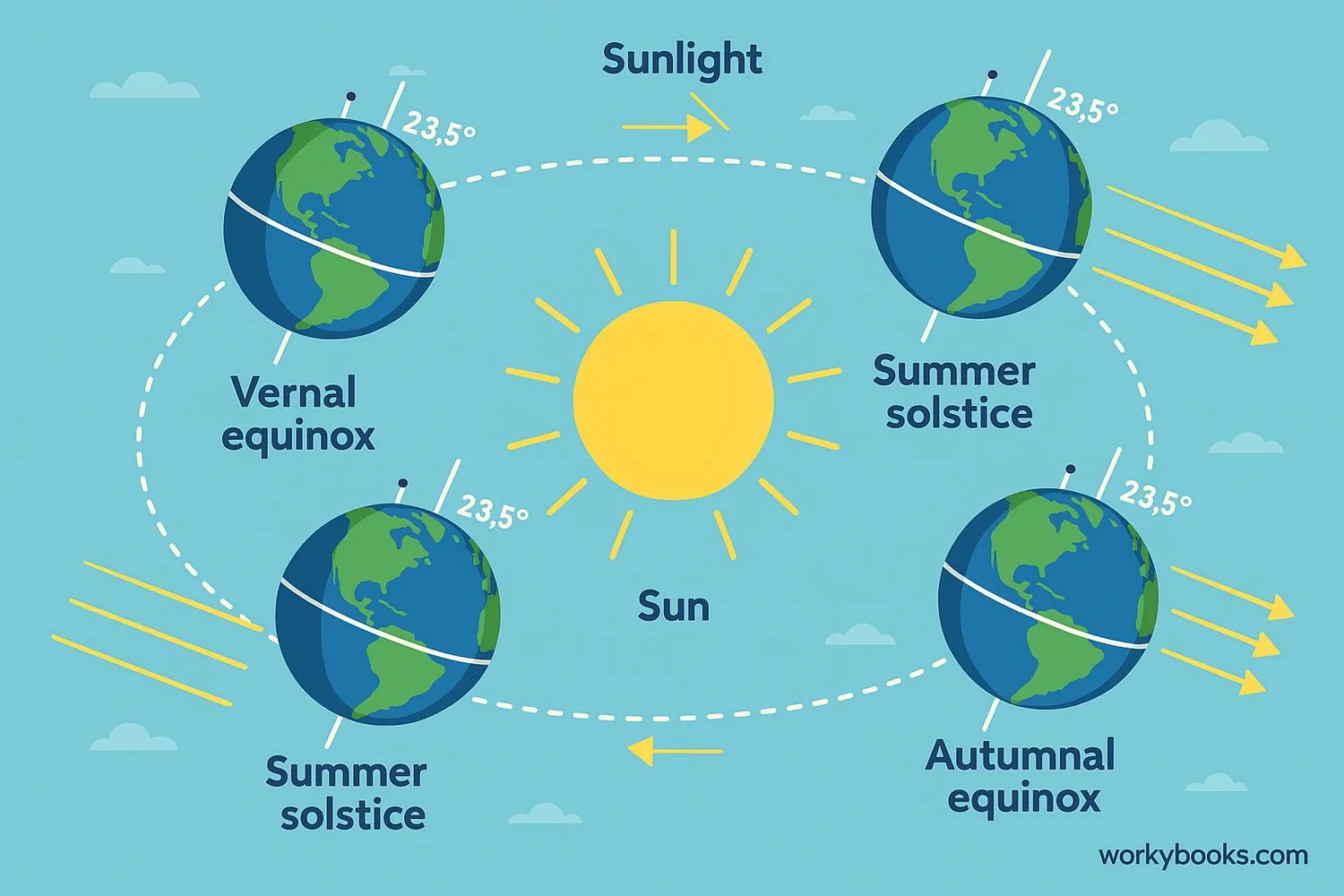
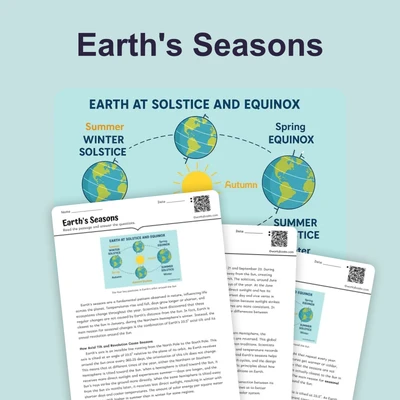
Earth spins on an axis that is tilted about 23.5 degrees from vertical. This axial tilt stays the same direction as Earth revolves around the Sun once every 365.25 days. This tilt causes sunlight to strike different parts of the planet at different angles during the year. For example, when the Northern Hemisphere is tilted toward the Sun in June, sunlight hits it more directly and days are longer. This is the summer solstice—the longest day of the year in the north. Six months later, in December, the Northern Hemisphere tilts away from the Sun. The sunlight is less direct, days are shorter, and it is winter. The Southern Hemisphere has the opposite pattern: it experiences summer when the Northern Hemisphere has winter.
Solstices, Equinoxes, and Sunlight Angles
The solstices mark the points when one hemisphere is tilted most toward or away from the Sun. The summer solstice (around June 21) is the longest day in the Northern Hemisphere, while the winter solstice (around December 21) is the shortest. In between, the equinoxes occur—around March 20 and September 22—when neither pole is tilted toward or away from the Sun. On equinoxes, day and night are nearly equal in length all over the world. In the tropics, the Sun can be directly overhead at certain times, like at the Tropic of Cancer during the summer solstice and the Tropic of Capricorn during the winter solstice. At the poles, the effects are extreme, leading to months of 24-hour daylight or darkness, known as midnight sun and polar night.
Common Misconceptions and Demonstrations
Many people think seasons happen because Earth is closer to the Sun in summer and farther away in winter. In reality, Earth is actually closest to the Sun in early January, when the Northern Hemisphere is experiencing winter. The real cause of seasons is the combination of axial tilt and revolution. Scientists use models, like a tilted globe and a flashlight, to show how the angle of sunlight changes. These demonstrations help us understand that the intensity and duration of sunlight, not distance, cause seasonal changes.
Earth’s tilted axis creates a system where sunlight is distributed unevenly throughout the year. This leads to a predictable pattern of temperature and daylight changes, shaping weather, ecosystems, and even cultures worldwide. The relationship between Earth’s movement and the Sun is a fundamental example of how systems interact in science.
Interesting Fact: The Arctic Circle experiences up to six months of continuous daylight during summer—this phenomenon is called the “midnight sun.”
What is the main reason Earth has seasons?
Earth's tilted axis combined with its revolution around the Sun.Earth gets closer to the Sun in summer.The Sun changes its brightness during the year.Earth's rotation speeds up and slows down.
When is the summer solstice in the Northern Hemisphere?
Around June 21Around December 21Around March 20Around September 22
What does the term 'equinox' mean in the passage?
Day and night are nearly equal in length everywhere.The longest day of the year.The shortest day of the year.The Sun is directly overhead at the poles.
What is the 'midnight sun'?
24 hours of daylight in polar regions during summer.A bright moon at midnight.When the Sun is directly overhead at noon.A special sunrise in the tropics.
What is a common misconception about why we have seasons?
That seasons are caused by Earth's distance from the Sun.That Earth's axis is tilted 23.5°.That the Sun is overhead at the equator.That the Southern Hemisphere has seasons too.
What does 'revolves' mean as used in the passage?
Moves in a path around something.Spins in place.Gets brighter over time.Tilts at an angle.
Why are days longer in summer in the Northern Hemisphere?
Because the North Pole is tilted toward the Sun, so sunlight is more direct.Because the Sun is closer to Earth.Because the Earth's tilt is less.Because there is more water in the hemisphere.
If the Earth's axis was not tilted, what would happen to the seasons?
There would be little or no seasonal change in most places.Summers would be much hotter.Winters would last all year.There would be more equinoxes.
True or False: The Southern Hemisphere has summer when the Northern Hemisphere has winter.
TrueFalse
True or False: Earth is closest to the Sun during Northern Hemisphere summer.
TrueFalse
Perfect For:
👩🏫 Teachers
• Reading comprehension practice
• Auto-graded assessments
• Literacy skill development
👨👩👧👦 Parents
• Reading practice at home
• Comprehension improvement
• Educational reading time
🏠 Homeschoolers
• Reading curriculum support
• Independent reading practice
• Progress monitoring
Reading Features:
📖
Reading Passage
Engaging fiction or nonfiction text
❓
Comprehension Quiz
Auto-graded questions
📊
Instant Feedback
Immediate results and scoring
📄
Printable Version
Download for offline reading
🔊
Read Aloud
Voice-over with word highlighting
Reviews & Ratings
No reviews yet. Be the first to share your experience!
Related Content
What is Solar Radiation
This NGSS-aligned science reading passage for middle school students explores the concept of solar radiation. Solar radi...
MS-ESS1-1
How Incoming Solar Radiation Changes with Latitude
This NGSS-aligned science reading passage helps middle school students understand how solar radiation, or insolation, ch...
MS-ESS1-1
Tides and Tidal Forces
This middle school science passage explores the mechanisms of tides and tidal forces, aligning with NGSS standards MS-ES...
MS-ESS1-1MS-ESS1-2
The Night Sky
This comprehensive science reading passage for grades 6-8 aligns with NGSS standard MS-ESS1-1 and explores the systems a...
MS-ESS1-1
Ancient Astronomy
This engaging passage for grades 6-8 explores the history of astronomy through the lens of ancient observations. Student...
MS-ESS1-1
Tools of Modern Astronomy
This passage introduces middle school students to modern astronomy, aligning with NGSS standard MS-ESS1-1. It explains h...
MS-ESS1-1
How Astronomy Became a Science
This passage explores the transformative period known as the Scientific Revolution, with a special focus on the history ...
MS-ESS1-1
Earth's Rotation
This middle school science passage, aligned with NGSS standard MS-ESS1-1, focuses on Earth's rotation—how Earth spins on...
MS-ESS1-1
Earth's Revolution
This middle school science passage explores the science behind Earth's revolution around the Sun, closely aligned with N...
MS-ESS1-1
Earth's Seasons
This comprehensive reading passage for grades 6-8 explains why Earth has seasons, revealing the scientific mechanisms be...
MS-ESS1-1
Phases of the Moon
This comprehensive middle school science passage explains the phases of the Moon, focusing on the mechanisms behind the ...
MS-ESS1-1
Tides
This comprehensive middle school science reading passage explores the phenomenon of ocean tides, aligned to NGSS standar...
MS-ESS1-1MS-ESS1-2
Eclipses
This comprehensive passage for grades 6-8 explores the science behind eclipses, including solar and lunar eclipses, thei...
MS-ESS1-1
The Moon's Characteristics
This comprehensive science reading passage for grades 6-8 examines the Moon's physical characteristics, including its si...
MS-ESS1-1MS-ESS1-2
Lunar Eclipses
This passage introduces middle school students to the phenomenon of lunar eclipses, connecting observable events to the ...
MS-ESS1-1
The Sun's Characteristics
This engaging science passage introduces middle school students to the Sun’s key characteristics, such as its classifica...
MS-ESS1-1MS-ESS1-2
What Is a Galaxy?
This comprehensive middle school science passage answers the question: What is a galaxy? Aligned to NGSS standard MS-ESS...
MS-ESS1-1
The Milky Way: Our Home Galaxy
This comprehensive science passage introduces middle school students to the Milky Way, the barred spiral galaxy that is ...
MS-ESS1-1
Types of Galaxies
This comprehensive middle school science passage introduces students to the classification and characteristics of galaxi...