The Milky Way: Our Home Galaxy — Reading Comprehension
Rate this
Premium Resource
Present
Present in classroom. No work saved
Assign
Classroom with student accounts, Track progress
Quick Play
No student accounts, assign with a link
Grades
5
6
7
8
Standards
MS-ESS1-1
PRINT+DIGITAL RESOURCE
This learning resource is available in interactive and printable formats. The interactive worksheet can be played online and assigned to students. The Printable PDF version can be downloaded and printed for completion by hand.
This comprehensive science passage introduces middle school students to the Milky Way, the barred spiral galaxy that is home to our solar system. Students will learn about the galaxy's structure, including its central bulge of old stars, spiral arms filled with gas, dust, and young stars, and the mysterious halo. The passage explains how the Milky Way’s features interact, such as how density waves in the spiral arms encourage star formation and how the Sun orbits the galactic center, taking around 230 million years to complete one revolution. It also explores how scientists study the galaxy using various wavelengths like radio and X-ray, especially to observe hidden features like Sagittarius A*, the supermassive black hole at the center. With vocabulary highlighted and explained, real-world applications, and activities aligned to NGSS MS-ESS1-1, this lesson supports reading, writing, and content mastery. Audio integration boosts accessibility for all learners.
CONTENT PREVIEW
Expand content preview
The Milky Way: Our Home Galaxy
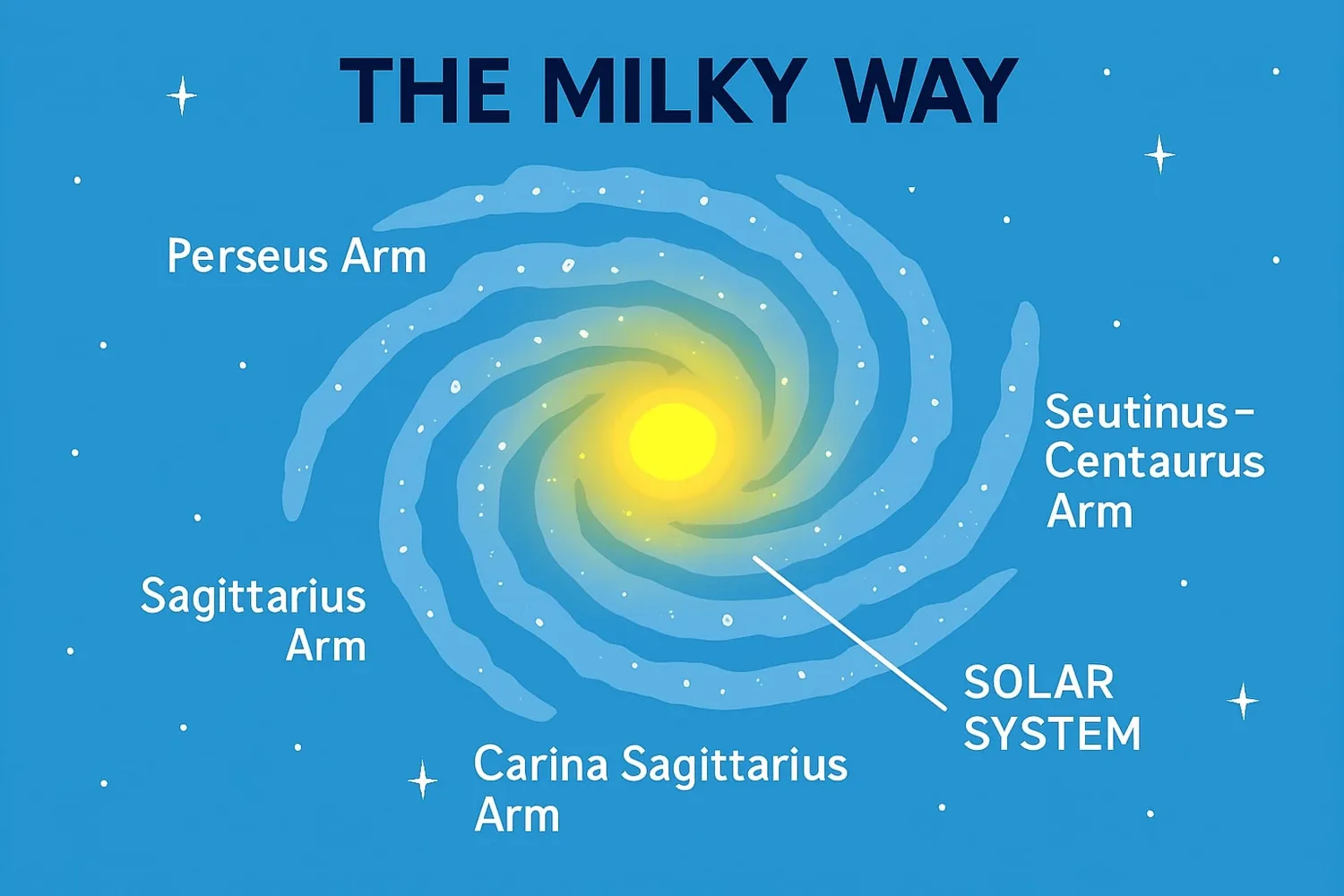
The Milky Way is a vast galaxy that stretches across our night sky as a faint, milky band of light. This band is not a cloud, but the combined glow of billions of distant stars. For centuries, people have wondered what the Milky Way truly is. Today, scientists know that it is a barred spiral galaxy—a system of stars, gas, dust, and dark matter bound together by gravity. Understanding the Milky Way helps us learn about our place in the universe and how galaxies work as complex systems.
Structure and Components of the Milky Way
The Milky Way is enormous, spanning about 100,000 to 180,000 light-years across. It contains an estimated 200 to 400 billion stars. At its center is the central bulge, a crowded, spherical region filled mostly with old stars. Extending from the bulge is a bright, elongated bar of stars, which gives the Milky Way its classification as a barred spiral. Surrounding the bulge and bar is a flat disk with several spiral arms made of younger stars, clouds of gas, and dark dust. The disk is where new stars are born, especially in the spiral arms, which are zones of higher density called density waves. Beyond the disk lies the halo, a vast, faint sphere containing old stars and clusters called globular clusters.
How We Study the Milky Way
Our solar system is located in the Orion Arm, about 26,000 light-years from the galaxy’s center. The center itself contains Sagittarius A*, a supermassive black hole with a mass four million times that of our Sun. This black hole cannot be seen in visible light because dust blocks our view, but astronomers use radio, infrared, and X-ray telescopes to observe its effects on nearby stars and gas. Scientists also study the Milky Way’s rotation: the Sun orbits the center at about 220 kilometers per second (km/s). It takes approximately 230 million years for the Sun to complete one orbit—a time sometimes called a "galactic year." These studies show how stars, gas, and gravity interact within the galaxy, shaping its structure and future.
Connections and Implications
Understanding the Milky Way is essential for learning how galaxies evolve. The spiral arms, for example, are key sites for star formation because their density waves compress gas clouds into new stars. The presence of a supermassive black hole like Sagittarius A* influences the motion of stars near the galactic center. By comparing the Milky Way to other galaxies, scientists discover patterns and differences that help explain the history of the universe. The study of our galaxy also inspires technology, such as improved telescopes and data analysis methods, which benefit society in many fields.
In summary, the Milky Way’s structure—from its bulge and bar to its spiral arms and halo—shows how stars, gas, dust, and gravity create a dynamic system. By observing and analyzing our galaxy, scientists uncover the mechanisms that shape galaxies everywhere and deepen our understanding of the universe.
Interesting Fact: The last time the Sun was in this position in the Milky Way, dinosaurs roamed Earth—one galactic year is about 230 million years!
What is the Milky Way?
A galaxy that contains our solar system.A planet in the solar system.A group of comets.A type of asteroid belt.
Where is the Sun located within the Milky Way?
In the central bulgeIn the Orion Arm, about 26,000 light-years from the centerIn the spiral barIn the halo
What is found at the very center of the Milky Way?
A large planetA supermassive black hole called Sagittarius A*A globular clusterThe Orion Arm
What are spiral arms mainly made of?
Old stars onlyGas, dust, and young starsPlanets and moonsRings of ice
What does the term 'density waves' mean in the passage?
Waves of water in the galaxyRegions where gas and stars are more crowded, leading to star formationRadio waves from the galactic centerGravity waves traveling from the Sun
Which tool do astronomers use to observe hidden objects like Sagittarius A*?
MicroscopesRadio, infrared, and X-ray telescopesMagnetsBinoculars
Why can't Sagittarius A* be seen in visible light?
It is too small.It is blocked by dust in the galaxy.It is made of ice.It is behind another galaxy.
What is one effect of the spiral arms' density waves?
They destroy old stars.They cause new stars to form.They stop the Sun from moving.They make planets disappear.
True or False: The Milky Way contains only young stars.
TrueFalse
True or False: One galactic year is about 230 million years long.
TrueFalse
Perfect For:
👩🏫 Teachers
• Reading comprehension practice
• Auto-graded assessments
• Literacy skill development
👨👩👧👦 Parents
• Reading practice at home
• Comprehension improvement
• Educational reading time
🏠 Homeschoolers
• Reading curriculum support
• Independent reading practice
• Progress monitoring
Reading Features:
📖
Reading Passage
Engaging fiction or nonfiction text
❓
Comprehension Quiz
Auto-graded questions
📊
Instant Feedback
Immediate results and scoring
📄
Printable Version
Download for offline reading
🔊
Read Aloud
Voice-over with word highlighting
Reviews & Ratings
No reviews yet. Be the first to share your experience!
Related Content
What is Solar Radiation
This NGSS-aligned science reading passage for middle school students explores the concept of solar radiation. Solar radi...
MS-ESS1-1
How Incoming Solar Radiation Changes with Latitude
This NGSS-aligned science reading passage helps middle school students understand how solar radiation, or insolation, ch...
MS-ESS1-1
Tides and Tidal Forces
This middle school science passage explores the mechanisms of tides and tidal forces, aligning with NGSS standards MS-ES...
MS-ESS1-1MS-ESS1-2
The Night Sky
This comprehensive science reading passage for grades 6-8 aligns with NGSS standard MS-ESS1-1 and explores the systems a...
MS-ESS1-1
Ancient Astronomy
This engaging passage for grades 6-8 explores the history of astronomy through the lens of ancient observations. Student...
MS-ESS1-1
Tools of Modern Astronomy
This passage introduces middle school students to modern astronomy, aligning with NGSS standard MS-ESS1-1. It explains h...
MS-ESS1-1
How Astronomy Became a Science
This passage explores the transformative period known as the Scientific Revolution, with a special focus on the history ...
MS-ESS1-1
Earth's Rotation
This middle school science passage, aligned with NGSS standard MS-ESS1-1, focuses on Earth's rotation—how Earth spins on...
MS-ESS1-1
Earth's Revolution
This middle school science passage explores the science behind Earth's revolution around the Sun, closely aligned with N...
MS-ESS1-1
Why We Have Seasons
This comprehensive middle school science reading passage explains the mechanisms behind Earth's seasons, directly addres...
MS-ESS1-1
Earth's Seasons
This comprehensive reading passage for grades 6-8 explains why Earth has seasons, revealing the scientific mechanisms be...
MS-ESS1-1
Phases of the Moon
This comprehensive middle school science passage explains the phases of the Moon, focusing on the mechanisms behind the ...
MS-ESS1-1
Tides
This comprehensive middle school science reading passage explores the phenomenon of ocean tides, aligned to NGSS standar...
MS-ESS1-1MS-ESS1-2
Eclipses
This comprehensive passage for grades 6-8 explores the science behind eclipses, including solar and lunar eclipses, thei...
MS-ESS1-1
The Moon's Characteristics
This comprehensive science reading passage for grades 6-8 examines the Moon's physical characteristics, including its si...
MS-ESS1-1MS-ESS1-2
Lunar Eclipses
This passage introduces middle school students to the phenomenon of lunar eclipses, connecting observable events to the ...
MS-ESS1-1
The Sun's Characteristics
This engaging science passage introduces middle school students to the Sun’s key characteristics, such as its classifica...
MS-ESS1-1MS-ESS1-2
What Is a Galaxy?
This comprehensive middle school science passage answers the question: What is a galaxy? Aligned to NGSS standard MS-ESS...
MS-ESS1-1
Types of Galaxies
This comprehensive middle school science passage introduces students to the classification and characteristics of galaxi...