This learning resource is available in interactive and printable formats. The interactive worksheet can be played online and assigned to students. The Printable PDF version can be downloaded and printed for completion by hand.
This middle school science passage explores the mechanisms of tides and tidal forces, aligning with NGSS standards MS-ESS1-1 and MS-ESS1-2. Students learn how differential gravitational pull from the Moon creates tidal bulges on Earth, and how similar forces drive phenomena on other planets and moons, such as volcanic activity on Io and subsurface oceans on Europa and Enceladus. The passage covers key concepts like tidal locking, tidal heating, and the Roche limit, connecting these processes to observable changes on Earth, such as the gradual lengthening of the day and the Moon's movement away from us. Real-world data, scientific reasoning, and vocabulary are integrated for a rich learning experience. This resource includes reading comprehension activities, writing prompts, graphic organizers, and audio integration, supporting diverse learners in mastering the disciplinary core ideas.
CONTENT PREVIEW
Expand content preview
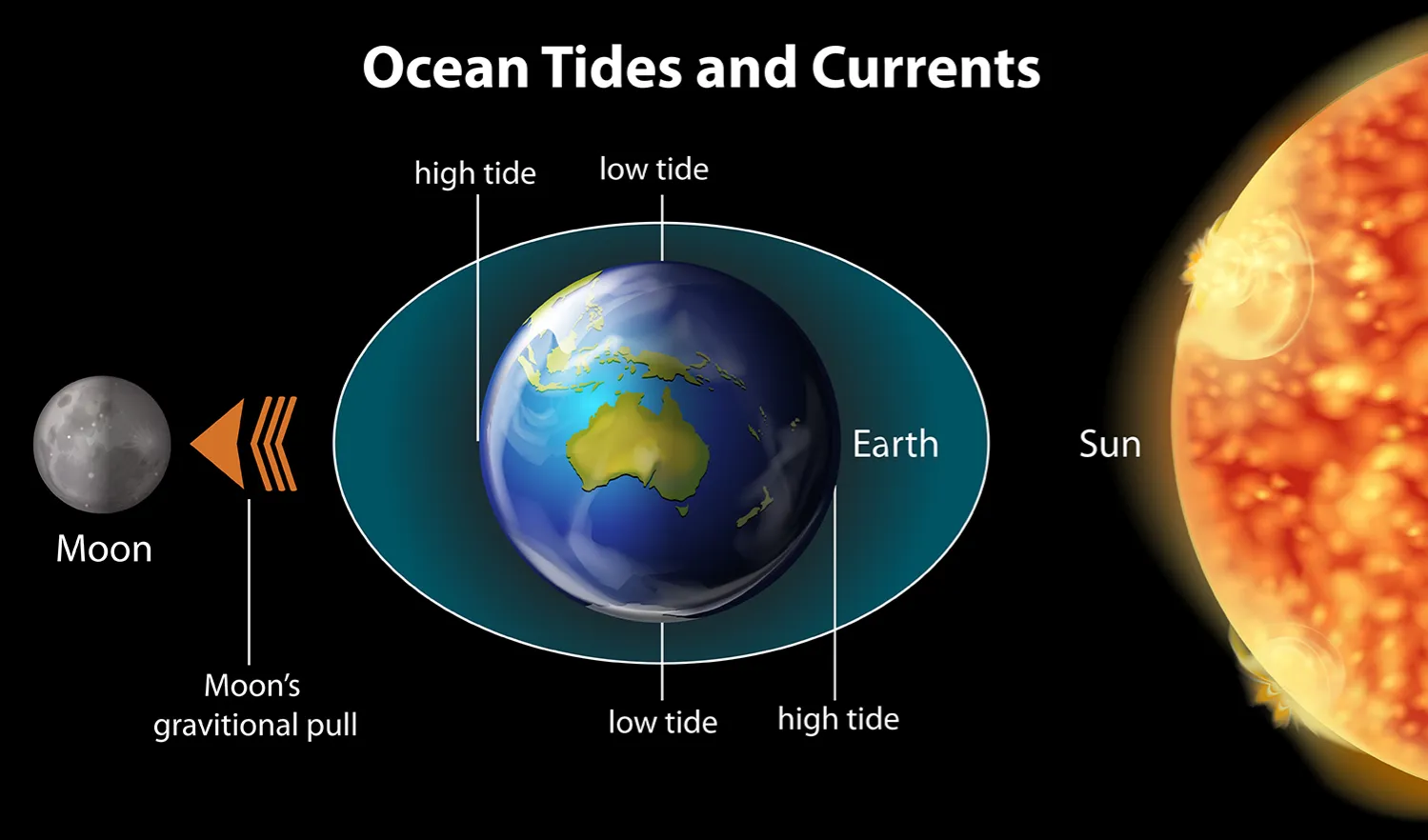
Ocean tides and currents
Tides are a regular and observable rise and fall of Earth's oceans, occurring every day along coastlines across the world. The changing water levels have shaped human activity for centuries, affecting fishing, navigation, and even the construction of coastal cities. Scientists have long asked: what causes tides, and how do these changes connect to deeper forces at work in our solar system?
At the heart of tidal forces is the concept of gravity. The Moon’s gravity pulls on the Earth, but not equally everywhere. The side of Earth closest to the Moon experiences a stronger gravitational pull than the side facing away. This difference, called the differential gravitational effect, stretches Earth’s oceans into two bulges—one facing the Moon and one on the opposite side. As Earth rotates, these bulges move, creating two high tides and two low tides in most coastal areas every 24 hours. The Sun’s gravity also influences tides, but the Moon’s effect is stronger because it is much closer to Earth. During full and new moons, the Sun and Moon align, causing especially high and low tides called spring tides.
Other Effects of Tidal Forces
Tidal forces do more than just move water. Over millions of years, the friction caused by tides has slowed Earth’s rotation, gradually increasing the length of our day. The same friction has also pushed the Moon farther away from Earth—by about 3.8 centimeters per year, according to precise laser measurements. This process is called tidal locking when a moon’s rotation slows until it always shows the same face to its planet. For example, the Moon is tidally locked to Earth, so we always see the same side from our planet.
Tidal heating is another powerful effect. When a moon or planet has an elliptical orbit, tidal forces flex and squeeze the body, generating heat through friction. Jupiter’s moon Io is the most volcanically active body in the solar system because of tidal heating caused by Jupiter’s massive gravity. On Europa and Saturn’s moon Enceladus, tidal heating keeps subsurface oceans warm enough to exist beneath icy surfaces, raising hopes for life beyond Earth.
Limits and Dangers of Tidal Forces
There are also limits to what tidal forces can do. If a moon or object gets too close to its planet, the difference in gravity can become so extreme that the object is torn apart. This distance is called the Roche limit. Scientists believe Saturn’s rings may have formed when a moon crossed Saturn’s Roche limit and was pulled apart by tidal forces. Studying these processes helps us understand the formation and evolution of planetary systems throughout the universe.
Understanding tides and tidal forces connects to broader scientific principles about how forces and energy shape our world and others. From the rhythm of Earth’s oceans to volcanic eruptions on distant moons, tidal forces show the powerful and far-reaching effects of gravity in the cosmos.
Interesting Fact: The Earth's day increases by about 1.7 milliseconds every century because of tidal friction slowing our planet’s rotation.
What causes tides on Earth?
The gravitational pull of the Moon and the SunWinds blowing across the oceanEarth’s internal heatFish swimming in groups
Why does the Moon's gravity create two tidal bulges on Earth?
Because the Moon pulls harder on the near side of Earth than the far sideBecause the Moon is smaller than EarthBecause the Sun blocks the Moon’s gravityBecause the Earth’s axis is tilted
What is tidal locking?
When the Moon always shows the same face to EarthWhen tides stop movingWhen the Sun's gravity is stronger than the Moon'sWhen the Moon spins faster than Earth
What happens during spring tides?
The Sun and Moon align, causing especially high and low tidesThe Sun and Moon are at right angles, causing mild tidesThere are no tidesEarth rotates faster
According to the passage, how fast is the Moon moving away from Earth?
About 3.8 centimeters per year10 meters per yearOne kilometer per dayIt is not moving
What is the Roche limit?
The closest distance a moon can approach its planet without being torn apartThe temperature where water boilsThe time it takes for tides to changeThe farthest distance a planet can be from the Sun
What is one result of tidal heating on Jupiter’s moon Io?
Intense volcanic activityNo tides at allComplete freezing of the surfaceFormation of a new moon
Tidal forces can affect planets and moons only on Earth. (True/False)
FalseTrue
Tidal friction has slowly increased the length of a day on Earth. (True/False)
TrueFalse
Which of the following best describes the differential gravitational effect?
The difference in gravitational pull on the near and far sides of EarthThe temperature difference between day and nightThe change in Moon phasesThe effect of Earth's wind on the ocean
Perfect For:
👩🏫 Teachers
• Reading comprehension practice
• Auto-graded assessments
• Literacy skill development
👨👩👧👦 Parents
• Reading practice at home
• Comprehension improvement
• Educational reading time
🏠 Homeschoolers
• Reading curriculum support
• Independent reading practice
• Progress monitoring
Reading Features:
📖
Reading Passage
Engaging fiction or nonfiction text
❓
Comprehension Quiz
Auto-graded questions
📊
Instant Feedback
Immediate results and scoring
📄
Printable Version
Download for offline reading
🔊
Read Aloud
Voice-over with word highlighting
Reviews & Ratings
No reviews yet. Be the first to share your experience!
Related Content
What is Solar Radiation
This NGSS-aligned science reading passage for middle school students explores the concept of solar radiation. Solar radi...
MS-ESS1-1
How Incoming Solar Radiation Changes with Latitude
This NGSS-aligned science reading passage helps middle school students understand how solar radiation, or insolation, ch...
MS-ESS1-1
The Night Sky
This comprehensive science reading passage for grades 6-8 aligns with NGSS standard MS-ESS1-1 and explores the systems a...
MS-ESS1-1
Ancient Astronomy
This engaging passage for grades 6-8 explores the history of astronomy through the lens of ancient observations. Student...
MS-ESS1-1
Tools of Modern Astronomy
This passage introduces middle school students to modern astronomy, aligning with NGSS standard MS-ESS1-1. It explains h...
MS-ESS1-1
How Astronomy Became a Science
This passage explores the transformative period known as the Scientific Revolution, with a special focus on the history ...
MS-ESS1-1
Earth's Rotation
This middle school science passage, aligned with NGSS standard MS-ESS1-1, focuses on Earth's rotation—how Earth spins on...
MS-ESS1-1
Earth's Revolution
This middle school science passage explores the science behind Earth's revolution around the Sun, closely aligned with N...
MS-ESS1-1
Why We Have Seasons
This comprehensive middle school science reading passage explains the mechanisms behind Earth's seasons, directly addres...
MS-ESS1-1
Earth's Seasons
This comprehensive reading passage for grades 6-8 explains why Earth has seasons, revealing the scientific mechanisms be...
MS-ESS1-1
Phases of the Moon
This comprehensive middle school science passage explains the phases of the Moon, focusing on the mechanisms behind the ...
MS-ESS1-1
Tides
This comprehensive middle school science reading passage explores the phenomenon of ocean tides, aligned to NGSS standar...
MS-ESS1-1MS-ESS1-2
Eclipses
This comprehensive passage for grades 6-8 explores the science behind eclipses, including solar and lunar eclipses, thei...
MS-ESS1-1
The Moon's Characteristics
This comprehensive science reading passage for grades 6-8 examines the Moon's physical characteristics, including its si...
MS-ESS1-1MS-ESS1-2
Lunar Eclipses
This passage introduces middle school students to the phenomenon of lunar eclipses, connecting observable events to the ...
MS-ESS1-1
The Sun's Characteristics
This engaging science passage introduces middle school students to the Sun’s key characteristics, such as its classifica...
MS-ESS1-1MS-ESS1-2
What Is a Galaxy?
This comprehensive middle school science passage answers the question: What is a galaxy? Aligned to NGSS standard MS-ESS...
MS-ESS1-1
The Milky Way: Our Home Galaxy
This comprehensive science passage introduces middle school students to the Milky Way, the barred spiral galaxy that is ...
MS-ESS1-1
Types of Galaxies
This comprehensive middle school science passage introduces students to the classification and characteristics of galaxi...