Dark Matter and Dark Energy — Reading Comprehension
Rate this
Premium Resource
Present
Present in classroom. No work saved
Assign
Classroom with student accounts, Track progress
Quick Play
No student accounts, assign with a link
Grades
5
6
7
8
Standards
MS-ESS1-1
PRINT+DIGITAL RESOURCE
This learning resource is available in interactive and printable formats. The interactive worksheet can be played online and assigned to students. The Printable PDF version can be downloaded and printed for completion by hand.
This engaging middle school science passage introduces students to the mysteries of dark matter and dark energy, two of the most puzzling components of our universe. Aligned to NGSS MS-ESS1-1, students will learn about the evidence that led scientists to discover that ordinary matter only makes up about 5% of the universe, while dark matter accounts for 27% and dark energy for 68%. The passage explains key phenomena such as galaxy rotation curves, galaxy cluster masses, and gravitational lensing, showing how these observations reveal the existence of invisible matter and mysterious forces. With academic vocabulary, real-world examples, and accessible explanations, this resource is perfect for grades 6-8. Audio integration supports diverse learners. Activities include comprehension questions, writing prompts, and graphic organizers to deepen understanding. This passage helps students think like scientists and connects to broader scientific principles and inquiry.
CONTENT PREVIEW
Expand content preview
Dark Matter and Dark Energy
Dark matter and dark energy are two of the most mysterious components of the universe. Though normal matter—like stars, planets, and gas—makes up everything we can see, it accounts for only about 5% of the universe. The rest consists of invisible substances that do not emit or absorb light. Understanding dark matter and dark energy is crucial because they control how the universe behaves and evolves.
Evidence for Dark Matter
Scientists first suspected the existence of dark matter when they observed the rotation of galaxies. Stars at the edges of spiral galaxies move much faster than expected based on the visible mass present. According to the laws of gravity, there should be much more mass holding these fast-moving stars in place than what can be seen. Further evidence comes from observations of galaxy clusters. The total visible matter in these clusters is not enough to account for the gravitational forces measured. Another clue is gravitational lensing, where light from distant objects bends more than visible mass alone can explain. These findings suggest that about 27% of the universe is made up of dark matter. Scientists think it may be composed of unknown particles like WIMPs (Weakly Interacting Massive Particles), but no one has detected them directly yet.
Discovering Dark Energy
While dark matter pulls things together with gravity, dark energy works in the opposite way. In 1998, astronomers studying supernovae (exploding stars) found that these distant objects were dimmer than expected. This discovery meant that the universe is not just expanding, but the rate of expansion is speeding up. Dark energy is the name given to the mysterious force causing this acceleration. It makes up about 68% of the universe. Some scientists think dark energy might be a property of space itself, often described as the cosmological constant, a term first used by Albert Einstein.
Unsolved Mysteries and Interactions
Dark matter and dark energy interact with normal matter in indirect ways. Dark matter influences the formation and structure of galaxies by adding extra gravity, while dark energy affects how the universe expands on the largest scales. Despite decades of research, scientists still do not know exactly what dark matter and dark energy are made of. Their existence is one of the biggest mysteries in modern science. Understanding them could lead to major discoveries about the fate and structure of the universe.
In summary, the universe is about 68% dark energy, 27% dark matter, and only 5% ordinary matter. Studying the unseen parts of the universe teaches scientists about the underlying forces that shape everything, reminding us that there is still much to discover.
Interesting Fact: Even though scientists have built huge detectors underground and in space, no one has ever directly captured a particle of dark matter!
What percentage of the universe is made up of dark energy?
About 68%About 27%About 5%About 50%
What evidence suggests the existence of dark matter in galaxies?
Stars at the edges move faster than expectedStars at the center are brighterGalaxies are all the same sizeThere are more planets than stars
What is gravitational lensing?
The bending of light by massive objectsThe spinning of galaxiesThe explosion of a starThe rotation of planets
What is another name for the possible particles that make up dark matter?
WIMPsSupernovaeNeutronsPhotons
Why is dark energy important in the universe?
It causes the expansion of the universe to speed upIt keeps galaxies from collidingIt makes stars shine brighterIt creates new planets
What does the term 'cosmological constant' refer to in the passage?
A property of space related to dark energyA type of galaxyA method to find dark matterA kind of supernova
What did astronomers discover about the expansion of the universe in 1998?
It is acceleratingIt is slowing downIt has stoppedIt is shrinking
Why haven't scientists directly detected dark matter yet?
It does not emit or absorb light, making it hard to detectIt is too hotIt is smaller than atomsIt is only found on Earth
True or False: Dark matter makes up more of the universe than normal matter.
TrueFalse
True or False: Dark energy pulls galaxies together with gravity.
TrueFalse
Perfect For:
👩🏫 Teachers
• Reading comprehension practice
• Auto-graded assessments
• Literacy skill development
👨👩👧👦 Parents
• Reading practice at home
• Comprehension improvement
• Educational reading time
🏠 Homeschoolers
• Reading curriculum support
• Independent reading practice
• Progress monitoring
Reading Features:
📖
Reading Passage
Engaging fiction or nonfiction text
❓
Comprehension Quiz
Auto-graded questions
📊
Instant Feedback
Immediate results and scoring
📄
Printable Version
Download for offline reading
🔊
Read Aloud
Voice-over with word highlighting
Reviews & Ratings
No reviews yet. Be the first to share your experience!
Related Content
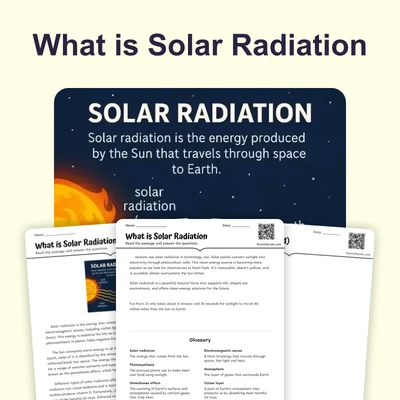
What is Solar Radiation
This NGSS-aligned science reading passage for middle school students explores the concept of solar radiation. Solar radi...
MS-ESS1-1
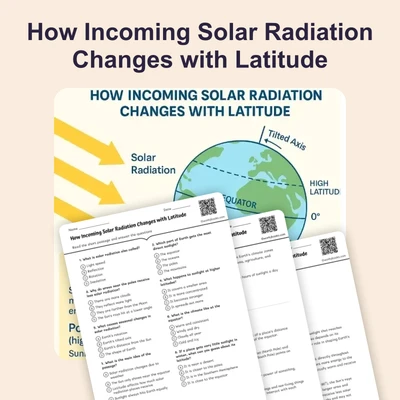
How Incoming Solar Radiation Changes with Latitude
This NGSS-aligned science reading passage helps middle school students understand how solar radiation, or insolation, ch...
MS-ESS1-1
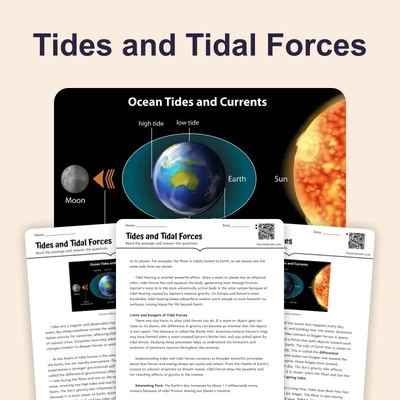
Tides and Tidal Forces
This middle school science passage explores the mechanisms of tides and tidal forces, aligning with NGSS standards MS-ES...
MS-ESS1-1MS-ESS1-2
The Night Sky
This comprehensive science reading passage for grades 6-8 aligns with NGSS standard MS-ESS1-1 and explores the systems a...
MS-ESS1-1
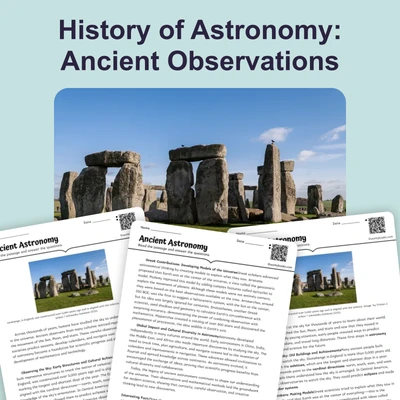
Ancient Astronomy
This engaging passage for grades 6-8 explores the history of astronomy through the lens of ancient observations. Student...
MS-ESS1-1
Tools of Modern Astronomy
This passage introduces middle school students to modern astronomy, aligning with NGSS standard MS-ESS1-1. It explains h...
MS-ESS1-1
How Astronomy Became a Science
This passage explores the transformative period known as the Scientific Revolution, with a special focus on the history ...
MS-ESS1-1
Earth's Rotation
This middle school science passage, aligned with NGSS standard MS-ESS1-1, focuses on Earth's rotation—how Earth spins on...
MS-ESS1-1
Earth's Revolution
This middle school science passage explores the science behind Earth's revolution around the Sun, closely aligned with N...
MS-ESS1-1
Why We Have Seasons
This comprehensive middle school science reading passage explains the mechanisms behind Earth's seasons, directly addres...
MS-ESS1-1
Earth's Seasons
This comprehensive reading passage for grades 6-8 explains why Earth has seasons, revealing the scientific mechanisms be...
MS-ESS1-1
Phases of the Moon
This comprehensive middle school science passage explains the phases of the Moon, focusing on the mechanisms behind the ...
MS-ESS1-1
Tides
This comprehensive middle school science reading passage explores the phenomenon of ocean tides, aligned to NGSS standar...
MS-ESS1-1MS-ESS1-2
Eclipses
This comprehensive passage for grades 6-8 explores the science behind eclipses, including solar and lunar eclipses, thei...
MS-ESS1-1
The Moon's Characteristics
This comprehensive science reading passage for grades 6-8 examines the Moon's physical characteristics, including its si...
MS-ESS1-1MS-ESS1-2
Lunar Eclipses
This passage introduces middle school students to the phenomenon of lunar eclipses, connecting observable events to the ...
MS-ESS1-1
The Sun's Characteristics
This engaging science passage introduces middle school students to the Sun’s key characteristics, such as its classifica...
MS-ESS1-1MS-ESS1-2
What Is a Galaxy?
This comprehensive middle school science passage answers the question: What is a galaxy? Aligned to NGSS standard MS-ESS...
MS-ESS1-1
The Milky Way: Our Home Galaxy
This comprehensive science passage introduces middle school students to the Milky Way, the barred spiral galaxy that is ...
MS-ESS1-1
Types of Galaxies
This comprehensive middle school science passage introduces students to the classification and characteristics of galaxi...