This learning resource is available in interactive and printable formats. The interactive worksheet can be played online and assigned to students. The Printable PDF version can be downloaded and printed for completion by hand.
This comprehensive middle school science passage answers the question: What is a galaxy? Aligned to NGSS standard MS-ESS1-1, it defines galaxies as huge collections of stars, gas, dust, and dark matter held together by gravity. The passage explores their sizes, which range from thousands to hundreds of thousands of light-years across, and discusses their components, including billions to trillions of stars, gas clouds, dust, planets, and more. Students learn about different types of galaxies—spiral, elliptical, and irregular—and the concept of dark matter. The text highlights how Edwin Hubble’s discovery of the Andromeda galaxy changed our understanding of the universe, revealing that there are about two trillion galaxies observable today. Integrated audio, glossary, quiz, writing prompts, and graphic organizers support comprehension and critical thinking. This resource is ideal for grades 6-8 and provides key vocabulary and scientific reasoning, making it perfect for building foundational astronomy knowledge.
CONTENT PREVIEW
Expand content preview
What Is a Galaxy?
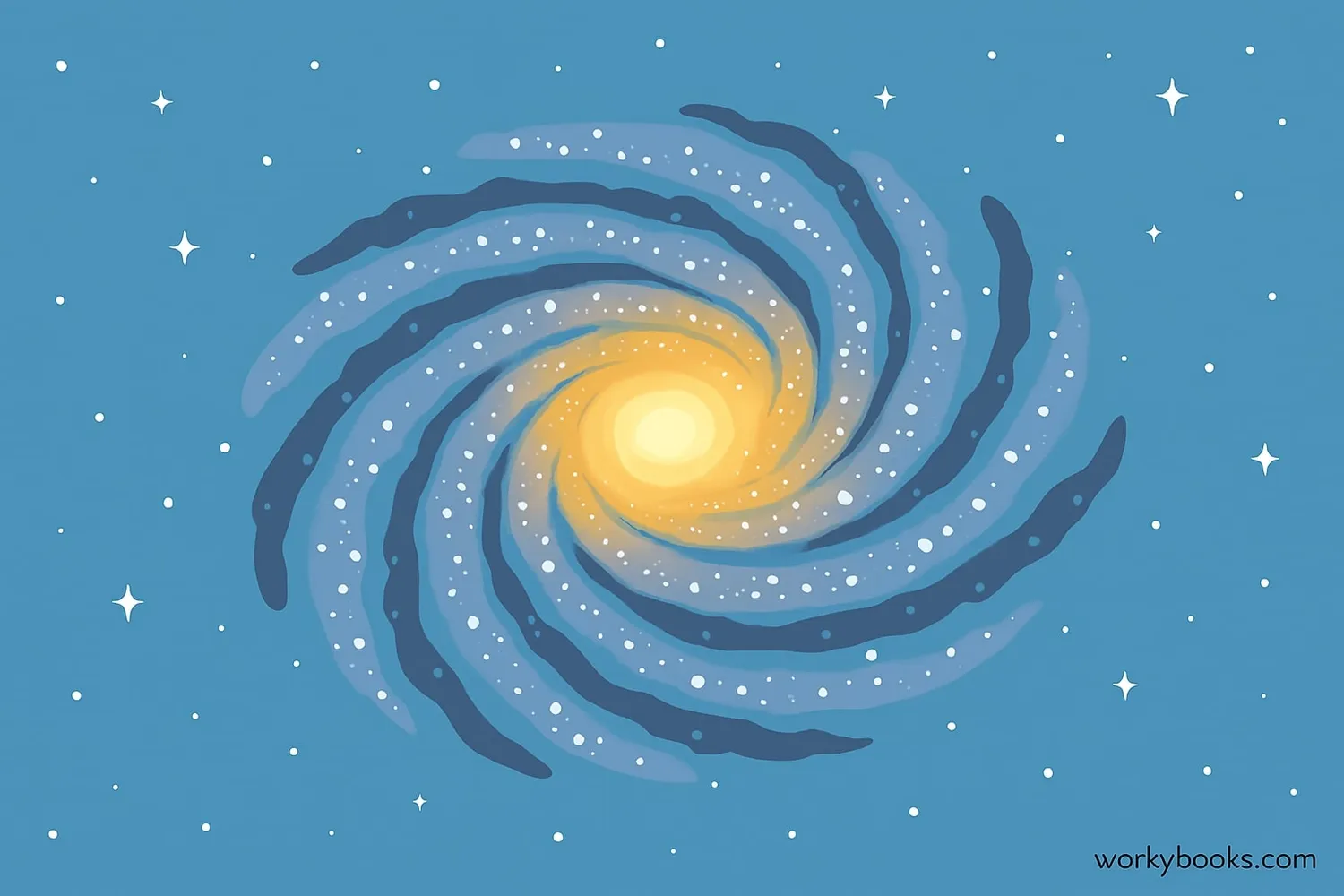
A galaxy is a vast system in space made up of stars, gas, dust, and an invisible material called dark matter. Gravity holds all these components together, forming structures that can stretch from thousands to hundreds of thousands of light-years across. Our own Milky Way galaxy is just one of about two trillion galaxies that scientists estimate exist in the observable universe. Galaxies are important because they are the main building blocks of the universe and are home to nearly everything we see in the night sky.
The Structure and Components of Galaxies
Every galaxy contains billions to trillions of stars, including many that may have planets, moons, asteroids, and comets. Large clouds of gas and dust drift between the stars, sometimes forming new stars or hiding others. One of the most mysterious parts of a galaxy is dark matter, which cannot be seen directly but makes up most of a galaxy’s mass. Scientists know dark matter exists because the gravity in galaxies is much stronger than what visible matter alone could create. Gravity is the force that keeps everything in a galaxy from flying apart, and it also connects galaxies to each other in groups and clusters.
Types of Galaxies and Their Discovery
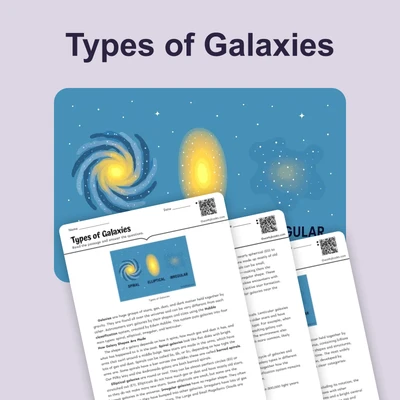
Galaxies come in several shapes. Spiral galaxies, like the Milky Way, have swirling arms that wrap around a bright center. Elliptical galaxies are more rounded or oval, with fewer young stars and less gas. Irregular galaxies do not have a clear shape at all. For a long time, astronomers believed the Milky Way was the entire universe. In the early 20th century, Edwin Hubble observed the Andromeda galaxy and proved it was separate from the Milky Way. This discovery showed that there are billions of "island universes"—other galaxies—far beyond our own.
Distances and the Scale of the Universe
Galaxies are separated by vast distances. Andromeda, the nearest large galaxy to the Milky Way, is about 2.5 million light-years away. The farthest galaxies ever observed are over 13 billion light-years away, meaning we see them as they were 13 billion years ago, soon after the universe began. By studying galaxies, astronomers learn how the universe formed and changed over time. The types and numbers of galaxies help scientists understand cosmic evolution and the mysterious role of dark matter in shaping the universe.
Understanding galaxies also has technological and societal impacts. For example, the study of distant galaxies drives the invention of more powerful telescopes and computer technology. It also inspires questions about the possibility of life elsewhere in the universe.
Interesting Fact: Scientists estimate that only about 15% of the mass in a typical galaxy is visible. The rest is dark matter, which we can only detect by its gravitational effects!
What holds a galaxy together?
GravityWindElectricityMagnetism
Which material makes up most of a galaxy's mass but cannot be seen directly?
StarsDark matterGasDust
How far away is the Andromeda galaxy from the Milky Way?
2.5 million light-years13 billion light-years800,000 light-years1,000 light-years
What is a spiral galaxy?
A galaxy with swirling arms around a bright centerA round or oval-shaped galaxyA galaxy without a clear shapeA group of stars outside a galaxy
Which word in the passage means 'the distance light travels in one year'?
GravityLight-yearDark matterCluster
What does 'observable universe' mean as used in the passage?
The part of the universe we can study and see with telescopesEverything that existsOnly the Milky WayA group of stars
Why do scientists believe in the existence of dark matter?
It is made of stars and gasGalaxies have more gravity than visible matter can explainIt can be seen with a telescopeIt is mostly found on planets
What changed astronomers’ understanding of the universe in the early 20th century?
The discovery of elliptical galaxiesHubble’s proof that Andromeda is a separate galaxyThe invention of the telescopeThe naming of the Milky Way
True or False: Elliptical galaxies have a clear spiral arm structure.
TrueFalse
True or False: Most of a galaxy’s mass is made up of things we can see.
TrueFalse
Perfect For:
👩🏫 Teachers
• Reading comprehension practice
• Auto-graded assessments
• Literacy skill development
👨👩👧👦 Parents
• Reading practice at home
• Comprehension improvement
• Educational reading time
🏠 Homeschoolers
• Reading curriculum support
• Independent reading practice
• Progress monitoring
Reading Features:
📖
Reading Passage
Engaging fiction or nonfiction text
❓
Comprehension Quiz
Auto-graded questions
📊
Instant Feedback
Immediate results and scoring
📄
Printable Version
Download for offline reading
🔊
Read Aloud
Voice-over with word highlighting
Reviews & Ratings
No reviews yet. Be the first to share your experience!
Related Content
What is Solar Radiation
This NGSS-aligned science reading passage for middle school students explores the concept of solar radiation. Solar radi...
MS-ESS1-1
How Incoming Solar Radiation Changes with Latitude
This NGSS-aligned science reading passage helps middle school students understand how solar radiation, or insolation, ch...
MS-ESS1-1
Tides and Tidal Forces
This middle school science passage explores the mechanisms of tides and tidal forces, aligning with NGSS standards MS-ES...
MS-ESS1-1MS-ESS1-2
The Night Sky
This comprehensive science reading passage for grades 6-8 aligns with NGSS standard MS-ESS1-1 and explores the systems a...
MS-ESS1-1
Ancient Astronomy
This engaging passage for grades 6-8 explores the history of astronomy through the lens of ancient observations. Student...
MS-ESS1-1
Tools of Modern Astronomy
This passage introduces middle school students to modern astronomy, aligning with NGSS standard MS-ESS1-1. It explains h...
MS-ESS1-1
How Astronomy Became a Science
This passage explores the transformative period known as the Scientific Revolution, with a special focus on the history ...
MS-ESS1-1
Earth's Rotation
This middle school science passage, aligned with NGSS standard MS-ESS1-1, focuses on Earth's rotation—how Earth spins on...
MS-ESS1-1
Earth's Revolution
This middle school science passage explores the science behind Earth's revolution around the Sun, closely aligned with N...
MS-ESS1-1
Why We Have Seasons
This comprehensive middle school science reading passage explains the mechanisms behind Earth's seasons, directly addres...
MS-ESS1-1
Earth's Seasons
This comprehensive reading passage for grades 6-8 explains why Earth has seasons, revealing the scientific mechanisms be...
MS-ESS1-1
Phases of the Moon
This comprehensive middle school science passage explains the phases of the Moon, focusing on the mechanisms behind the ...
MS-ESS1-1
Tides
This comprehensive middle school science reading passage explores the phenomenon of ocean tides, aligned to NGSS standar...
MS-ESS1-1MS-ESS1-2
Eclipses
This comprehensive passage for grades 6-8 explores the science behind eclipses, including solar and lunar eclipses, thei...
MS-ESS1-1
The Moon's Characteristics
This comprehensive science reading passage for grades 6-8 examines the Moon's physical characteristics, including its si...
MS-ESS1-1MS-ESS1-2
Lunar Eclipses
This passage introduces middle school students to the phenomenon of lunar eclipses, connecting observable events to the ...
MS-ESS1-1
The Sun's Characteristics
This engaging science passage introduces middle school students to the Sun’s key characteristics, such as its classifica...
MS-ESS1-1MS-ESS1-2
The Milky Way: Our Home Galaxy
This comprehensive science passage introduces middle school students to the Milky Way, the barred spiral galaxy that is ...
MS-ESS1-1
Types of Galaxies
This comprehensive middle school science passage introduces students to the classification and characteristics of galaxi...