Types of Galaxies
Interactive passage with audio narration, comprehension questions, and printable PDF.
By completing this purchase you agree to our Terms of Use and Privacy Policy. Your subscription renews automatically until you cancel. You can cancel anytime from your account settings. All sales are final and non-refundable. Digital content is available for download in your account immediately upon purchase.
What's included
Types of Galaxies preview and details
About this printable Types of Galaxies science reading passage, NGSS-aligned (Grades 5-8)
Sample passage and quiz from Types of Galaxies
Reading passage and comprehension quiz preview
Types of Galaxies
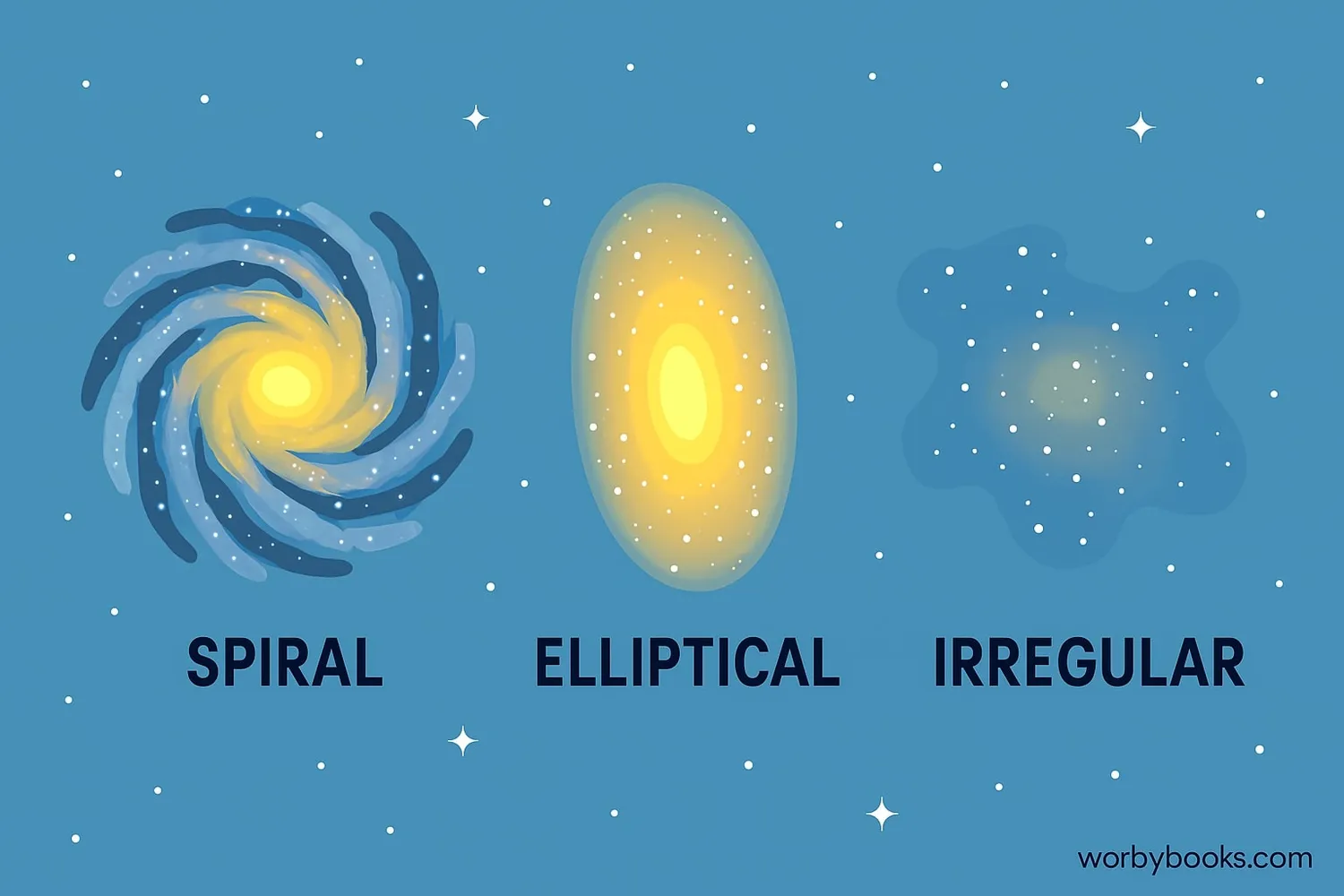
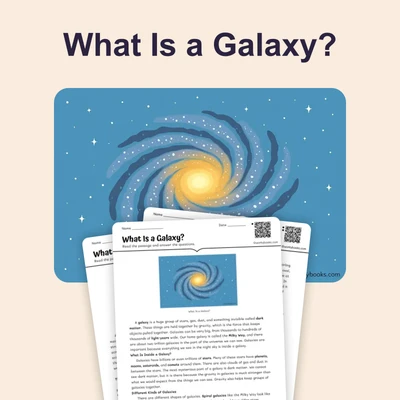
Galaxies are vast systems of stars, gas, dust, and dark matter held together by gravity. They are the fundamental building blocks of the universe, containing billions to trillions of stars. Scientists classify galaxies based on their shapes and structures, which helps us understand how galaxies form and evolve over time. The most widely used system for classifying galaxies is the Hubble classification, developed by astronomer Edwin Hubble. This system organizes galaxies into clear categories: spiral, elliptical, irregular, and lenticular.
Mechanisms Behind Galaxy Shapes
The shape of a galaxy is determined by several factors, including its rotation, the amount of gas and dust it contains, and its history of interactions with other galaxies. Spiral galaxies have a flat disk with winding spiral arms and a bright central bulge. Most of the star formation in spirals happens in their arms, where gas and dust are abundant. These galaxies are further divided into Sa, Sb, and Sc types based on how tightly their arms are wound. Some spirals have a bar-shaped feature through the center, called barred spirals (SBa, SBb, SBc). Our own Milky Way is a barred spiral galaxy, as is the Andromeda galaxy.
Elliptical galaxies are round or oval-shaped, ranging from nearly spherical (E0) to very elongated (E7). They usually have little gas or dust and are made up mostly of old stars, so they have very little ongoing star formation. Ellipticals can be small, containing a few million stars, or giant, with trillions of stars—making them the largest known galaxies. In contrast, irregular galaxies lack a regular shape. These galaxies often look distorted, usually because of collisions or close encounters with other galaxies. Irregulars are rich in gas and dust, leading to active star formation. The Large and Small Magellanic Clouds are well-known irregular galaxies near the Milky Way.
Evolution and Interactions of Galaxies
Some galaxies have properties between spirals and ellipticals. Lenticular galaxies (S0) have a disk like spirals but lack spiral arms. They contain older stars and have little ongoing star formation. Over time, galaxies can change type. For example, when two spiral galaxies collide, their stars and gas mix, and the resulting galaxy can become an elliptical. This process is called galaxy evolution. The environment also matters: in the centers of galaxy clusters, ellipticals are much more common, likely due to frequent galaxy mergers and interactions.
Studying galaxy types helps scientists understand the life cycle of galaxies and the history of the universe. By observing the distribution of galaxy types in different environments and at different times, astronomers can piece together how the universe has changed over billions of years. The Hubble classification system remains a key tool for comparing galaxies and tracking their evolution.
Interesting Fact: Some giant elliptical galaxies are more than 300,000 light-years across—three times wider than the Milky Way!
Comprehension quiz (10 questions)
1. What is the Hubble classification system used for?
2. Which type of galaxy is the Milky Way?
3. What feature is found in spiral galaxies but not in elliptical galaxies?
4. According to the passage, what often causes irregular galaxies to have no regular shape?
5. What does the term 'star formation' mean in the context of galaxies?
6. Which statement best describes lenticular galaxies?
7. Why are elliptical galaxies more common in the centers of galaxy clusters?
8. If two spiral galaxies collide, what type of galaxy can form as a result?
9. Elliptical galaxies usually have a lot of gas and dust. (True/False)
10. The Hubble classification was developed by Edwin Hubble. (True/False)
Perfect for the way you teach
- Build comprehension skills
- Auto-graded quiz
- Differentiated reading
- Read together at home
- Improve fluency
- Quiet reading time
- Reading curriculum support
- Independent practice
- Track Lexile growth