Articles of Confederation Strengths and Weaknesses
Interactive passage with audio narration, comprehension questions, and printable PDF.
By completing this purchase you agree to our Terms of Use and Privacy Policy. Your subscription renews automatically until you cancel. You can cancel anytime from your account settings. All sales are final and non-refundable. Digital content is available for download in your account immediately upon purchase.
What's included
Articles of Confederation Strengths and Weaknesses preview and details
About this printable Articles of Confederation Strengths and Weaknesses reading passage (Grades 6-8)
Sample passage and quiz from Articles of Confederation Strengths and Weaknesses
Reading passage and comprehension quiz preview
Articles of Confederation
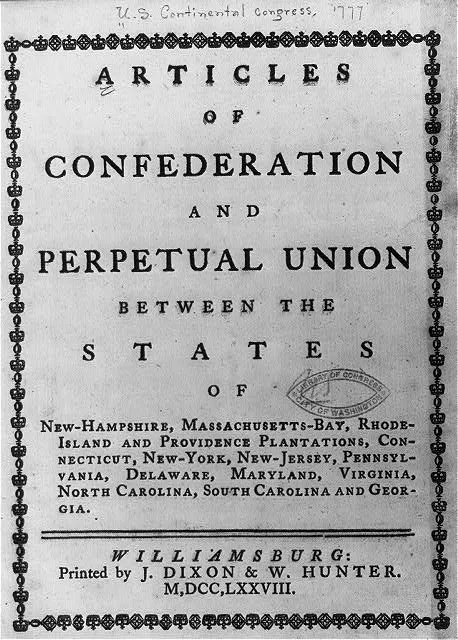
Source: Library of Congress
The Articles of Confederation created the first government of the United States after independence from Britain. Written in 1777 and ratified in 1781, the Articles established a system known as a confederation. In this arrangement, each state retained most of its sovereignty, or independence, while the national government had very limited power. The central government consisted of a single Congress, where each state, regardless of size, had one vote.
This system was designed to avoid the problems Americans associated with strong central rule, such as those experienced under British monarchy. As a result, the Articles intentionally made the national government weak. Congress could not collect taxes, regulate commerce (trade between states), or enforce its laws directly. Instead, Congress had to ask the states for money and troops, which the states often refused to provide. These weaknesses made it difficult to pay debts from the Revolutionary War and to maintain national security.
Conflicts soon arose between the states. Several states printed their own money and set up separate trade policies, leading to economic confusion and competition. Disputes over boundaries and trade could not be settled effectively, since there was no national court system. Without a strong executive branch, there was no leader to enforce Congress’s decisions or respond quickly to crises.
The weakness of the Articles became obvious during events such as Shays’ Rebellion, when farmers in Massachusetts protested high taxes and debt. The national government was unable to help the state put down the rebellion because it could not raise an army. Many leaders, including George Washington and James Madison, argued that the country needed a stronger, more unified government to survive and prosper.
As problems increased, delegates from the states met in 1787 at the Constitutional Convention. Their original goal was to amend, or change, the Articles to make them more effective. However, they realized that the Articles’ problems were too deep to fix with simple amendments. Instead, they wrote a completely new Constitution to create a stronger federal government that could tax, regulate trade, and enforce laws.
The Articles of Confederation were important because they showed the dangers of a government that is too weak to unite a nation. The experience under the Articles taught Americans the value of balancing state and national powers. The lessons learned helped shape the Constitution, which remains the foundation of U.S. government today.
Interesting Fact: The Articles of Confederation required all 13 states to agree before any changes could be made, making amendment nearly impossible.
Comprehension quiz (8 questions)
1. When were the Articles written?
2. How many states had to agree to amend?
3. Which state rebellion showed the Articles' weakness?
4. Why was Congress weak under the Articles?
5. How did states act under the Articles?
6. What problem did separate state money cause?
7. The Articles created a strong national government.
8. What does 'amend' mean?
Common Core standards for Articles of Confederation Strengths and Weaknesses
Explain events, procedures, ideas, or concepts in a historical, scientific, or technical text, including what happened and why, based on specific information in the text.
Determine the meaning of general academic and domain-specific words or phrases in a text relevant to a grade 4 topic or subject area.
Write informative/explanatory texts to examine a topic and convey ideas and information clearly.
Perfect for the way you teach
- Build comprehension skills
- Auto-graded quiz
- Differentiated reading
- Read together at home
- Improve fluency
- Quiet reading time
- Reading curriculum support
- Independent practice
- Track Lexile growth